
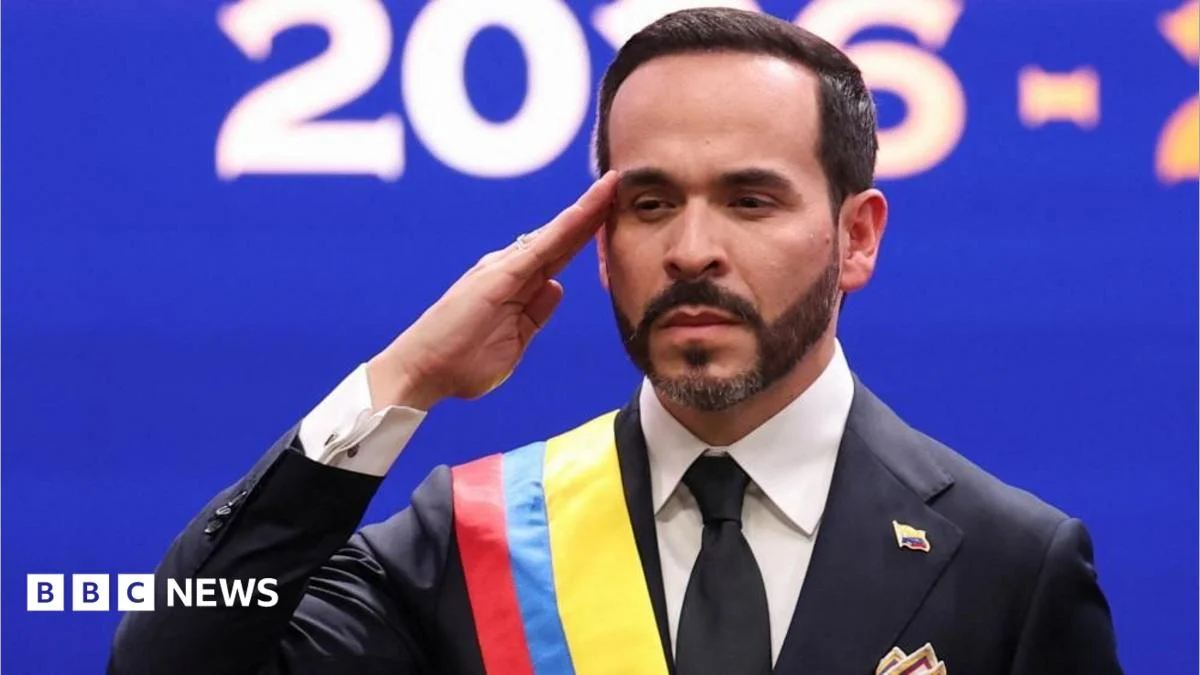
United States Pledges $1 Billion to Colombia as New Right-Wing President Vows ‘All-Out War’ on Narco-Terrorism
The United States has pledged a substantial £1 billion ($1.27 billion USD, based on current exchange rates) in assistance to Colombia following the inauguration of its new right-wing president, Abelardo de la Espriella, on Friday. This significant financial commitment signals a renewed and strengthened alliance between Washington and Bogotá, pivoting sharply from the previous administration’s often-strained relationship. De la Espriella, a staunch ally of former U.S. President Donald Trump, used his inaugural address to declare an "all-out war" on what he termed "narco-terrorism," setting a confrontational tone for his presidency.
A New Era in US-Colombia Relations
In a statement released shortly after the inauguration, the U.S. State Department hailed the beginning of a "new era in US-Colombia relations." The announced financial support is designated as a "security package," intended to bolster de la Espriella’s administration in achieving "our shared goals," which prominently include combating organized crime and stemming illegal immigration. This rapid and robust endorsement from Washington underscores the strategic importance the U.S. places on Colombia, a long-standing partner in a region grappling with complex security and economic challenges. The aid package is expected to fund initiatives ranging from military and law enforcement training to intelligence sharing and border security enhancements, aiming to disrupt the financial and operational networks of criminal organizations.
The inauguration of Abelardo de la Espriella marks a profound political shift for Colombia, moving decisively to the right after the tenure of left-wing former leader Gustavo Petro. Petro’s presidency was characterized by efforts to pursue "total peace" through negotiations with armed groups and a more independent foreign policy stance, which frequently led to friction with the Trump administration. Donald Trump had openly endorsed de la Espriella during the election campaign, predicting a "much better relationship" with his new counterpart after de la Espriella’s victory in June. This pre-existing rapport between the two political figures is seen as a foundational element of the revitalized bilateral relationship.
Inauguration in Cali: A Symbolic Declaration
Breaking with the tradition of swearing in at Colombia’s capital, Bogotá, President de la Espriella chose the volatile city of Cali, in the western Valle del Cauca department, as the site for his oath of office. This unconventional choice was a deliberate and potent signal of his administration’s tough approach to the pervasive illegal armed groups and criminal organizations operating in the region. Cali and its surrounding areas have historically been flashpoints for drug trafficking, paramilitary activity, and guerrilla insurgencies. By taking the oath amidst this backdrop, de la Espriella aimed to project an image of direct confrontation with the forces he has vowed to crush.
In a fiery maiden speech delivered to troops at a nearby military base, de la Espriella reiterated his pledge to eradicate armed insurgents, rebuild the national fabric of Colombia, and defend democracy "by reason or by force." He adopted the self-appointed nickname "the Tiger," asserting that "in the age of the Tiger," the state would be exceptionally forceful and decisive against all forms of crime. "There will not be a single place in our territory where criminals can feel safe," he declared, signaling an uncompromising stance that departs sharply from his predecessor’s emphasis on dialogue and peace processes. This rhetoric resonates with a segment of the Colombian populace weary of decades of conflict and perceived governmental leniency towards criminal elements.
De la Espriella’s Background and Political Ascent
Before entering the political arena, Abelardo de la Espriella carved out a highly successful and often controversial career as a lawyer. He gained prominence representing a diverse clientele, including drug-trafficking paramilitaries, high-profile footballers, and individuals accused of fraud. This professional background, while showcasing his legal acumen, has also drawn criticism, with detractors warning that his confrontational style and past associations could exacerbate divisions in an already highly polarized country. His critics suggest that his hardline approach might alienate moderate factions and potentially undermine delicate peace-building efforts.
De la Espriella has unequivocally promised a sharp break from the policies of his left-wing predecessor. While Petro pursued peace talks and negotiated ceasefires with various armed groups as part of his "total peace" agenda, de la Espriella has vowed a brutal crackdown on their activities. His proposed strategies include large-scale military operations, enhanced intelligence gathering, and the construction of "mega-prisons" to house a significant influx of incarcerated criminals. This shift reflects a belief that only through overwhelming force can the state reassert control and dismantle the structures of organized crime and insurgency.
Historical Context of US-Colombia Anti-Drug Efforts
The U.S.-Colombia partnership in combating drug trafficking has a long and complex history, dating back decades. Programs like "Plan Colombia," initiated in 2000, saw billions of dollars in U.S. aid flow to Colombia, primarily for military and law enforcement assistance aimed at eradicating coca crops and dismantling drug cartels. While Plan Colombia was credited with significantly weakening the FARC (Revolutionary Armed Forces of Colombia) and other armed groups, it also drew criticism for its militarized approach, its impact on rural communities, and its limited success in permanently stemming the flow of illicit drugs to the U.S. Despite these efforts, Colombia remains the world’s largest producer of cocaine, with the illicit drug trade continuing to fuel violence and corruption. The new £1 billion security package from the U.S. can be seen as a continuation, and potentially an intensification, of this long-standing anti-narcotics cooperation, albeit under a new strategic framework that also explicitly targets illegal immigration.
Data from the United Nations Office on Drugs and Crime (UNODC) consistently places Colombia at the top of global cocaine production. In recent years, coca cultivation has reached record levels, highlighting the persistent challenges despite past and ongoing international aid. The U.S. Drug Enforcement Administration (DEA) estimates that a significant portion of cocaine entering the U.S. originates from Colombia. This enduring problem provides a clear impetus for the renewed U.S. commitment and de la Espriella’s aggressive stance.
Strategic Alliances and Regional Geopolitics
Beyond domestic security, de la Espriella has also pledged to forge a strong military alliance with the U.S. and Israel. This is a stark contrast to his predecessor, Gustavo Petro, who was a long-time critic of Israeli Prime Minister Benjamin Netanyahu and had sought to diversify Colombia’s international relations. In one of his inaugural acts, de la Espriella announced that Colombia would join the "Shield of the Americas" security partnership, an initiative founded by former President Trump. This partnership aims to strengthen regional security cooperation among like-minded nations in the Western Hemisphere, primarily focusing on counter-terrorism, organized crime, and border security.
The U.S. promptly welcomed Colombia’s decision to join the "Shield of the Americas," stating that it "stands ready to support the de la Espriella administration’s efforts to defeat the vicious narco-terrorist and criminal organisations" that threaten regional security. This alignment signifies a significant geopolitical shift, potentially solidifying a conservative bloc in Latin America and reinforcing U.S. influence in the region, particularly against a backdrop of increasing Chinese and Russian engagement.
Addressing Illegal Immigration and Economic Ties
The U.S. State Department also emphasized that shared goals with the new Colombian administration include halting illegal immigration through "closer coordination on border security." Colombia, situated strategically between Central and South America, has become a crucial transit country for migrants attempting to reach the U.S. southern border, particularly through the treacherous Darién Gap. The scale of this migration has presented immense humanitarian and logistical challenges for both Colombia and the U.S. Enhanced cooperation in this area will likely involve intelligence sharing, joint patrols, and efforts to disrupt human trafficking networks.
Furthermore, Washington highlighted de la Espriella’s "pro-growth agenda" as an opportunity to "increase trade and deepen economic ties between our countries." The U.S. is Colombia’s largest trading partner, and bilateral trade already amounts to tens of billions of dollars annually. The U.S. views a stable, secure, and economically prosperous Colombia as vital to its regional interests. De la Espriella’s commitment to market-friendly policies and foreign investment is expected to foster an environment conducive to increased U.S. business engagement, potentially diversifying Colombia’s economy beyond its traditional reliance on commodities.
Reactions and Implications
The new administration’s policies and the significant U.S. backing are likely to elicit varied reactions both domestically and internationally. Supporters of de la Espriella laud his decisive leadership and commitment to restoring order, viewing the U.S. aid as crucial for tackling entrenched security problems. However, human rights organizations and segments of the political opposition have voiced concerns. Critics warn that a purely militaristic approach could lead to increased human rights abuses, alienate rural populations, and undermine the fragile progress made in peace-building efforts. The emphasis on "mega-prisons," for instance, raises questions about due process, prison conditions, and the potential for exacerbating social tensions if not managed carefully.
The presence of a high-level U.S. delegation, led by then-acting Attorney General Todd Blanche (who has since been confirmed to the post), at the inauguration further underscored Washington’s commitment. The attendance of embattled FIFA president Gianni Infantino also drew attention, though his presence was likely less about political alignment and more about fostering relationships for football development in the region.
The coming months will be critical in observing how de la Espriella’s aggressive strategies translate into concrete action and what impact they have on Colombia’s complex security landscape, its economy, and its international standing. The £1 billion U.S. assistance package, while substantial, also places a significant onus on the new Colombian government to demonstrate tangible progress in addressing the deep-seated challenges of narco-terrorism, organized crime, and irregular migration, all while navigating the delicate balance between security and civil liberties. The "new era" promised in U.S.-Colombia relations hinges on the effective implementation of these shared objectives and the ability of both nations to adapt to the evolving realities of a dynamic region.

Related Posts
Zambia on Edge: Opposition Leader Arrested Amid Allegations of Insurrection Plot and Election Tensions
Rescuers search for survivors of powerful Indonesia earthquake

