
Zambia on Edge: Opposition Leader Arrested Amid Allegations of Insurrection Plot and Election Tensions
Zambia’s political landscape has been rocked by a dramatic turn of events following the country’s presidential election, with security forces announcing the seizure of a cache of weapons and the arrest of eleven individuals, including senior opposition figures, on allegations of involvement in an insurrection plot. The government asserts that these arrests are a direct response to a serious threat to national security, involving "high-grade military weapons," ammunition, and plans for an armed uprising.
The leading opposition candidate in last Thursday’s presidential election, Brian Mundubile, was reportedly present at the scene of a security raid in the capital, Lusaka, though his exact status regarding the arrests has been a point of contention. According to the country’s top civil servant, Patrick Kangwa, the operation uncovered extensive military plans, including purported links to foreign nationals and illegal military training camps. Kangwa detailed that shots were allegedly fired at law enforcement officers during the raid, leading to an exchange of fire, and stressed the gravity of the threat posed by the apprehended individuals and their alleged intentions.
However, Mundubile has vehemently dismissed these accusations as "total fabrications," painting a starkly different picture of the events. In an interview with the BBC, he alleged that the security forces staged an assassination attempt on his life during the raid at his home on Friday. He refuted claims of any militia being present at his residence, expressing disbelief that senior government officials would propagate what he described as "falsehoods" to the nation.
Unfolding Crisis: Allegations and Counter-Allegations
The government’s account, presented by Patrick Kangwa, paints a grim picture of a coordinated effort to destabilize the state. The individuals arrested are said to be connected to elaborate "military plans involving foreign nationals and illegal military training camps," equipped with "high-grade military weapons," ammunition, and other materials intended for an armed insurrection. Kangwa’s assertion that shots were fired at law enforcement officers, necessitating a defensive response, underscores the perceived severity of the situation from the government’s perspective. Among those reportedly arrested is Patrick Mwansa, the husband of Tasila Lungu, who is the daughter of former Zambian President Edgar Lungu, alongside other prominent political figures. The suspects are currently held in custody across various police stations in Lusaka.
Conversely, Brian Mundubile’s detailed recounting of the raid portrays a scene of intense violence and a blatant disregard for due process. He described how armed personnel used an armoured vehicle to knock down his gate, subsequently breaking doors and windows before opening fire indiscriminately. Mundubile claims that two shots were directed at him, and he attributes his survival to "God’s grace," concluding that the intent of the raid was to kill him and those present. He further alleged that former minister Mutotwe Kafwaya was shot during the raid while in his presence. Mundubile stated that Kafwaya was bleeding profusely and was "dragged like an animal," with his current whereabouts remaining unknown despite Mundubile’s pleas for officers to take him to a hospital. The opposition leader emphasized the profound trauma inflicted upon his family, particularly his children, who witnessed the violent intrusion by what he estimated to be "80 soldiers." The family has not returned home since Friday, citing ongoing fears for their safety.
Election Context and Underlying Tensions
These dramatic events unfold against the backdrop of a closely contested presidential election. With results announced from more than half of the constituencies, incumbent President Hakainde Hichilema is leading, while Brian Mundubile is trailing. This current standing contrasts sharply with Mundubile’s earlier claims of victory and his allegations of widespread voting irregularities.
The electoral process itself has been fraught with tension and accusations. Mundubile had previously alleged military involvement at tallying centres and irregularities concerning ballot boxes. He also claimed that his campaign’s parallel vote tabulation showed him in the lead, although detailed evidence for these claims has not been publicly provided. Adding to the pre-existing political friction, Mundubile had accused Tanzania of sending individuals to interfere in the election, an allegation that the Tanzanian government firmly rejected as false and unfounded. He also reported being interrogated by Zambian army officers over two videos he released and alleged assault while in custody, which authorities have denied.
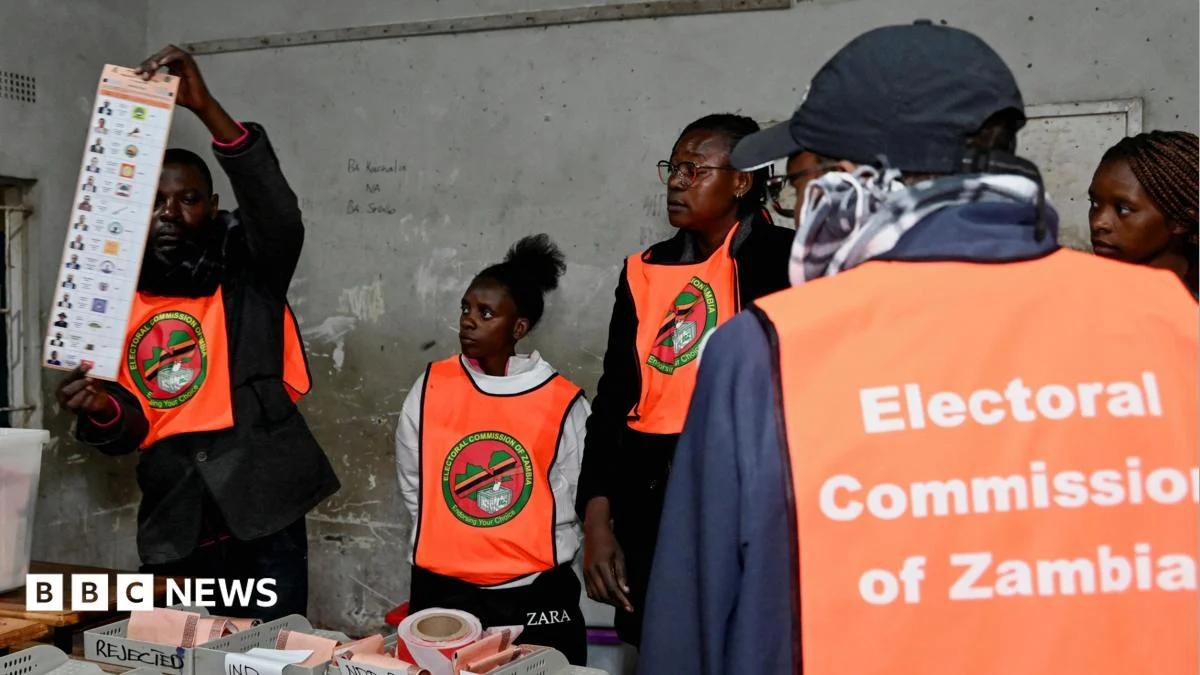
Zambia’s Electoral Commission (ECZ) briefly suspended the counting and announcement of results on Friday, citing violence against polling staff and the theft of marked ballot papers. While the suspension was lifted the same day with the ECZ stating that the security threat had been contained, this interruption drew significant concern from international observer missions.
International Scrutiny and Observer Concerns
Both the European Union (EU) and the Southern African Development Community (SADC) observer missions have since expressed their reservations regarding the suspension of vote counting. SADC stated on Saturday that the interruption had created "uncertainty and anxiety," while the EU mission underscored the necessity for any such interruption to be "clearly explained, legally grounded and proportionate."
Michael McNamara, the EU mission’s chief observer, offered a critical assessment of the overall electoral environment, noting that the elections took place "against a backdrop of constrained democratic space." While acknowledging the elections as "genuinely competitive," McNamara pointed out that the conditions under which candidates competed were "uneven." He specifically cited the blurring of lines between the state and the ruling party, highlighting state media coverage as being "heavily biased" in favour of the incumbent. The EU mission stressed the importance of conducting the remaining stages of the electoral process "calmly, transparently, and in full accordance with Zambian law and the procedures in place."
Zambia’s Democratic Credentials and Recent History
Zambia has historically been regarded as one of Africa’s more stable democracies, known for its relatively peaceful transitions of power since gaining independence in 1964. The nation has largely avoided the civil conflicts and political instability that have plagued some of its neighbours. The 2021 election, which saw Hakainde Hichilema defeat incumbent Edgar Lungu, was hailed as a testament to Zambia’s robust democratic institutions and the peaceful transfer of power, despite a period of heightened political tensions and concerns over human rights under the previous administration. Hichilema’s victory, achieved after several previous attempts, was widely celebrated as a triumph for democracy and accountability.
However, the current allegations of an insurrection plot and the arrests of opposition figures, particularly in the immediate aftermath of a contentious election, threaten to cast a shadow over this democratic reputation. Such events raise fundamental questions about political freedoms, the rule of law, and the fairness of the electoral process. The integrity of security forces and the judiciary are also brought into sharp focus when high-profile opposition leaders are implicated in serious criminal charges during a sensitive political period.
Implications for Stability and Governance
The unfolding situation carries significant implications for Zambia’s internal stability and its standing in the international community. On one hand, the government’s narrative emphasizes the imperative to protect national security and prevent any attempts to subvert the constitutional order. If proven true, an insurrection plot would represent a grave threat requiring decisive action. On the other hand, the opposition’s counter-narrative, alleging political persecution and an assassination attempt, raises serious concerns about the weaponization of state power and potential erosion of democratic norms.
The credibility of the ongoing election results is also at stake. While preliminary statements from observers described election day as largely peaceful and orderly, the subsequent events—the suspension of vote counting, the serious allegations against opposition figures, and the observer missions’ concerns about media freedom and an uneven playing field—have introduced a layer of uncertainty. The current mood in Zambia, while generally stable, reflects this uncertainty, with a noticeable heightened security presence in certain parts of Lusaka.
For Zambia to navigate this crisis effectively, transparency, adherence to the rule of law, and respect for human rights will be paramount. Any investigations into the alleged insurrection plot must be conducted thoroughly and impartially, with due process afforded to all accused. Similarly, the concerns raised by the opposition and international observers regarding the electoral process must be addressed comprehensively to safeguard public trust and the legitimacy of the outcome. The eyes of the region and the international community remain firmly on Zambia as it grapples with these complex and potentially far-reaching developments. The manner in which these allegations are handled, and the election results are finalized, will be critical in shaping Zambia’s democratic trajectory in the coming years.

Related Posts
Rescuers search for survivors of powerful Indonesia earthquake

Major Earthquakes Rock Eastern Indonesia, Triggering Tsunami Fears and Extensive Damage Across Multiple Provinces

