
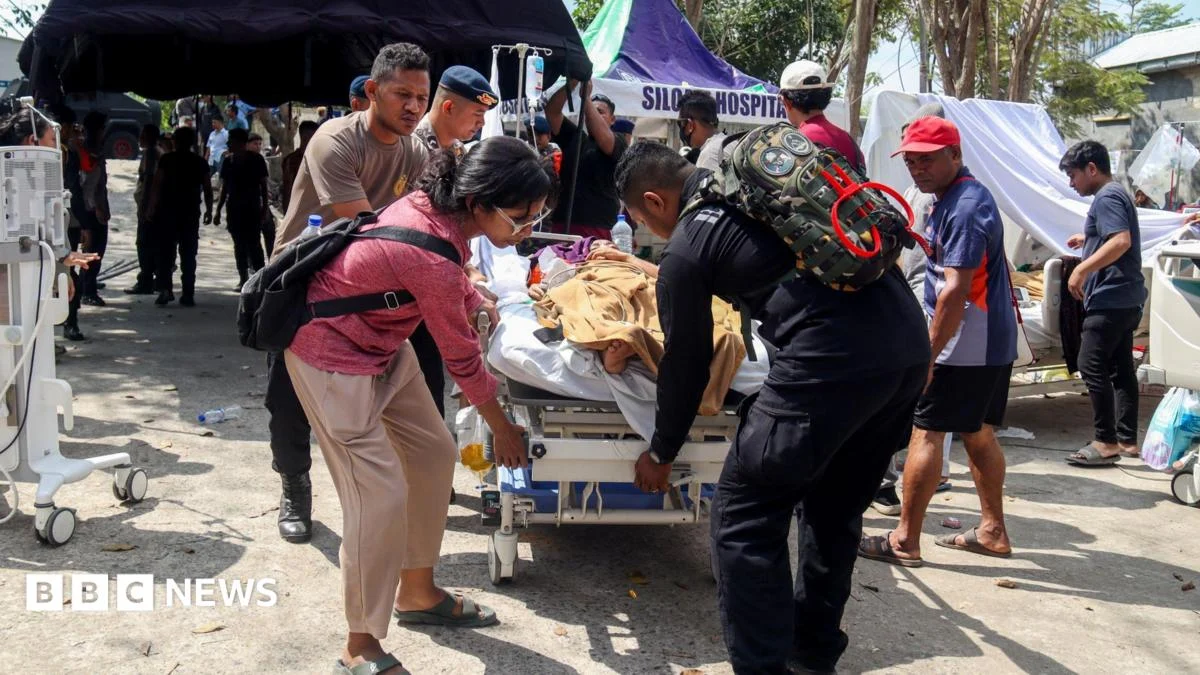
Rescuers search for survivors of powerful Indonesia earthquake
Rescue teams across Indonesia have been tirelessly searching for survivors following a powerful magnitude 7.7 earthquake that struck the island of Flores, West Nusa Tenggara, on Saturday, leaving at least 47 people confirmed dead and thousands displaced. The seismic event, which occurred shortly before 05:00 local time (22:00 GMT on Friday), originated at a shallow depth of 15 kilometers, according to Indonesia’s Meteorology and Geophysics Agency (BMKG), contributing to its destructive force. The quake’s impact was immediately felt across a vast area, triggering widespread panic and causing significant damage to infrastructure in a region already accustomed to the constant threat of seismic activity. Preliminary reports from the National Disaster Management Agency (BNPB) indicate that over 900 homes and hundreds of other buildings suffered severe damage, compounded by a relentless barrage of 341 aftershocks that further destabilized structures and terrorized residents. The full extent of the catastrophe remains under assessment, a task complicated by the remote and mountainous terrain of the affected areas, while news of a separate magnitude 6.9 earthquake at the other end of the archipelago served as a stark reminder of Indonesia’s precarious position along the Pacific "Ring of Fire."
Chronology of a Catastrophe: A Day of Tremors and Terror
The tranquility of early Saturday morning was shattered across Flores as the powerful earthquake ripped through the earth’s crust. Residents, many still asleep, were violently awakened by the sudden, prolonged shaking. Arnold Welianto, a resident of Talibura, a coastal village in Sikka, East Nusa Tenggara, recounted the terrifying moments: "I was startled awake and immediately went to my child’s room." His experience was echoed by countless others who described being thrown from their beds as their homes began to crumble around them. The shallow depth of the quake meant that its energy dissipated less before reaching the surface, intensifying ground motion and maximizing its destructive potential.
The initial tremor was followed by a series of significant aftershocks, with the BMKG meticulously recording 341 subsequent seismic events over the following hours and days. These aftershocks, some reaching magnitudes capable of causing further damage, severely hampered initial rescue efforts and prolonged the period of acute danger for survivors and responders alike. Fear of collapse kept many from returning to their damaged homes, forcing them into the open or to designated evacuation points. Compounding the immediate crisis, many residents along the coastline, including those in Talibura, reported the sea receding significantly shortly after the main quake. This phenomenon, often a precursor to a tsunami, prompted an instinctive flight to higher ground, even though no major tsunami materialized in this instance, highlighting the ingrained fear and awareness of such risks among coastal communities in Indonesia.
The broader context of Indonesia’s seismic vulnerability was underscored by the occurrence of a separate magnitude 6.9 earthquake that struck another part of the archipelago later the same day. While geographically distant and unrelated to the Flores quake in terms of direct causality, its timing served as a grim testament to the pervasive seismic instability that defines the nation’s geology. This unfortunate coincidence amplified the sense of a nation under siege from natural forces, placing immense strain on national disaster response mechanisms.
The Human Toll and Immediate Emergency Response
The preliminary casualty count of 47 fatalities is tragically expected to rise as search and rescue operations delve deeper into collapsed structures and reach more remote communities. The human impact has been particularly severe in the Manggarai region, where 24 deaths have been recorded in Manggarai province itself, and an additional 17 fatalities in East Manggarai province. Sikka province reported three deaths, while Ngada, Ende, and West Manggarai provinces each confirmed at least one fatality. Beyond the tragic loss of life, at least two individuals sustained serious injuries, requiring urgent medical attention, and 11 others suffered minor injuries. These figures represent the immediate, observable impact, with many more likely to be injured or trapped in inaccessible areas.
The National Disaster Management Agency (BNPB) immediately mobilized resources, deploying rescue teams to the most affected areas. However, the geographic challenges of Flores, characterized by its remote and mountainous terrain, have presented significant obstacles to rapid deployment and assessment. Roads were damaged, and communication lines disrupted, isolating many communities in the crucial initial hours. Priority was given to locating survivors, providing immediate medical aid to the injured, and establishing temporary shelters for the thousands displaced.
As of the latest reports, more than 5,000 people remain in evacuation shelters, seeking refuge from the damaged homes and the lingering threat of aftershocks. The BNPB has identified "meeting basic needs and providing logistics for evacuees" as one of the top priorities of the emergency response. In a swift initial effort, 10,500 aid packages, containing essential supplies such as food, water, blankets, and temporary shelter materials, have been dispatched to the affected regions. This logistical operation is complex, requiring coordination across various government agencies, military units, and local volunteer organizations to ensure supplies reach those most in need amidst the challenging landscape. The emotional toll on survivors, many of whom have lost their homes and livelihoods, is immense, necessitating psychological support alongside material aid.
Widespread Destruction and Infrastructure Breakdown
The sheer scale of destruction wrought by the magnitude 7.7 earthquake is becoming increasingly evident. Early assessments indicate that more than 900 homes have been severely damaged or completely destroyed, rendering thousands of families homeless. Beyond residential structures, the quake mercilessly targeted critical public infrastructure. Dozens of educational institutions, including schools and universities, have sustained significant damage, disrupting the academic year for thousands of students. Healthcare facilities, vital for responding to the emergency and providing ongoing medical care, also suffered, further complicating the response efforts. Places of worship, government offices, and various other public facilities have been compromised, impacting community life and administrative functions.
One of the most dramatic and harrowing scenes unfolded at the port in Maumere, the largest town on Flores island. Video footage captured the moment large chunks of concrete broke off the terminal building, cascading onto passengers who were waiting to board an inter-island ferry. In a terrifying sequence, the gangway connecting to a ship collapsed, throwing several individuals into the sea. This incident vividly illustrates the immediate and widespread danger posed by the quake, even in areas not directly at the epicenter. The governor of East Nusa Tenggara province, Emanuel Melkiades Laka Lena, shared grim details, stating that many victims were tragically killed in their sleep by collapsing rubble, underscoring the sudden and unavoidable nature of the disaster for those caught unaware.
The damage to infrastructure extends beyond buildings. Roads, bridges, and communication networks have been severely impacted, creating logistical nightmares for aid delivery and rescue teams. Landslides, often triggered by powerful earthquakes in mountainous regions, have further blocked access to remote villages, isolating communities and making it exceedingly difficult to assess their needs and provide assistance. The disruption of power lines and water supply systems adds another layer of complexity to the emergency, leaving many without basic utilities. The economic fabric of these communities, heavily reliant on agriculture, fishing, and nascent tourism, faces a profound setback, with livelihoods destroyed and recovery projected to be a long and arduous process.
Indonesia: Living on the Pacific Ring of Fire
Indonesia’s tragic susceptibility to earthquakes and tsunamis is a direct consequence of its geographical location on the notorious Pacific "Ring of Fire." This horseshoe-shaped belt, stretching approximately 40,000 kilometers, is characterized by a nearly continuous series of oceanic trenches, volcanic arcs, and plate movements, accounting for about 90% of the world’s earthquakes and over 75% of its active and dormant volcanoes. Indonesia itself sits at the convergence of three major tectonic plates: the Indo-Australian, Eurasian, and Pacific plates, along with several smaller microplates. The constant grinding, subduction, and collision of these massive geological formations release immense energy, manifesting as frequent and often devastating seismic events.
Historically, Indonesia has borne the brunt of some of the most catastrophic natural disasters. The 2004 Indian Ocean tsunami, triggered by a colossal magnitude 9.1 earthquake off the coast of Sumatra, claimed over 230,000 lives across fourteen countries, with Indonesia suffering the most significant losses, particularly in Aceh province. More recently, the 2018 Lombok earthquakes and the subsequent magnitude 7.5 earthquake and tsunami in Palu, Sulawesi, demonstrated the ongoing vulnerability, causing thousands of deaths and widespread destruction. These events have prompted Indonesia to invest heavily in early warning systems, disaster preparedness drills, and the development of more resilient infrastructure, yet the sheer power of nature often overwhelms even the most robust preparations. The Flores earthquake, with its shallow depth and high magnitude, serves as another painful reminder of the country’s relentless geological reality and the ever-present need for vigilance and adaptation.
Official Response, Coordination, and Broader Implications
The Indonesian government, through its National Disaster Management Agency (BNPB) and other relevant ministries, has initiated a comprehensive emergency response plan. The immediate focus is on search and rescue operations, provision of humanitarian aid, and rapid damage assessment. BNPB chief, Lieutenant General Suharyanto, has emphasized the commitment to ensuring all affected communities receive necessary support, acknowledging the logistical challenges posed by the region’s geography. The Meteorology and Geophysics Agency (BMKG) continues to monitor seismic activity, providing crucial data on aftershocks to inform safety protocols for rescue workers and residents. Provincial and local governments in East Nusa Tenggara are working in close coordination with national agencies, establishing command posts, allocating resources, and managing the flow of information and aid.
Beyond the immediate crisis, the Flores earthquake carries significant broader implications. Economically, the cost of reconstruction will be substantial. The damage to homes, businesses, and public infrastructure will require massive investment. Livelihoods dependent on local agriculture, fishing, and emerging tourism sectors will face long-term recovery challenges. Many residents, particularly those in rural areas, have limited resources to rebuild, necessitating sustained government and potentially international support.
Socially, the trauma of the event will linger. Displacement, loss of loved ones, and the destruction of communities can have profound psychological effects. Ensuring access to mental health support will be a critical component of the long-term recovery effort. The disruption to education and healthcare services will also have cascading effects on the well-being and future prospects of the affected population.
In terms of disaster preparedness, this event will undoubtedly lead to a re-evaluation of existing protocols and infrastructure resilience in Flores and similar vulnerable regions. While Indonesia has made strides in establishing early warning systems and public awareness campaigns, the scale of this disaster underscores the need for continuous improvement in building codes, evacuation routes, and community-level readiness. The unique challenges of remote island communities, where access is inherently difficult, highlight the importance of empowering local communities with the resources and training to respond effectively in the critical initial hours before external aid can arrive. International aid organizations and partner countries are closely monitoring the situation, and offers of support, ranging from financial assistance to technical expertise, are anticipated as the full scope of the disaster becomes clearer.
A Long Road to Recovery
As the initial shock of the magnitude 7.7 earthquake subsides, the people of Flores, Indonesia, face a daunting and protracted journey towards recovery. The immediate priority remains the search for survivors and the provision of essential aid to the thousands displaced. Beyond this, the task of rebuilding homes, restoring livelihoods, and reconstructing vital infrastructure will require immense effort, resources, and unwavering commitment from national and international stakeholders. The resilience of Indonesian communities in the face of recurrent natural disasters is well-documented, yet each event brings its unique challenges and heartbreak. The Flores earthquake serves as another poignant chapter in Indonesia’s ongoing struggle with the forces of nature, reminding the world of the profound human cost of living on the Pacific Ring of Fire and the enduring imperative for preparedness, response, and sustained support.

Related Posts

Zambia on Edge: Opposition Leader Arrested Amid Allegations of Insurrection Plot and Election Tensions

Major Earthquakes Rock Eastern Indonesia, Triggering Tsunami Fears and Extensive Damage Across Multiple Provinces

