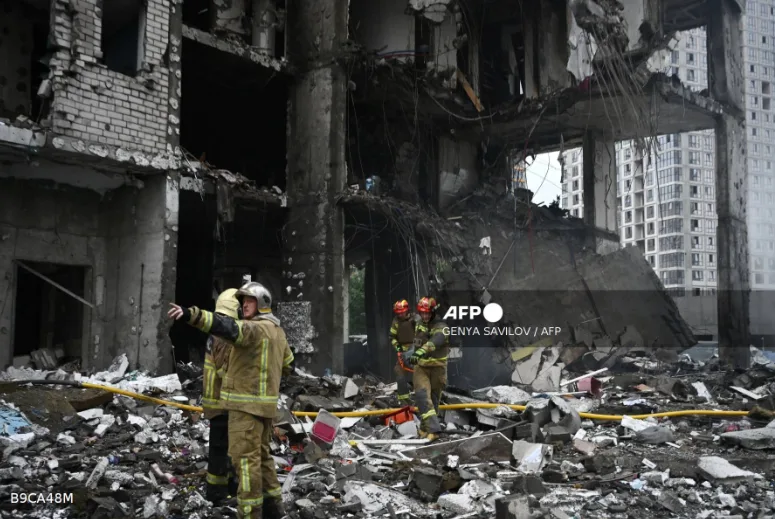
Russian missile strikes on Kyiv leave nine dead as air defense shortages intensify the humanitarian crisis
The Ukrainian capital of Kyiv was plunged into chaos on Saturday, July 6, 2026, as a massive wave of Russian ballistic missile strikes targeted residential neighborhoods, resulting in at least nine civilian fatalities and leaving over two dozen individuals wounded. The attack, which struck five distinct regions of the city, marks a devastating escalation in a conflict that has now entered its fifth year. As emergency crews continue to sift through the smoldering ruins of multi-storey apartment complexes, the incident has reignited urgent debates regarding the efficacy of Ukraine’s current air defense architecture and the geopolitical implications of stalled military assistance.
According to reports from the Ukrainian State Emergency Service, the assault unfolded during the early morning hours, catching many residents in their homes. Kyiv Mayor Vitali Klitschko issued immediate alerts via Telegram, urging the populace to seek cover as ballistic missiles breached the city’s defensive perimeter. The resulting explosions were heard across the capital, shattering windows, igniting fires in residential blocks, and triggering a city-wide security alert.
A Chronology of the Escalation
The conflict has experienced a marked intensification over the past several months, with both Moscow and Kyiv expanding the scope and frequency of their long-range operations. June 2026 was recorded by the United Nations as the deadliest month for Ukrainian civilians since April 2022, a grim statistic that underscores the changing nature of the war.
The trajectory of this latest assault began with early warnings of aerial activity. By dawn, the situation had deteriorated into a full-scale emergency. Local authorities confirmed that the Darnytsky district bore the brunt of the impact, suffering seven fatalities and 14 injuries. Simultaneously, the Solomiansky district witnessed the destruction of a five-storey residential building, where two additional lives were claimed and eight others were left with injuries. Emergency services confirmed that at least 105 people were rescued from the debris during the initial response phase, a testament to the scale of the destruction caused by the Russian munitions.
The Military-Industrial Rationale
In a statement issued shortly after the attack, the Russian Ministry of Defence characterized the operation as a "massive strike" aimed at degrading Ukraine’s "military-industrial complex enterprises and logistics centres." This framing is consistent with Moscow’s strategic pivot toward targeting infrastructure that supports the Ukrainian war effort. However, the concentration of strikes within densely populated residential areas has drawn widespread condemnation from local officials and international observers.
The Russian offensive is not merely a localized campaign against military targets; it is a systematic effort to exhaust Ukraine’s air defense capabilities. By compelling Ukraine to expend limited interceptors on high-volume, multi-vector attacks, Moscow aims to create vulnerabilities that can be exploited in future waves.
Economic Warfare and Reciprocal Strikes
While Kyiv faces relentless pressure from the skies, Ukraine has increasingly adopted a policy of asymmetric warfare, targeting strategic economic and logistics hubs deep within Russian territory. The retaliatory strategy is aimed at disrupting the logistical backbone of the Russian invasion and pressuring the Kremlin to seek a diplomatic off-ramp.
In the hours surrounding the Kyiv attack, Russian officials reported that their air defense systems had successfully intercepted 274 Ukrainian drones overnight. One notable incident involved the Russian retail giant Wildberries, which confirmed a fire at its logistics facility in Volgograd following a drone strike. Kyiv has long accused Wildberries of facilitating the Russian war effort by providing storage for military-grade drone components and logistics support for the Russian army. The targeting of such facilities suggests that Ukraine is shifting its focus toward the economic entities that bridge the gap between civilian commerce and military utility.
The Diplomatic Standoff and the Air Shield Dilemma
The humanitarian tragedy in Kyiv serves as a backdrop to the complex diplomatic maneuvering between President Volodymyr Zelensky and international partners. Following a recent summit with United States President Donald Trump, Zelensky reported a tentative agreement to license the production of Patriot missile systems within Ukraine. Such a move would be a paradigm shift, allowing Ukraine to manufacture its own high-end air defense assets rather than relying entirely on sporadic foreign shipments.
However, the reality of the geopolitical landscape remains fraught with caution. President Trump noted on Friday that the United States must exercise extreme prudence regarding the transfer of sensitive defense production licenses. This hesitancy highlights the broader tension within the Western alliance: while nations are committed to Ukraine’s survival, there is a persistent fear of technological proliferation and the potential for a direct escalation involving Western defense contractors or military secrets.
Ukrainian Foreign Minister Andrii Sybiha offered a blunt assessment of the situation on Saturday, asserting that the survival of the Ukrainian state hinges on the "battle for the skies." Sybiha noted, "Russia’s attacks show that we urgently need additional air and missile defense systems and interceptors. It is the battle for the skies that will define the trajectory of this war. The stronger the air shield over Ukraine, the closer peace becomes."
Humanitarian and Psychological Impact
Beyond the physical destruction of buildings and the loss of life, the attack has inflicted deep psychological scars on the population of Kyiv. For residents like 75-year-old Kateryna Kravchenko, whose apartment was left in shambles, the strike was an existential shock. "Everything was smashed, the windows, everything," she told journalists, her voice trembling. "I can barely stand. I don’t know how I’m going to get through all this."
Her sentiment is echoed by others, such as 46-year-old Oksana, who expressed a growing sense of hopelessness regarding the safety of the capital. "You can’t stay here after something like this. What guarantee is there that it won’t happen again?" This erosion of the sense of "relative safety" in the capital represents a secondary objective of Russia’s long-range campaign: to fracture the domestic morale and force the displacement of the civilian population.
Strategic Implications and Future Outlook
As the war enters its fifth year, the structural integrity of the conflict is being tested by both technological and political constraints. The intensity of the July 6 strike suggests that Russia is not moving toward a de-escalation, but rather toward an attrition-based strategy designed to outlast the resolve of Ukraine’s international donors.
The reliance on "mass strikes" indicates that Russia’s inventory of long-range precision munitions remains sufficient to conduct sustained campaigns. Conversely, Ukraine’s ability to defend itself is becoming increasingly dependent on the rapid deployment of advanced interceptors and the ability to manufacture defense systems locally. The outcome of these diplomatic negotiations regarding Patriot production and the supply of additional air defense batteries will likely determine the viability of urban life in major Ukrainian centers throughout the remainder of 2026.
As rescuers continue their work in the rubble of Kyiv, the international community faces a renewed imperative to define the parameters of its support. The death of civilians in the heart of the capital is a stark reminder that the conflict is not contained to the front lines. The "air shield" requested by the Ukrainian government is now the primary theater of the war, and the success or failure of that shield will dictate the future of the nation’s sovereignty and the stability of the European security order. The coming weeks will be critical as both sides assess the impact of Saturday’s operations and prepare for the next phase of a conflict that shows no signs of waning.