Independent Inquiry Reveals Tragic Details of Firefighter’s Final Moments in Hong Kong’s Deadliest Blaze in Decades
An independent inquiry into Hong Kong’s deadliest fire in decades has released further details about the final moments of fallen firefighter Ho Wai-ho, who died in the line of duty while responding to the blaze at Wang Fuk Court last November. An interim report from an interdepartmental fire investigation task force, commissioned by a government-appointed independent committee, shed new light on the circumstances surrounding the tragedy, including examinations of the recovered gear of the heroic firefighter.
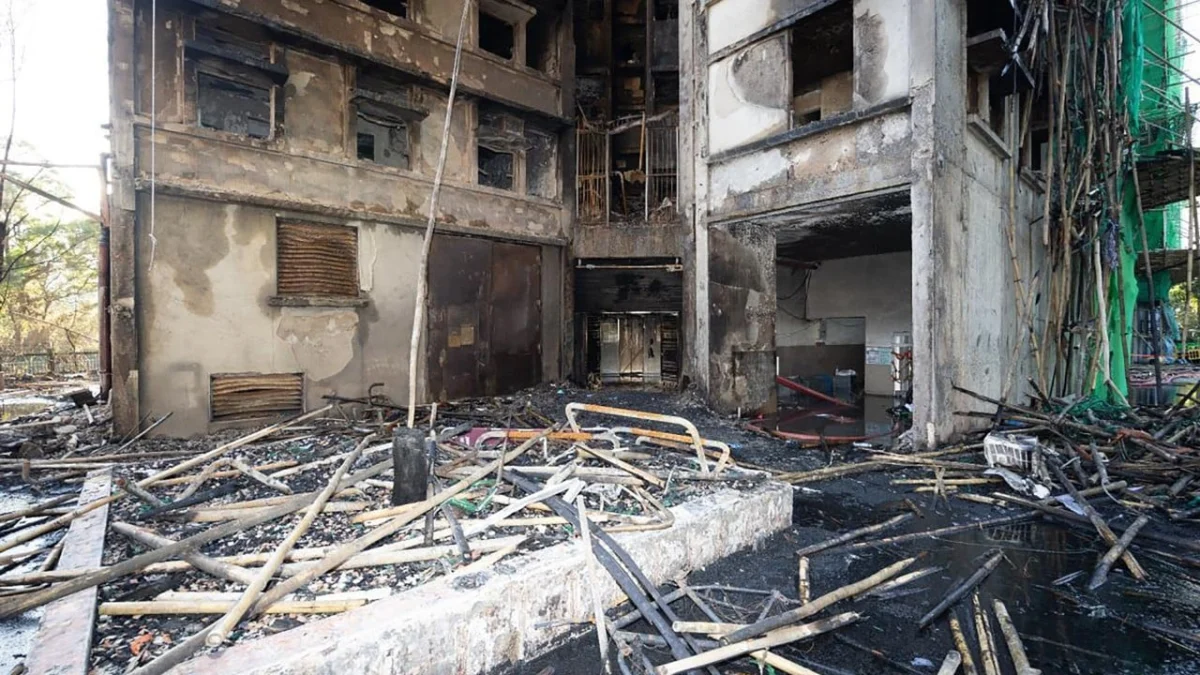
The report, disclosed on Thursday, presented a somber account of the inferno that engulfed the residential building in the densely populated district of Ngau Tau Kok. Firefighter Ho Wai-ho, a dedicated member of the Hong Kong Fire Services Department, was part of the initial response team dispatched to the scene of the multi-alarm fire. The blaze, which broke out on the afternoon of November 12, 2023, rapidly escalated, trapping residents and presenting extreme challenges for the arriving emergency personnel.
Background: The Wang Fuk Court Fire
The fire at Wang Fuk Court, a building known for its numerous small industrial units on lower floors and residential units above, was a complex and devastating event. Initial reports indicated that the fire originated in a storage area on one of the lower floors, quickly spreading through flammable materials. The building’s layout, with numerous partitions and potentially inadequate fire suppression systems in some areas, contributed to the rapid and uncontrolled spread of the flames.
By the time the fire reached its peak, thick plumes of black smoke billowed into the sky, visible for miles around, creating a scene of panic and chaos. Firefighters faced a dual threat: the intense heat and the toxic smoke, which reduced visibility to near zero and posed a severe inhalation hazard. The evacuation of residents was a critical and urgent undertaking, with many trapped in their homes due to the speed at which the fire advanced and the obstruction of escape routes.
Chronology of the Tragic Response
The interim report aims to provide a clearer chronological understanding of the events leading up to and during Firefighter Ho’s deployment. While a full timeline is still under investigation, the details released focus on the equipment recovered from the scene and its condition, offering crucial insights into the conditions Ho encountered.
The task force’s examination of Ho’s personal protective equipment (PPE) was a central component of the inquiry. This meticulous forensic analysis seeks to understand the environmental conditions Firefighter Ho faced and the extent to which his gear performed under extreme duress. The findings regarding his uniform and helmet provide a tangible, albeit tragic, testament to the severity of the fire.
Examination of Firefighter Ho’s Gear: A Stark Account
The post-fire visual inspection of Firefighter Ho’s equipment revealed significant damage, particularly to his uniform. The report stated, "The post-fire visual inspection revealed that [Ho] might have been in prolonged contact with hot or burning objects, resulting in severe fire damage to his [uniform]." This suggests that Ho was exposed to extreme heat for an extended period, likely while engaged in critical rescue or firefighting operations.
Specifically, the report highlighted the compromised state of his PBI Matrix tunic and trousers. These advanced firefighting garments are engineered from materials designed to offer exceptional thermal protection, capable of withstanding extreme temperatures for brief periods. However, the report indicated that the materials were "heavily compromised," indicating an exposure level that exceeded their designed resilience. This finding underscores the ferocious intensity of the fire and the immense heat Ho must have endured.
Crucially, the inquiry also examined his anti-flash hood and helmet. These items are designed to offer protection to the head and neck, with the anti-flash hood specifically intended to be non-flammable. The report noted that "his anti-flash hood, which should be non-flammable, and his helmet showed little to no signs of unusual damage." This observation, while seemingly counterintuitive given the damage to his uniform, offers a more nuanced understanding of his final moments.
The document further elaborated on the helmet’s condition: "No unusual damage was observed on [Ho’s] anti-flash hood and helmet, apart from a crack in the visor, which might have been caused by contact with a sharp or hard object either prior to or during the fire." The absence of significant thermal damage to these critical pieces of head protection suggests that while Ho was subjected to extreme heat that severely degraded his uniform, the direct impact of flames or intense radiant heat on his head may have been less prolonged or less direct in his final moments. The crack in the visor is being investigated as potentially resulting from physical impact, a factor that could be relevant to the circumstances of his incapacitation.
Implications and Further Investigations
The details emerging from this interim report carry significant weight for the ongoing investigation and for the broader understanding of firefighting safety in Hong Kong. The extent of the damage to Firefighter Ho’s uniform points to the overwhelming nature of the inferno and the extreme conditions faced by the first responders. It raises critical questions about the fire’s progression, the time firefighters had to operate, and the potential for unforeseen hazards within the building.
The independent committee, chaired by a prominent figure with expertise in disaster management and public safety, is tasked with a comprehensive review of the fire’s origin and spread, the effectiveness of the emergency response, and the adequacy of building safety regulations. The findings related to Firefighter Ho’s equipment will undoubtedly inform the committee’s analysis of operational procedures, the deployment of resources, and the training protocols for firefighters facing such catastrophic events.
Reactions and Broader Impact
While specific statements from all relevant parties are pending the full release of the inquiry’s findings, the tragic loss of Firefighter Ho Wai-ho has deeply impacted the Hong Kong community and the emergency services. The Fire Services Department has a proud tradition of bravery and sacrifice, and the death of one of its own is felt profoundly.
The Hong Kong government has pledged full support for the independent inquiry, emphasizing its commitment to understanding the full circumstances of the fire and implementing any necessary recommendations to prevent future tragedies. This commitment is crucial for maintaining public trust and ensuring the safety of both citizens and the dedicated professionals who protect them.
The incident has also reignited discussions about fire safety standards in older buildings and the challenges of managing fires in mixed-use structures. The density of Hong Kong’s urban environment means that fires in such buildings can have devastating consequences, both in terms of loss of life and property. The inquiry’s findings are expected to provide critical data for evaluating and potentially strengthening existing fire prevention measures, building codes, and emergency response strategies.
Looking Ahead: The Path to Prevention
The interim report is a crucial step in a comprehensive investigation. The task force will continue to analyze evidence, conduct interviews, and reconstruct the events of that fateful day. The ultimate goal of the independent inquiry is not only to provide answers and closure to the family of Firefighter Ho Wai-ho and the affected community but also to derive actionable insights that will enhance the safety and effectiveness of Hong Kong’s emergency services.
The lessons learned from this tragedy, particularly concerning the extreme conditions firefighters may face and the performance of their vital equipment, will be instrumental in shaping future training, equipment procurement, and operational strategies. The memory of Firefighter Ho Wai-ho serves as a solemn reminder of the inherent risks faced by those who dedicate their lives to public service, and the unwavering commitment to ensuring their safety must be paramount. The ongoing inquiry represents a critical opportunity to learn, adapt, and ultimately, to prevent future losses in the face of such devastating incidents. The full report is anticipated to offer a more complete picture, providing the foundation for systemic improvements in fire safety and emergency response in Hong Kong.