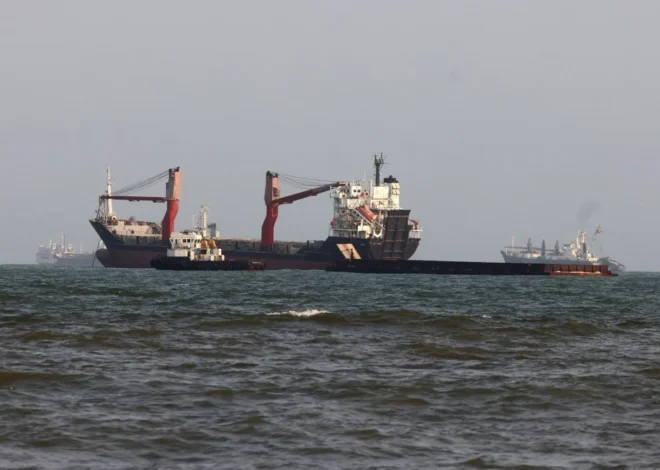
US Forces Disable Tanker Evading Iranian Port Blockade Amidst Escalating Regional Conflict.
The incident occurred on July 25, 2026, at approximately 01:45 British Summer Time (BST), when a vessel, whose flag state and ownership details remain undisclosed, was intercepted by American naval assets. The US military, through Captain Tim Hawkins, spokesman for US Central Command (Centcom), confirmed that its forces fired upon and successfully disabled a tanker ship attempting to breach the American-imposed blockade on Iranian ports. Captain Hawkins stated that the crew of the targeted tanker had been "repeatedly warned" before US forces resorted to disabling the ship by firing into its engine room after "at least four" prior attempts to evade the blockade. This decisive action underscores the heightened tensions and the operational realities of the ongoing "War on Iran," as acknowledged in official communications surrounding the event. The disabled vessel is reportedly no longer proceeding towards its intended Iranian destination, marking a significant enforcement action in a critical maritime chokepoint.
The Incident Unfolds: A Detailed Account
The confrontation transpired in a strategically vital maritime corridor, likely near the Strait of Hormuz or in the Gulf of Oman, a narrow waterway essential for global oil shipments. According to Centcom’s initial report, US naval forces detected the tanker approaching the designated blockade zone, an area where international shipping to and from Iranian ports has been restricted as part of intensified sanctions and military pressure against Tehran. Naval protocols dictate a series of escalating warnings when a vessel is suspected of violating a blockade. These typically include radio hails, visual signals, and, if necessary, warning shots fired across the bow. Captain Hawkins’ statement indicates that such procedures were meticulously followed, with the tanker’s crew allegedly ignoring multiple explicit warnings over a sustained period.
When these warnings proved ineffective and the vessel persisted in its course, US forces, presumably from a guided-missile destroyer or a patrol craft operating within the Centcom area of responsibility, made the decision to employ direct force. The targeting of the engine room suggests a calibrated response aimed at incapacitating the vessel’s propulsion system rather than causing catastrophic damage or significant loss of life, though the inherent risks of such an operation remain high. This method of disabling a ship is a standard tactic in naval engagements where the objective is to stop a vessel without necessarily sinking it. The successful execution of this maneuver highlights the readiness and operational doctrine of the US naval presence in the region, which has been significantly bolstered since the escalation of hostilities. The specific location of the incident has not been officially disclosed, but maritime intelligence sources suggest it occurred within the Gulf of Oman, just outside the Strait of Hormuz, a common staging area for vessels attempting to access or depart Iranian waters.
Background to Conflict: The "War on Iran"
This recent maritime interdiction is not an isolated event but rather a direct consequence of a deeply entrenched and rapidly escalating geopolitical conflict, widely referred to as the "War on Iran." The genesis of this conflict can be traced back several years, characterized by a steady deterioration of relations between the United States and Iran, exacerbated by persistent disagreements over Iran’s nuclear program, its regional influence, and its ballistic missile development. Following the US withdrawal from the Joint Comprehensive Plan of Action (JCPOA) in 2018, economic sanctions were progressively reimposed and tightened, aiming to cripple Iran’s oil exports and financial sector.
The situation reached a critical inflection point in late 2025 and early 2026. A series of alleged attacks on international shipping, drone strikes on oil infrastructure in neighboring states, and an increasingly assertive posture by Iran’s Revolutionary Guard Corps (IRGC) were met with robust military deployments by the United States and its regional allies. Tensions spiraled further following an incident in the spring of 2026, where a major cyberattack, attributed to state-sponsored actors, severely disrupted critical infrastructure in several Gulf nations, leading to widespread calls for decisive action. This was followed by Iran’s alleged seizure of several commercial vessels and the downing of a US surveillance drone, which collectively prompted the US and its allies to formally declare a naval blockade of Iranian ports in June 2026, aimed at severing Iran’s economic lifelines and pressuring its leadership. This blockade, enforced by a formidable multinational naval presence, marked a clear transition from economic pressure to direct military confrontation, setting the stage for incidents like the one reported today. The "War on Iran" is therefore not a sudden eruption but the culmination of years of escalating tit-for-tat actions, strategic miscalculations, and a fundamental breakdown in diplomatic channels.
Strategic Importance of Maritime Chokepoints
The Strait of Hormuz and the broader Gulf region represent one of the world’s most critical maritime chokepoints. Approximately 20% of the world’s petroleum—and about one-third of all seaborne traded oil—passes through this narrow passage, connecting the oil-rich Persian Gulf to the Arabian Sea and beyond. Any disruption to shipping in this area has immediate and profound global economic repercussions, particularly for energy markets. The imposition of a naval blockade on Iranian ports effectively weaponizes this strategic geography, turning commercial shipping into a potential flashpoint.
Naval blockades, historically a powerful tool in warfare, are designed to isolate an adversary economically by preventing goods, supplies, and military hardware from entering or leaving its territory by sea. Under international law, particularly the San Remo Manual on International Law Applicable to Armed Conflicts at Sea, a blockade must be effective, impartially applied, and publicly declared. The US-led blockade of Iranian ports meets these criteria, having been announced months prior, with clear warnings issued to international shipping. However, the legality and proportionality of specific enforcement actions, such as firing upon a vessel, often become subjects of intense international debate. The disabling of the tanker today underscores the enforcement mechanism of this blockade, demonstrating the commitment of the US-led coalition to uphold its declared maritime restrictions, despite the inherent risks of escalation. The implications for global shipping are severe, with increased insurance premiums, rerouting of vessels, and significant delays becoming commonplace. Many international shipping companies have already declared the Persian Gulf and adjacent waters as war risk zones, necessitating additional security measures and costs, which are ultimately passed on to consumers.
Official Responses and Justifications
Following the Centcom announcement, the US Department of Defense swiftly issued a statement reinforcing the necessity of the action. Pentagon Press Secretary, Brigadier General Lena Chen, reiterated the US commitment to enforcing the blockade, emphasizing that the action was a direct response to the tanker’s "willful disregard" for established maritime warnings. "Our forces operated under strict rules of engagement designed to ensure the safety of our personnel and to minimize collateral damage, while upholding the integrity of the declared blockade," General Chen stated during a press briefing. "The repeated attempts by this vessel to breach the blockade left our naval assets with no alternative but to employ disabling fire to prevent its entry into Iranian waters." She further warned that any vessel attempting to circumvent the blockade would face similar consequences, signaling a firm and uncompromising stance from Washington.

The US also indicated that investigations are underway to determine the ownership, crew nationality, and specific cargo of the disabled tanker. While the initial focus was on enforcing the blockade, subsequent inquiries will aim to ascertain if the vessel was engaged in illicit activities beyond merely attempting to reach an Iranian port, such as transporting prohibited goods or military supplies. This detail is crucial for framing the incident within the broader context of international law and public perception. The US has maintained that the blockade is a legitimate measure under international law, designed to pressure a rogue regime and prevent the proliferation of dangerous capabilities, a narrative it continues to articulate to its allies and the international community.
International Reactions and Condemnations
The incident immediately triggered a torrent of international reactions, reflecting the deeply polarized geopolitical landscape surrounding the "War on Iran."
From Tehran, the Iranian Foreign Ministry released a strongly worded condemnation, denouncing the US action as an "act of piracy and a blatant violation of international law." Ministry spokesman, Bahram Ghasemi, asserted that the tanker was a civilian vessel carrying legitimate cargo and accused the United States of "terrorizing maritime commerce" and "endangering global energy security." He vowed a "proportionate and firm response" to what he termed an "unprovoked act of aggression," though he did not specify the nature of such a response. State media outlets echoed these sentiments, portraying the incident as further evidence of American belligerence and a violation of Iranian sovereignty, despite the action occurring in international waters. The IRGC also issued a statement, warning that the "criminal actions" of the US Navy would not go unpunished and that "the security of the Gulf is a shared responsibility, not a unilateral imposition."
Meanwhile, several US allies, including the United Kingdom and Australia, issued statements of support for the US action, albeit with nuanced calls for de-escalation. A spokesperson for the UK Foreign Office affirmed support for the "legitimate enforcement of the international blockade against Iran" while urging all parties to "exercise restraint and prioritize the safety of maritime personnel." Conversely, Russia and China expressed deep concern, with the Russian Foreign Ministry calling for an immediate investigation and warning against "reckless actions that destabilize global energy markets and push the region closer to a full-scale catastrophe." China’s Ministry of Foreign Affairs urged all parties to "abide by international law and ensure the safety of navigation," implicitly criticizing the use of force. The European Union, caught between its economic interests and security concerns, issued a statement calling for dialogue and a diplomatic resolution, expressing profound alarm over the escalating military confrontations in the Gulf.
Economic and Geopolitical Fallout
The disabling of the tanker is poised to have immediate and far-reaching economic and geopolitical repercussions. In energy markets, oil prices surged by over 4% in early trading following the news, reflecting heightened fears of supply disruptions. Analysts predict sustained volatility, particularly if the incident leads to retaliatory actions that further endanger shipping in the Strait of Hormuz. Global insurance premiums for vessels transiting the region are expected to skyrocket, potentially leading to increased consumer costs for goods reliant on sea freight. Shipping companies are already reconsidering routes, with some opting for longer, more expensive detours around the Cape of Good Hope to avoid the volatile Gulf, adding weeks to delivery times and significantly increasing operational costs.
Geopolitically, the incident represents a significant escalation in the "War on Iran." It demonstrates the US-led coalition’s resolve to enforce the blockade through direct military action, setting a dangerous precedent. The risk of miscalculation leading to broader conflict is now palpably higher. Analysts at the International Crisis Group noted that "each such incident chips away at the remaining thin veil of diplomatic possibility, pushing both sides further down a path of kinetic confrontation." The international community faces a stark choice: either actively engage in de-escalation efforts or brace for a potential regional conflagration with global ramifications. The incident also tests the unity of the US-led coalition, as some member states may grow increasingly uneasy with the direct military engagements, potentially creating fissures in the alliance.
Looking Ahead: Escalation Pathways
The immediate aftermath of this incident will be critical. The Iranian government’s promised "proportionate and firm response" could manifest in various ways: increased harassment of shipping in the Gulf, cyberattacks against coalition infrastructure, or even proxy attacks against US interests in the region. Any such retaliation would inevitably invite further counter-responses, trapping both sides in a dangerous cycle of escalation.
The focus now turns to diplomatic efforts, however fragile they may be. Calls from international bodies for de-escalation are intensifying, but the pathways for meaningful dialogue appear increasingly narrow. The incident highlights the urgent need for robust communication channels to prevent further misunderstandings and to manage potential crises. Without such mechanisms, the risk of a minor incident spiraling into a full-scale regional war remains alarmingly high. The global community watches with bated breath as the "War on Iran" enters a new, more perilous phase, underscored by the disabling of a tanker in the strategic waters of the Gulf. The long-term implications for global trade, energy security, and regional stability are profound, suggesting a protracted period of uncertainty and danger ahead.

Related Posts
Over 150 Israeli Settlers Storm Al-Aqsa Compound and Perform Prayers, Violating Status Quo Under Police Protection.
UN Report Highlights Over 900 Obstacles Hampering West Bank Aid Amid Escalating Humanitarian Crisis