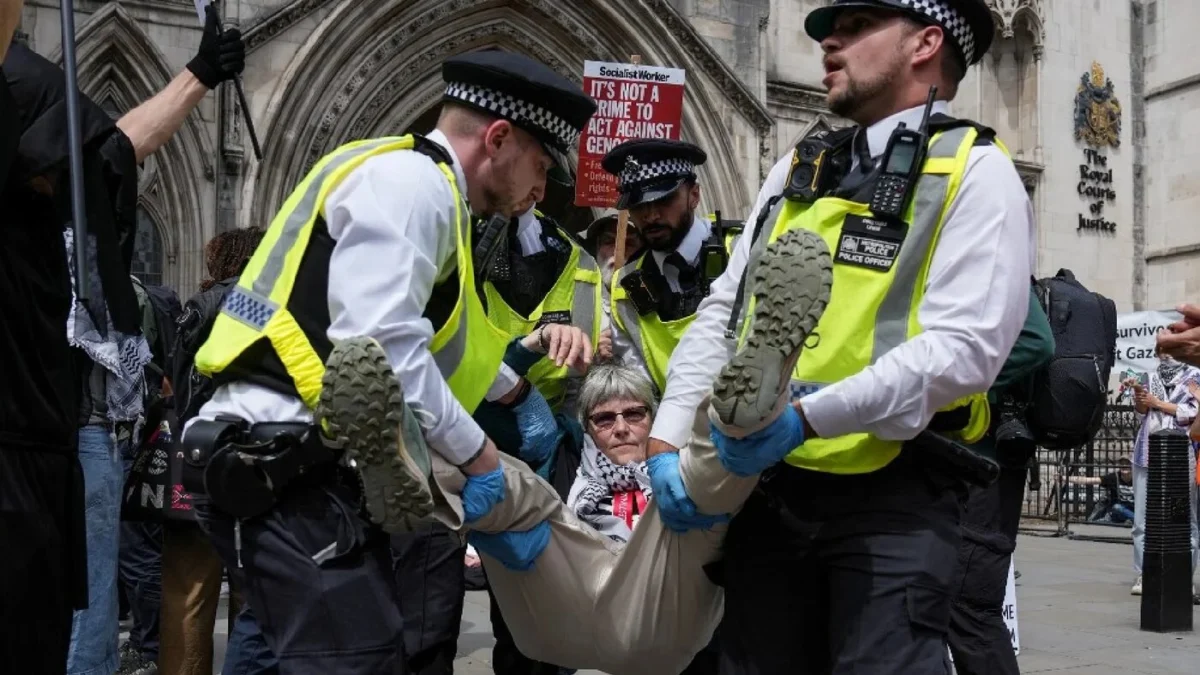
Grandmothers and Grandfathers Under Siege: UK Counter-Terrorism Police Target Elderly Palestine Action Supporters
Marji Mansfield, a 70-year-old grandmother of seven, lives in a state of perpetual apprehension, awaiting the arrival of British counter-terrorism police at her doorstep. The deepest anxieties crystallize between five and seven in the morning, a period historically favoured by law enforcement for dawn raids, a fear particularly acute when her grandchildren are staying overnight. "It’s been really, really quite scary not knowing when there’s going to be the knock at the door," Mansfield shared with Middle East Eye, her voice tinged with a weariness that belies her activist spirit. "This isn’t the Britain that I thought I grew up in at all. We’ve been scared enough to go and sleep elsewhere."
Mansfield is one among scores of activists across the United Kingdom, many of whom are elderly, now living under the shadow of potential police action. Their perceived transgression: publishing videos inviting support for the direct action group Palestine Action, an organisation proscribed by the UK government. These actions have ignited a fierce debate about the scope of counter-terrorism powers, the right to protest, and the chilling effect on freedom of expression in the UK.
A Broadening Crackdown: Proscription and Protest
The current climate of fear stems from a significant legal development concerning Palestine Action, a group known for its direct action campaigns targeting companies involved in arms manufacturing and supply to Israel. The group’s stated aim is to disrupt and dismantle the UK’s arms trade with Israel, employing tactics that often involve property damage and blockades. While their methods have been contentious, their supporters view their actions as a legitimate form of civil disobedience against what they perceive as complicity in human rights abuses.
In a move that dramatically escalated the legal risks for its supporters, the UK government officially proscribed Palestine Action as a terrorist organisation in July 2025. This designation, made under the Terrorism Act, carries severe penalties for those found to be members or offering support. Proscription is a powerful tool available to the Home Secretary, allowing the government to ban organisations it believes are "concerned in terrorism." The definition of "terrorism" under UK law is broad, encompassing not only acts of violence but also actions designed to influence government policy or intimidate the public for political, religious, or ideological causes. For Palestine Action, the government’s rationale centered on the disruptive and damaging nature of its protests, arguing they fit within this expansive definition.
Since this proscription, over 3,000 individuals have been arrested under various sections of the Terrorism Act for activities related to Palestine Action. Initially, many of these arrests were under Section 13, which pertains to the display of articles in public that arouse reasonable suspicion of being a member or supporter of a proscribed organisation, often carrying a lesser charge. However, the legal landscape shifted significantly in June, following a pivotal decision by the Court of Appeal. This court quashed an earlier High Court ruling, thereby affirming the lawfulness of Palestine Action’s ban. This judicial endorsement emboldened the authorities and intensified the pressure on activists.
The Legal Labyrinth: Section 12 and the "Escalation"
In response to the Court of Appeal’s ruling, Defend Our Juries (DOJ) – a grassroots organisation actively campaigning to reverse the proscription – called for an "escalation" in activism. This call marked a critical turning point. DOJ urged activists to move beyond merely expressing support for Palestine Action and to actively invite others to support the group. This distinction is crucial under the Terrorism Act, particularly Section 12, which criminalises "inviting support" for a proscribed organisation. An offence under Section 12 can carry a maximum sentence of 14 years in prison, a stark increase in potential penalty compared to charges under Section 13.
It was this specific call to action that Marji Mansfield and approximately 100 other activists embraced. They recorded and uploaded videos of themselves, unequivocally stating: "Saving lives is not terrorism, I support Palestine Action, and I think you should too." This deliberate and public invitation for support placed them squarely within the crosshairs of Section 12, marking a new, more perilous phase for the Palestine Action solidarity movement. The decision to make such statements was a conscious act of defiance, aimed at challenging the legitimacy of the ban and testing the boundaries of free speech under the stringent provisions of the Terrorism Act.
Chronicle of Anxiety: From Public Statements to Private Fears
The government’s response to this "escalation" was swift and comprehensive. Following the widespread dissemination of these videos, counter-terrorism police began conducting raids across the UK. In late July, a wave of coordinated operations saw at least 19 individuals, many of them retired citizens, targeted by police. These raids spanned the breadth of the nation, from London and the West Midlands to Somerset, Wales, Cornwall, and Scotland, underscoring the coordinated nature of the police operation.
For those who have not yet been raided, like Mansfield, the experience is one of debilitating anxiety. Many activists have reported severe sleep disturbances, while others, caring for sick partners, feel unable to leave their homes for fear that police will arrive in their absence. "It really impacts people’s lives. It causes great fear and anxiety," Mansfield observed, highlighting the profound psychological toll of living under constant threat of a dawn raid. This uncertainty effectively creates a form of pre-emptive punishment, impacting mental health and daily routines even before any formal charges are brought.
Accounts from the Front Line: Personal Stories of Raids
The personal narratives of those who have endured these raids paint a vivid picture of the police’s approach and the profound impact on individuals.
Asghar Ahmad: From Public Service to Scrutiny
At around 7:30 am one late July morning, Asghar Ahmad, a 53-year-old former government IT worker, found his home in Telford, Shropshire, surrounded. "I just had my shorts on, but that was it," Ahmad recounted to Middle East Eye, describing the moment he opened his door to a dozen officers, a police van, and four police cars. Despite the intimidating presence, Ahmad stated, "I wasn’t challenging anything because I knew what they were going to do. They were going to go through the whole house." When he requested to get dressed, an officer followed him upstairs, maintaining constant surveillance. Ahmad was then handcuffed and transported to the local police station.
During his absence, officers meticulously searched his entire residence, confiscating all his electronic devices. "They went through every single room," Ahmad confirmed. Later that day, during his interview with his solicitor present, police presented him with a collection of items removed from his home: laptops, old phones, hard drives, scraps of paper, and "anything that was remotely Palestinian," including flags and bracelets. Despite the extensive search and questioning, Ahmad was released at 5 pm that day without charge.
Ahmad reflected on his past and present motivations: "I spent 38 years working for the government on their IT systems. I’ve got to a point in my life where I can see things for what they are." He explained that his former career had consumed much of his time and attention. "Once I finished work, I realised I could do things without fear of losing my job or my income." Now, in retirement, Ahmad dedicates his time to volunteer work and advocacy. He remains unbowed, asserting, "I’ve got nothing to hide." He warned, "If they want to put pensioners in prison, it will not go down well," underscoring the potential public backlash against such measures.
Paul Gravesbrown: The Archaeologist and the Private Diary
Paul Gravesbrown, a 64-year-old semi-retired archaeologist residing in Powys, experienced a similarly intrusive raid. He reported that approximately 20 police officers spent six and a half hours meticulously searching his home. The thoroughness of the search extended to deeply personal spaces, with officers reportedly rummaging through his wife’s underwear drawer and leafing through a diary she had kept as a teenager. "They left the diary on the top, highlighting the fact that they’ve been looking through a teenage girl’s diary, which is a bit creepy," Gravesbrown commented, highlighting the invasive nature of the search.
Gravesbrown was detained at the local police station from 8 am to 4 pm before being released without charge. The experience left a lasting psychological mark. "Being raided is quite traumatic, it’s one of those things which hangs around in your mind," he told MEE. He drew a unsettling parallel: "Our house was burgled just before the first lockdown, so it’s a similar sort of experience – total strangers wandering around your house." The feeling of violation, he suggested, was akin to that of a criminal act, despite the officers acting under legal authority.
Allie: The Late-Night Arrest and Shattered Trust
Allie, a 30-year-old bartender from Staffordshire, who spoke using an alias for fear of further repercussions, faced a particularly unsettling experience. She was arrested shortly after returning home from a pub shift, woken by insistent banging on her door at around 1 am. "I opened the door and I think the first thing I said was, ‘Oh my God, you actually came’," Allie recounted, revealing the pervasive expectation of a raid among activists.
Both Allie and Asghar Ahmad reported that officers verbally requested the pin numbers to unlock their electronic devices. This practice raises legal questions, as Section 49 of the Investigatory Powers Act typically stipulates that such requests should be made in writing. Allie also recalled a moment of disbelief during her arrest, remarking as she was being handcuffed, "This is a bit much for what this is, isn’t it?" She was then asked by police to sign a document acknowledging this comment, an action that could be perceived as an attempt to document her non-compliance or a challenge to police authority.
After being driven to Oldbury police station near Birmingham, Allie was held for eight to nine hours before being released without charge. The emotional impact was profound. "I think the worst thing for me is that it really shatters any sense of personal safety," Allie lamented. "You go through life with a belief in the systems that are there to protect you. This is such a heinous overreach and abuse of those systems. I don’t think that I’ll ever be able to fully reconcile myself with it. It’s like having to reconstruct a new reality." Her statement underscores a deep-seated loss of trust in state institutions designed to protect citizens, now perceived as instruments of repression.
Police Powers Under Scrutiny: Tactics and Procedures
The accounts from these raids highlight several points of contention regarding police tactics and adherence to established procedures. The use of handcuffs, for instance, has been questioned. While Metropolitan Police policy stipulates that officers may only use restraints when there are "objective grounds" for believing it is necessary – such as a risk of escape, self-harm, or harm to others – two individuals reported being handcuffed despite appearing to pose no immediate threat. Critics argue that handcuffing elderly or non-violent individuals, especially within their own homes, can be seen as disproportionate and intimidatory.
The confiscation of personal devices and items bearing the Palestinian flag also raises concerns about the breadth of police searches and the potential for overreach. While counter-terrorism investigations often involve digital forensics, the seizure of every electronic device, even old phones or hard drives, can be perceived as excessive. The confiscation of items simply bearing a Palestinian flag, a symbol of national identity and solidarity, rather than direct links to proscribed activity, blurs the lines between legitimate evidence gathering and suppression of political expression.
The verbal requests for device PINs, rather than written requests as suggested by Section 49 of the Investigatory Powers Act, further complicates the legal picture. While officers can make such requests, the formality of a written notice provides greater legal clarity and protection for the individual. The departure from this practice, if widespread, could be challenged on procedural grounds.
The Chilling Effect: Implications for Freedom of Expression
These raids and the climate of fear they engender carry significant implications for civil liberties and the right to protest in the UK. The proscription of Palestine Action and the subsequent application of the Terrorism Act to peaceful activists, many of whom are elderly, sends a chilling message to anyone considering public expressions of dissent or solidarity, particularly on sensitive geopolitical issues.
Civil liberties organisations have consistently voiced concerns that the UK’s broad counter-terrorism legislation, while intended to combat genuine threats, can be misused to suppress legitimate protest and stifle freedom of speech. The targeting of individuals merely for "inviting support" through a video statement, without any direct involvement in violent acts or planning, represents a significant expansion of what constitutes "terrorism-related activity" in the eyes of the state. This risks criminalising political speech and association, eroding the democratic space for dissent.
The psychological impact on activists, as described by Mansfield and Allie, is a direct consequence of this chilling effect. The fear of dawn raids, the intrusion into private lives, and the potential for lengthy prison sentences under Section 12 can deter individuals from engaging in political activism, even when their actions are non-violent and driven by moral conviction. This, critics argue, undermines the very principles of a free and open society where citizens should be able to express their views without fear of disproportionate state intervention.
The Broader Context: UK Counter-Terrorism Framework
The UK operates under one of the most comprehensive counter-terrorism frameworks globally, continuously evolving since the early 2000s. The government’s stated objective is to protect national security and public safety. However, critics, including human rights lawyers and academics, have long argued that the scope of these laws often encroaches upon fundamental rights, including freedom of expression, assembly, and privacy.
The application of the Terrorism Act to groups like Palestine Action, which do not engage in conventional acts of violence but employ disruptive direct action, highlights the elastic interpretation of "terrorism." This approach draws parallels with concerns raised by international human rights bodies regarding the potential for counter-terrorism legislation to be used against environmental activists, trade unionists, and other forms of protest. The UK’s approach to proscription has also faced scrutiny, with debates over the transparency of the decision-making process and the difficulty in challenging such designations.
Official Response and Silence
Middle East Eye contacted the UK’s Counter Terrorism Police for comment on these raids, the specific tactics employed, and the broader implications for civil liberties. However, no response was received by the time of publication. The absence of an official statement leaves many questions unanswered and contributes to the perception among activists and civil liberties advocates that authorities are unwilling to publicly justify or explain their actions, further eroding public trust.
A Community Under Pressure: Resilience Amidst Fear
Despite the palpable fear and anxiety, the activists targeted by these operations, and those awaiting them, express a resilient determination. Asghar Ahmad’s declaration of having "nothing to hide" and his willingness to face potential imprisonment reflects a conviction that their actions are morally justified, regardless of the legal consequences. This collective resolve suggests that while the state’s tactics may induce fear, they may also solidify the commitment of a segment of the population determined to speak out on issues they believe are critical.
The ongoing situation presents a critical juncture for civil liberties in the UK, pitting the state’s expansive counter-terrorism powers against the fundamental rights to protest and free expression. The targeting of elderly activists, in particular, raises uncomfortable questions about the proportionality and appropriateness of state force, and the future landscape of political dissent in a nation increasingly defined by its stringent security apparatus.

Related Posts

Over 150 Israeli Settlers Storm Al-Aqsa Compound and Perform Prayers, Violating Status Quo Under Police Protection.
UN Report Highlights Over 900 Obstacles Hampering West Bank Aid Amid Escalating Humanitarian Crisis