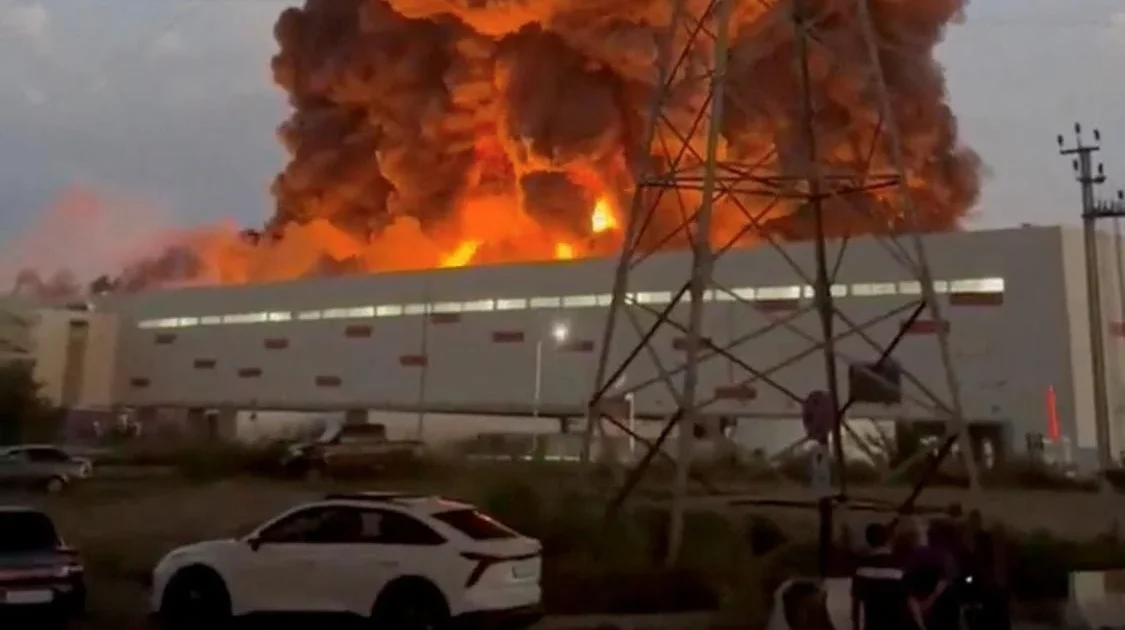
Ukrainian Drone Strikes Cripple Major Logistics Hub Near Saint Petersburg as Regional Tensions Escalate
A massive fire engulfed a sprawling logistics warehouse belonging to Wildberries, Russia’s largest e-commerce retailer, on the outskirts of Saint Petersburg early Friday morning, following a precision drone strike launched by Ukrainian forces. The facility, often described as the "Amazon of Russia," suffered extensive damage, sending plumes of grey smoke billowing over the historic city skyline. This incident marks a significant intensification in Kyiv’s long-range strategic campaign, which has increasingly targeted deep-territory logistics, military, and energy infrastructure over 800 kilometers (500 miles) from the Ukrainian border.
The assault, which prompted regional authorities to scramble emergency services, resulted in at least three confirmed injuries. While Russian officials reported that their air defense systems successfully intercepted 59 incoming drones across the region, the visible destruction of the Wildberries hub suggests a significant penetration of the Russian defensive perimeter. The strike on the Saint Petersburg facility is the third such operation targeting the retailer’s infrastructure in the past week, highlighting a tactical shift by Kyiv toward disrupting the economic and logistical foundations that support the Russian war effort.
Chronology of the Escalation
The recent spike in hostilities follows a pattern of high-frequency long-range strikes. Last weekend, a similar logistics hub located outside Moscow was completely destroyed in an overnight attack that claimed the lives of eight night-shift employees. That event marked a turning point in how Ukrainian officials characterize these strikes. President Volodymyr Zelensky has publicly alleged that these commercial warehouses are not merely civilian retail points, but are being utilized to store sanctioned components essential for the assembly of military drones and sophisticated navigation systems.
The timeline of the current campaign against logistics infrastructure suggests a coordinated effort by Ukrainian forces to maximize economic disruption. By targeting the backbone of Russia’s digital retail economy, Kyiv claims it is conducting a form of "long-range sanctions" that directly impacts the Kremlin’s financial ability to fund the ongoing conflict. This strategy is intended to stretch Russian air defense resources, which are simultaneously tasked with protecting vital energy refineries and military airfields across the European portion of the Russian Federation.
Operational Impact and Civil Disruption
The immediate fallout from the Saint Petersburg strike was felt across the city’s transportation network. Pulkovo Airport, a major transit hub, was forced to suspend all incoming and outgoing flights during the height of the attack. Operations did not resume until approximately 06:00 local time, leaving roughly 50 departures delayed or cancelled, and creating a ripple effect of disruption for thousands of passengers.
Wildberries, which has seen its market dominance grow significantly since the onset of the 2022 invasion, issued a brief statement confirming that two of its warehouses in the Saint Petersburg area had ceased operations indefinitely. The company, which has seen its logistics network become a frequent target, has not yet provided a detailed assessment of the financial losses or the extent of the inventory destruction. However, industry analysts suggest that the cumulative loss of three major hubs in seven days will likely cause significant bottlenecks in Russia’s supply chain, affecting both consumer goods and potential dual-use components.
Strategic Context and Regional Tensions
The intensity of the current drone campaign is set against a backdrop of deteriorating diplomatic relations and an increasingly desperate military situation on the front lines. Moscow has responded to these deep-territory strikes with its own intensified ballistic missile barrages, targeting residential blocks in Kyiv and other major urban centers. These retaliatory strikes have caused significant civilian casualties, with the United Nations reporting that June 2026 was the deadliest month for non-combatants since the initial months of the full-scale invasion in 2022.
The geopolitical landscape remains complex. While the United States has largely been occupied with its own ongoing military engagement with Iran, Washington’s attempts to broker a peace settlement have stalled. Notably, President Donald Trump has offered a degree of tacit support for the current Ukrainian counter-attacks, labeling them "an escalation that can lead to an end," a statement that has been interpreted by military analysts as a signal that the West may be moving toward a more permissive stance regarding deep-strike capabilities.
Despite these developments, the Kremlin has remained steadfast in its refusal to engage in negotiations that would require a reversal of its territorial gains. Moscow continues to insist that any future peace deal must account for the permanent loss of Ukrainian land and a total renunciation of Western military support for Kyiv. In the wake of the latest drone strikes, Russian leadership has signaled that they are prepared to escalate their own military operations in the east and south, threatening further territorial seizures as a direct consequence of what they term "terrorist actions" by the Ukrainian government.
Military Hierarchy and Internal Challenges
The strike also comes at a time of internal volatility for the Ukrainian administration. In the past week, President Zelensky has enacted a sweeping overhaul of his military leadership, replacing both the defense minister and the commander-in-chief. Reports indicate that these changes are the result of deepening splits within the military hierarchy concerning the pace and direction of structural reforms. The pressure to maintain operational tempo on the front lines while simultaneously executing high-risk, long-range missions into Russian territory has placed an unprecedented strain on the Ukrainian military apparatus.
With hundreds of thousands of soldiers killed or wounded on both sides, the attrition rate remains one of the most significant factors of the war. While official casualty figures remain classified, the human cost is mounting. The destruction of logistics infrastructure, such as the Wildberries warehouse, is designed to reduce the Russian military’s capacity to sustain its frontline operations, yet experts caution that such strikes may also harden the resolve of the Russian public and provide the Kremlin with a pretext for further mobilization or increased military spending.
Analytical Perspective: The Future of Deep Strikes
From a military analysis standpoint, the effectiveness of these drone strikes lies in their ability to force Russia to commit valuable air defense systems to the protection of internal assets rather than frontline positions. However, the Russian state remains resilient, frequently downplaying the impact of these strikes by attributing fires to falling debris rather than direct hits. This policy of silence is aimed at maintaining an image of domestic security and preventing public panic.
As the conflict stretches into its fourth year, the nature of the warfare is evolving. The reliance on cost-effective, long-range drones has democratized the ability to strike deep into enemy territory, effectively neutralizing the safety that Russia previously enjoyed behind its borders. The long-term implications of this shift are profound: a persistent threat to Russian logistics could force a decentralization of supply chains, driving up costs and complicating the distribution of both military and commercial goods.
In the immediate term, both nations appear locked in a cycle of reciprocal destruction. As long as the diplomatic channels remain frozen and the battlefield stalemate persists, the use of long-range aerial assets will likely continue to expand. For the residents of cities like Saint Petersburg, the dawn of a new, precarious reality has arrived—one where the front lines of a distant war are no longer confined to the trenches, but are instead playing out in the industrial parks and warehouses of their own backyards. The incident on Friday serves as a stark reminder that as the conflict deepens, the distinction between civilian infrastructure and military necessity continues to blur, with the civilian population caught in the crossfire of a strategic chess match that shows no signs of concluding.