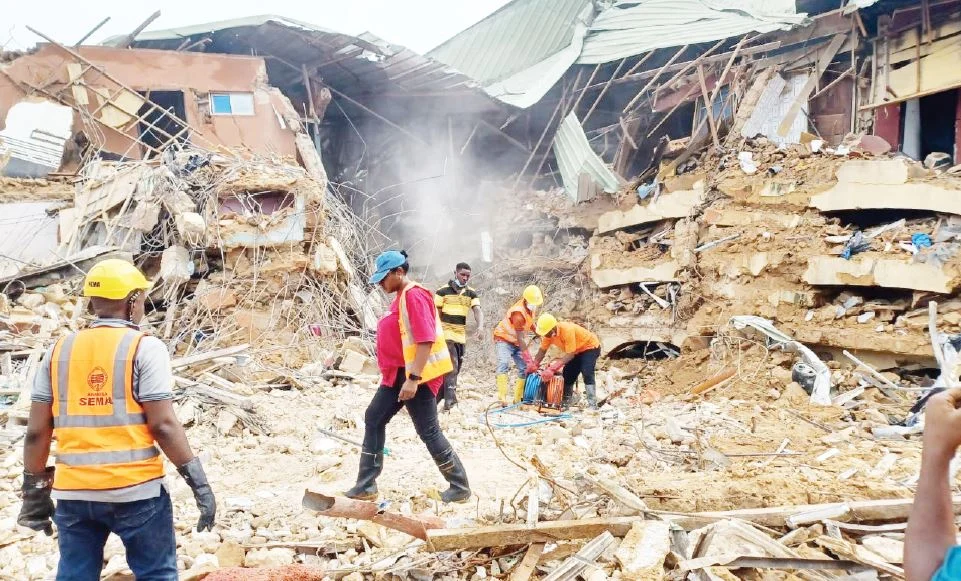
Tragedy at Elite Five Star Lodge: Two Confirmed Dead and Three Rescued Following Massive Building Collapse Near Federal Polytechnic Oko
The serene atmosphere of Amaokpala, a community situated in the Orumba North Local Government Area of Anambra State, was shattered on Sunday night when the Elite Five Star Lodge, a three-storey hostel facility serving students of the nearby Federal Polytechnic, Oko, suffered a catastrophic structural failure. The incident, which occurred under the cover of darkness, has left the local student population in mourning and raised urgent questions regarding building safety standards and regulatory oversight in Nigeria’s tertiary education hubs.
As of the latest reports from emergency management authorities, two individuals have been confirmed dead, while three survivors have been extracted from the rubble and transported to local medical facilities for urgent treatment. The massive structure, which reportedly contained approximately 60 rooms, disintegrated into a pile of concrete and twisted metal, trapping an indeterminate number of occupants and triggering an exhaustive, multi-agency rescue operation that spanned through Monday.
A Chronology of the Disaster
The collapse began in the late hours of Sunday, according to eyewitness accounts. Residents of the area reported hearing a deafening, thunderous sound that echoed across the community, signaling the structural integrity of the building had been entirely compromised. Within moments, the silence of the night was replaced by the desperate cries of victims trapped beneath the debris.
The immediate aftermath was defined by chaos and panic as students and local residents rushed to the site, attempting to clear the rubble with bare hands before the arrival of professional responders.
By the early hours of Monday, a sophisticated rescue apparatus had been mobilized. A joint task force, comprising the National Emergency Management Agency (NEMA), the Anambra State Emergency Management Agency (SEMA), the Nigerian Red Cross Society, the Anambra State Fire Service, and the Nigeria Police Force, established a command center at the site. Throughout the day, the operation utilized heavy-duty excavators to peel back layers of concrete, a delicate process aimed at locating survivors without causing further instability to the remaining ruins.
By 6:55 p.m. on Monday, the rescue mission had recovered the body of a second male victim, adding to the earlier recovery of a female occupant. While the search remains active, authorities have cautioned that the total casualty count remains fluid as debris continues to be cleared.
Official Response and Search Operations
The scale of the disaster prompted immediate responses from state and federal agencies. Ndidi Omega, the acting Executive Secretary of SEMA, confirmed the grim statistics during a press briefing at the scene. "One female body was recovered, while three persons were rescued and taken to the hospital," Omega stated. She emphasized that the operation is far from concluded, noting that the rescue teams remain committed to clearing every section of the rubble to ensure no other victims remain beneath the site.
Chukwudi Chiketa, Head of Media and Publicity for the Anambra State Fire Service, detailed the challenges faced by his team. Upon arrival, fire service personnel had to navigate the precarious landscape of the collapsed building to reach victims. "Regrettably, one female victim was recovered from the rubble. She was confirmed dead at the scene, and her body was evacuated and handed over to the appropriate authorities for deposition in a morgue," Chiketa confirmed. He reiterated the importance of public compliance, urging bystanders to maintain a distance to prevent further injury and allow emergency personnel to maneuver specialized equipment effectively.
The Nigeria Police Force, through Command spokesperson Tochukwu Ikenga, moved to secure the perimeter. The police presence served dual purposes: managing the crowd to prevent secondary accidents and protecting the crime scene to facilitate a thorough investigation into the causes of the collapse. Ikenga urged the public to eschew the spread of unverified information, which often causes undue distress to families of the victims.
Regulatory and Structural Context
The collapse of the Elite Five Star Lodge brings into sharp focus the broader issue of building regulations and structural integrity in areas surrounding Nigeria’s higher institutions. In many parts of the country, the rapid expansion of student populations has outpaced the development of standard, monitored housing. This leads to the proliferation of private hostels, often constructed with limited oversight from urban planning and building control authorities.
While the specific cause of the Amaokpala collapse is yet to be determined, experts in civil engineering often point to a combination of factors in similar incidents: the use of substandard building materials, the absence of proper soil testing, unauthorized vertical extensions of existing structures, and a lack of adherence to approved architectural designs.
NEMA officials have officially sealed the premises, encircling the site with red tape and barricades. This action is a critical procedural step. By securing the site, investigators from the Ministry of Works and the Anambra State Physical Planning Board can now begin a forensic analysis of the construction materials and foundation to ascertain why a building of this scale failed so suddenly.
Broader Implications for Student Housing
The incident at the Federal Polytechnic, Oko, is a sobering reminder of the hazards inherent in the housing market for Nigerian students. Thousands of students reside in private accommodation that falls outside the direct control of university management. This creates a regulatory gray area where landlords, driven by the demand for affordable rooms, may cut corners on safety and maintenance.
Education stakeholders are now calling for a comprehensive audit of all student housing facilities in the vicinity of Federal Polytechnic, Oko, and indeed across the state. Such an audit would require landlords to provide structural certification, ensure compliance with fire safety standards, and provide evidence of building approvals from the relevant local planning authorities.
Furthermore, there is a renewed call for the government to mandate that private hostel developers work in tandem with the Nigerian Institute of Building (NIOB) to certify every stage of construction. The loss of life in Amaokpala is being viewed by community leaders as a preventable tragedy, one that should serve as a catalyst for a stricter enforcement regime regarding building permits and inspections.
Community Impact and Psychological Strain
For the students of the Federal Polytechnic, Oko, the collapse is a traumatic event that extends beyond the loss of the physical structure. Many have lost their personal belongings, academic records, and, most importantly, their sense of security. The psychological toll on the student body, who now watch as their peers are pulled from the wreckage, is immense.
Local leaders and the school management have been urged to provide counseling services to students affected by the trauma of the incident. The incident has also sparked a debate on the necessity of communal disaster preparedness. While the joint rescue mission was eventually effective, the initial minutes following the collapse were marked by confusion. Experts suggest that institutions and local communities should engage in periodic emergency response drills to ensure that, in the event of future structural failures, the response is swift, organized, and informed.
As the rescue operations transition into the recovery phase, the focus of the public and the media remains on the identification of the victims and the subsequent investigation. The Anambra State government is expected to release a preliminary report on the cause of the disaster once forensic experts conclude their site assessments.
For now, the site remains a somber monument to the risks of unregulated urban development. The red tape surrounding the Elite Five Star Lodge stands as a warning—a stark, physical reminder that the safety of the student population must be treated with the same urgency as the pursuit of academic excellence. The families of the deceased and the three survivors currently undergoing treatment represent a human cost that the community of Amaokpala will not soon forget. As the dust settles in Orumba North, the call for accountability, rigorous oversight, and safer living standards for students rings louder than ever.