
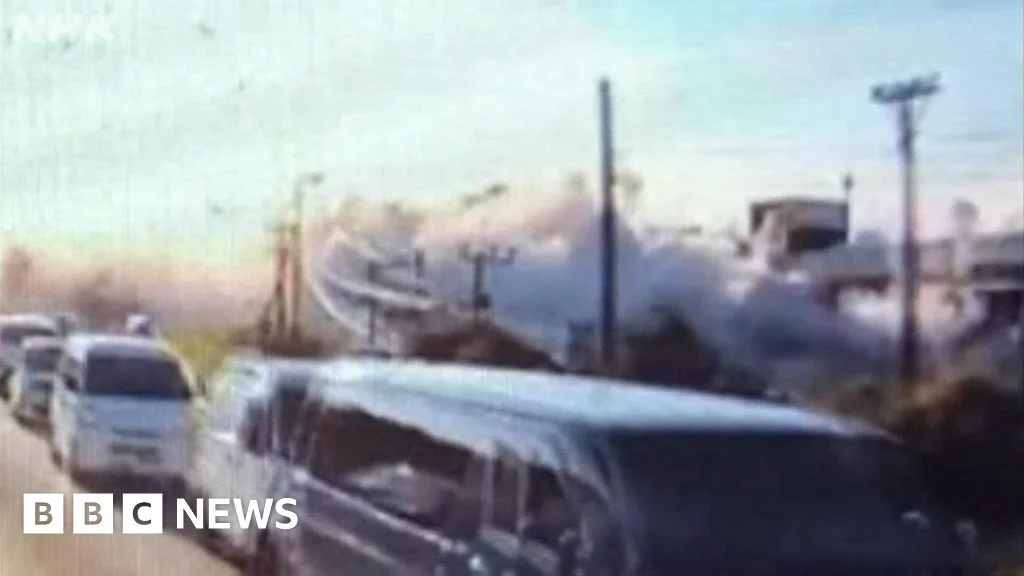
The moment a Japanese mall explodes after a 6.8 earthquake
Search teams are continuing their arduous operations within the partially collapsed Aeon shopping mall in Kumamoto, Kyushu, following a powerful earthquake that rocked the region on Tuesday. The operator of the expansive retail complex confirmed to AFP that an explosion occurred after staff and customers had successfully evacuated the premises, an account corroborated by a witness who described seeing an explosion and smoke emanating from the structure, leading to the collapse of its second floor. The seismic event, initially reported as a significant tremor, struck Kumamoto prefecture at 16:27 local time (07:27 GMT) on Tuesday, setting off a chain of events that has plunged parts of the island into disarray and raised urgent questions about infrastructure resilience.
The Seismic Event: A Region Under Stress
The earthquake, later designated as a magnitude 6.5 temblor by the Japan Meteorological Agency (JMA), with a relatively shallow depth of approximately 10 kilometers, had its epicenter in the vicinity of Mashiki town, east of Kumamoto city. This shallow depth amplified its destructive power, leading to intense ground shaking that registered an upper 6 on Japan’s Shindo seismic intensity scale in several areas. The Shindo scale measures the degree of ground motion and its impact on people and structures, with an upper 6 indicating severe difficulty in remaining standing and widespread damage to non-seismically reinforced structures. While Japan boasts some of the world’s most stringent building codes, particularly post-1981 revisions, the sheer force and specific characteristics of this quake, including prolonged shaking in some areas, tested even modern infrastructure.
Kumamoto Prefecture, located on the island of Kyushu, lies within a seismically active zone, crisscrossed by numerous fault lines, including the prominent Futagawa and Hinagu fault zones. While Japan is accustomed to frequent seismic activity, major quakes of this magnitude can expose vulnerabilities even in a nation renowned for its disaster preparedness. The initial jolt caused widespread power outages, disrupted transportation networks including bullet train services, and triggered numerous landslides in mountainous areas, further complicating emergency response efforts. Many residents reported furniture toppling, cracks appearing in walls, and goods scattering from shelves in homes and businesses across the prefecture.
Chronology of Catastrophe at Aeon Mall Kumamoto
The sequence of events at the Aeon shopping mall, a major commercial hub for the region, unfolded rapidly after the initial earthquake strike.
16:27 JST (07:27 GMT) – The Initial Jolt: As the powerful earthquake struck, the multi-story Aeon mall, bustling with shoppers and staff during the late afternoon, began to shake violently. Automatic seismic sensors likely triggered immediate alarms, initiating emergency protocols.
Immediate Aftermath – Rapid Evacuation: In line with Japan’s highly developed disaster response training, staff members, guided by established procedures, quickly moved to facilitate the evacuation of hundreds, possibly thousands, of customers from the sprawling complex. Announcements would have been made over the public address system, directing people to designated emergency exits and assembly points outside the building. This swift action is credited by the operator for preventing potentially catastrophic casualties from the subsequent incident. Witnesses outside the mall described a chaotic but orderly exodus, with people streaming out into the open areas surrounding the building.
Post-Quake Assessment – Initial Damage and Secondary Hazards: While the evacuation was underway, the structural integrity of the mall was likely already compromised in various sections. Earthquakes, particularly shallow ones, can rupture utility lines, including gas pipes and electrical conduits. It is inferred that internal damage, such as falling ceiling panels, shattered display cases, and structural stress cracks, would have been evident even during the initial evacuation.
Reported Explosion and Collapse: Sometime after the bulk of the evacuation was completed, a significant explosion occurred within the mall. A witness vividly described seeing a flash and then a plume of smoke, followed by the audible sound of collapsing debris. This explosion is believed to have been caused by a ruptured gas line, ignited by an electrical short circuit or other sparks resulting from the earthquake’s damage. The force of the explosion, combined with the earlier seismic stress, led to the partial collapse of the second floor, a critical structural failure that sent tons of concrete, steel, and debris crashing downwards.
Arrival of Emergency Services: Within minutes of the reports of the explosion and collapse, local fire departments, police, and specialized rescue units were dispatched to the scene. The immediate priority shifted from general earthquake response to a more complex urban search and rescue operation, complicated by the potential for secondary explosions, lingering gas leaks, and the inherent instability of the damaged structure. The area around the mall was quickly cordoned off to ensure public safety and facilitate emergency access.
The Aftermath: Search, Rescue, and Hazard Mitigation
The immediate hours and days following the incident at Aeon Mall Kumamoto have been dominated by intense search and rescue efforts. Teams comprising firefighters, police, and units from the Japan Self-Defense Forces (JSDF), along with medical personnel from Disaster Medical Assistance Teams (DMAT), have converged on the site. Their mission is twofold: to ensure that no individuals were trapped inside despite the reported evacuation, and to mitigate ongoing hazards.
The search operation is fraught with challenges. The partial collapse has created a precarious environment of twisted metal, shattered glass, and unstable concrete slabs. Aftershocks, which have continued to rattle the region, pose a constant threat, risking further collapses and endangering rescue workers. Specialized equipment, including thermal imaging cameras, acoustic sensors to detect faint sounds, and sniffer dogs, are being utilized to locate any potential survivors amidst the rubble. Heavy machinery is being deployed cautiously to remove large sections of debris without compromising the integrity of remaining structures.
HAZMAT (Hazardous Materials) teams are also on site, meticulously monitoring for gas leaks, electrical hazards, and potential spills of chemicals from various retail outlets within the mall. The initial explosion underscored the critical importance of identifying and neutralizing such secondary hazards, which can pose a significant risk to both rescuers and the surrounding community. Emergency crews are working around the clock, illuminated by powerful floodlights through the night, a testament to the urgency of their mission.
Official Responses and Public Statements
Aeon Co. Ltd.: In the wake of the disaster, Aeon Co. Ltd., one of Japan’s largest retail groups, issued a statement expressing its profound regret for the incident and confirming the immediate evacuation of all staff and customers following the earthquake. A spokesperson reiterated the company’s commitment to cooperating fully with local authorities in the ongoing investigation into the explosion’s cause and the extent of the damage. They also affirmed their priority in ensuring the safety of rescue workers and pledged support for affected employees and tenants. Internal teams have been mobilized to assess the structural integrity of the remaining parts of the mall and plan for future actions, which could range from extensive repairs to complete demolition and rebuilding.
Kumamoto Prefectural Government: Governor Ikuo Kabashima of Kumamoto Prefecture declared a state of emergency for the affected areas, mobilizing all available prefectural resources for disaster relief. During a press conference, Governor Kabashima emphasized the coordination of rescue efforts with national agencies and the JSDF. He urged residents to remain vigilant against aftershocks, which could trigger further building collapses or landslides, and advised those in damaged homes to seek shelter in designated evacuation centers. Public advisories also included warnings about potential gas leaks in earthquake-affected buildings and the need for professional inspection before re-entry.
National Government: From Tokyo, the national government, through the Prime Minister’s Office and the Ministry of Land, Infrastructure, Transport and Tourism (MLIT), swiftly offered comprehensive support to Kumamoto Prefecture. Prime Minister Fumio Kishida issued a statement conveying condolences to those affected and pledging the full resources of the central government, including financial aid and the deployment of additional JSDF personnel, to assist with search and rescue, recovery, and long-term reconstruction efforts. The focus was on ensuring a coordinated national response to a complex and evolving disaster situation.
Japan Meteorological Agency (JMA): The JMA has been providing continuous updates on seismic activity, including forecasts for aftershocks. Experts from the agency reiterated warnings for residents in affected areas to prepare for strong tremors for at least the next week, emphasizing that even smaller aftershocks could cause further damage to already weakened structures. They also highlighted the increased risk of landslides in areas where the ground has been loosened by the main quake and subsequent rainfall.
Expert Analysis: Disaster management experts and structural engineers have weighed in on the incident. Dr. Kenji Ishihara, a professor of earthquake engineering at a leading Japanese university, noted that while Japanese building codes are exemplary, "secondary hazards like gas explosions are a significant concern in any major earthquake, particularly in urban areas with extensive underground infrastructure." He emphasized the importance of regular inspections and maintenance of utility lines, especially in older buildings or those located near active fault lines. Others pointed to the effectiveness of Japan’s early warning systems and evacuation drills in saving lives, even in the face of such destructive events.
Broader Implications and Long-Term Outlook
The partial collapse of the Aeon Mall Kumamoto, following a powerful earthquake, carries significant broader implications for the region and for Japan’s continuous efforts in disaster preparedness.
Economic Impact: The immediate economic impact on Kumamoto Prefecture will be substantial. The closure of a major retail hub like Aeon Mall will affect local businesses, supply chains, and employment. Reconstruction costs, both for the mall and for the wider infrastructure damaged by the earthquake, will run into billions of yen. The disruption to tourism, a vital sector for Kyushu, is also a concern. While Japan has a robust economy capable of absorbing such shocks, the local recovery will be a prolonged process, requiring significant public and private investment.
Infrastructure Safety and Regulations: The incident is likely to prompt a renewed review of infrastructure safety standards, particularly concerning gas distribution networks in seismically active zones. While existing regulations are stringent, the interplay between seismic stress and the vulnerability of utility lines will be closely scrutinized. There may be calls for enhanced monitoring systems, automatic shut-off valves in earthquake-prone areas, and more frequent inspections of aging infrastructure. The focus will be on ensuring that structures not only withstand the initial quake but also prevent secondary hazards.
Psychological Toll: Beyond the physical damage, the earthquake and the dramatic incident at the mall will undoubtedly take a psychological toll on the residents of Kumamoto. Experiencing such a powerful tremor, followed by the visible destruction of a familiar community landmark, can cause significant trauma. Support services for mental health will be crucial in the coming months, helping communities cope with anxiety, stress, and loss.
Lessons in Resilience: Despite the devastation, the swift evacuation of the mall prior to the explosion stands as a testament to Japan’s culture of disaster preparedness and the effectiveness of its emergency protocols. This incident, while tragic, will likely become another case study for continuous improvement in disaster management, reinforcing the importance of public education, regular drills, and resilient urban planning. Japan, a nation accustomed to confronting the forces of nature, will once again demonstrate its remarkable capacity for recovery and adaptation, learning from each event to build an even safer and more prepared society. The search for survivors continues, a stark reminder of the human element at the heart of every disaster.

Related Posts

Zambia on Edge: Opposition Leader Arrested Amid Allegations of Insurrection Plot and Election Tensions
Rescuers search for survivors of powerful Indonesia earthquake

