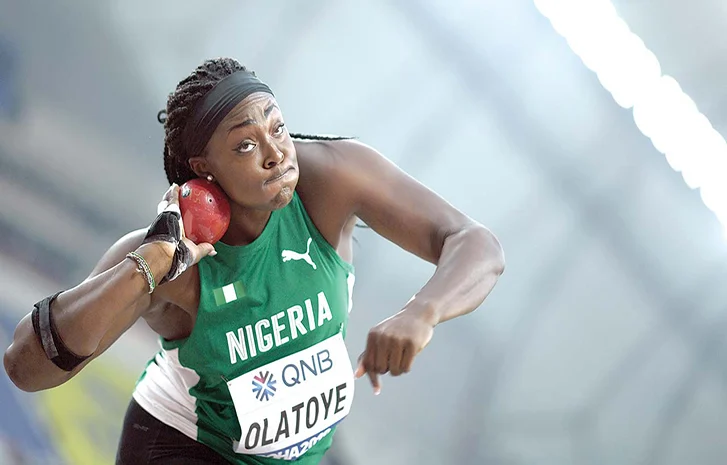
Olatoye vows to return stronger after Commonwealth Games hammer throw disappointment
Nigerian hammer thrower Oyesade Olatoye has pledged to recalibrate her training and return to the international stage with renewed vigor following a challenging outing at the 2026 Commonwealth Games in Glasgow. The 29-year-old athlete, who entered the competition with high expectations following a stellar season, finished in eighth position in the women’s hammer throw final on Tuesday. While the result fell short of her podium aspirations, Olatoye remains focused on the long-term objective of becoming a consistent global contender in the discipline.
The final was characterized by both elite athletic performance and significant environmental challenges. Canada’s Camryn Rogers delivered a masterclass in technical precision, successfully defending her Commonwealth title by setting a new Games record of 74.91 meters. For Olatoye, the competition proved to be a test of mental fortitude as much as physical capability, as she struggled to record a mark that reflected her training metrics. Her best effort of 63.27 meters left her outside the medal bracket, a result that she attributes to a temporary lapse in rhythm rather than a lack of preparation.
Technical and Environmental Challenges in Glasgow
The Glasgow weather proved to be a defining factor for many of the field athletes on Tuesday. Consistent rainfall transformed the throwing circle into a treacherous environment, complicating the complex rotational movements required for high-level hammer throwing. Olatoye, who has previously demonstrated the ability to compete at the highest levels, highlighted how the external conditions directly influenced the technical execution of her throws.
"Having the grip on the hammer and having our hands wet throughout the competition isn’t the best," Olatoye explained in a post-event interview. "The ring was flooded with water, making it extremely difficult to maintain the necessary friction and stability while generating the force required for a maximum-distance throw."
In the sport of hammer throw, the margin for error is razor-thin. A slight slip in the ring or a fraction of a second’s delay in the release can result in a significant loss of distance. Olatoye noted that despite the poor conditions, she felt flashes of her potential during practice attempts within the cage. The frustration stems from her inability to translate that latent potential into the official competition window. However, she maintained a stoic outlook, refusing to use the weather as an excuse for her final standing, acknowledging that all competitors faced the same environmental variables.
A Chronology of Olatoye’s Season and Aspirations
Oyesade Olatoye’s journey to the 2026 Commonwealth Games has been one of consistent development. As a former African champion, she has spent the last several years refining her technique under high-pressure conditions. Her season leading up to Glasgow had been marked by improved consistency and a tactical shift in her training volume, aimed at peaking during the mid-summer championship cycle.
Following her participation in various regional and continental meets earlier in 2026, Olatoye had established herself as a favorite to challenge for a medal. Her progression throughout the year suggested that a distance in the high 60-meter range was well within her grasp, which would have put her in direct contention for a bronze or silver medal had she replicated her best form.
Looking ahead, the athlete has outlined a clear trajectory for the next two years. The immediate future involves a period of physical and mental recovery, followed by a transition into off-season training. The roadmap for 2027 and 2028 is clear:
- Late 2026: Off-season recovery and assessment of biomechanical data from the Glasgow performance.
- Early 2027: Resumption of intensive strength and conditioning cycles to prepare for the upcoming World Athletics Championships.
- 2027 World Athletics Championships: A primary target for establishing a new personal best and securing a top-six global finish.
- 2028 Los Angeles Olympic Games: The ultimate culmination of the current four-year cycle, where Olatoye aims to represent Nigeria on the world’s biggest stage.
Fact-Based Analysis of the Hammer Throw Landscape
The women’s hammer throw has seen a rapid evolution in technical standards over the last decade. The dominance of athletes like Camryn Rogers, who has consistently pushed the boundaries of the 75-meter mark, has forced the rest of the field to elevate their training intensity. For Nigerian athletics, the emergence of athletes like Olatoye is critical for diversifying the nation’s medal prospects beyond the track events.
Data from the 2026 final underscores the high barrier to entry for the podium. To secure a medal in Glasgow, competitors had to maintain a high degree of technical stability even under fatigue. While Olatoye’s 63.27m result did not meet her internal benchmarks, the proximity of the top three finishers suggests that the gap between her current performance and the podium is bridged by incremental gains in stability rather than a need for a fundamental overhaul of her style.
Sports analysts observing the event noted that Olatoye’s ability to remain composed in the face of a disappointing result is a hallmark of an experienced athlete. In the technical field events, psychological resilience is often as important as raw power. The ability to "reset" after a subpar performance is what distinguishes top-tier athletes from the rest of the pack.
Official Response and Support Systems
The Nigerian delegation in Glasgow has expressed continued confidence in Olatoye’s abilities. While the athletics federation has not issued a formal statement on the specific results of the hammer throw, coaching staff associated with the team have emphasized the importance of continuity. Providing athletes with the necessary support systems—ranging from specialized throwing coaches to mental health resources—remains a priority for the Nigerian sports authorities as they look toward the 2027 and 2028 seasons.
The broader impact of Olatoye’s performance extends to the visibility of field events within Nigeria. By consistently participating in global finals, she serves as a role model for a new generation of Nigerian throwers who may previously have focused exclusively on sprinting. Her transparency regarding the difficulties faced during the competition—and her refusal to succumb to defeatism—provides a constructive narrative for younger athletes learning to navigate the highs and lows of professional sports.
Looking Toward the Future: The Path to Los Angeles
As the curtain falls on the 2026 Commonwealth Games, the conversation surrounding Olatoye shifts from the disappointment of the Glasgow final to the preparations for the 2028 Los Angeles Olympics. The four-year Olympic cycle is designed to allow athletes to build toward a peak performance, and Olatoye’s current trajectory suggests she is still in her prime as a competitive thrower.
"I wish I was able to deliver the way I wanted to and the way I know I’m capable of," Olatoye said in her closing remarks to the press. "But I’m still proud of the effort and proud of my season. Knowing that the top three were definitely within range of what I could do, it motivates me. I don’t hang my head. I’m proud of Nigeria, all the supporters, and everyone who has been cheering us on. I’m excited and ready to get back to work."
The "reboot" phase that Olatoye mentioned will likely involve a comprehensive review of her training regimen, potentially incorporating more specific drills to handle inclement weather and high-pressure environments. In the world of elite athletics, the difference between a medal and a secondary finish is often found in these minute adjustments.
As she prepares to head into the off-season, Olatoye carries with her the knowledge that she belongs in the final of major international championships. For the Nigerian athletic community, her determination serves as a reminder that the pursuit of excellence is a marathon, not a sprint. The setback in Glasgow, while painful, is viewed by her camp as a necessary stepping stone in the journey toward future success at the World Championships and the ultimate challenge of the Olympic Games. The resolve displayed by Olatoye ensures that her name will remain one to watch as the international athletics calendar moves into its next phase.