
Sonam Wangchuk: Indian activist on hunger strike for 20 days forcibly taken to hospital
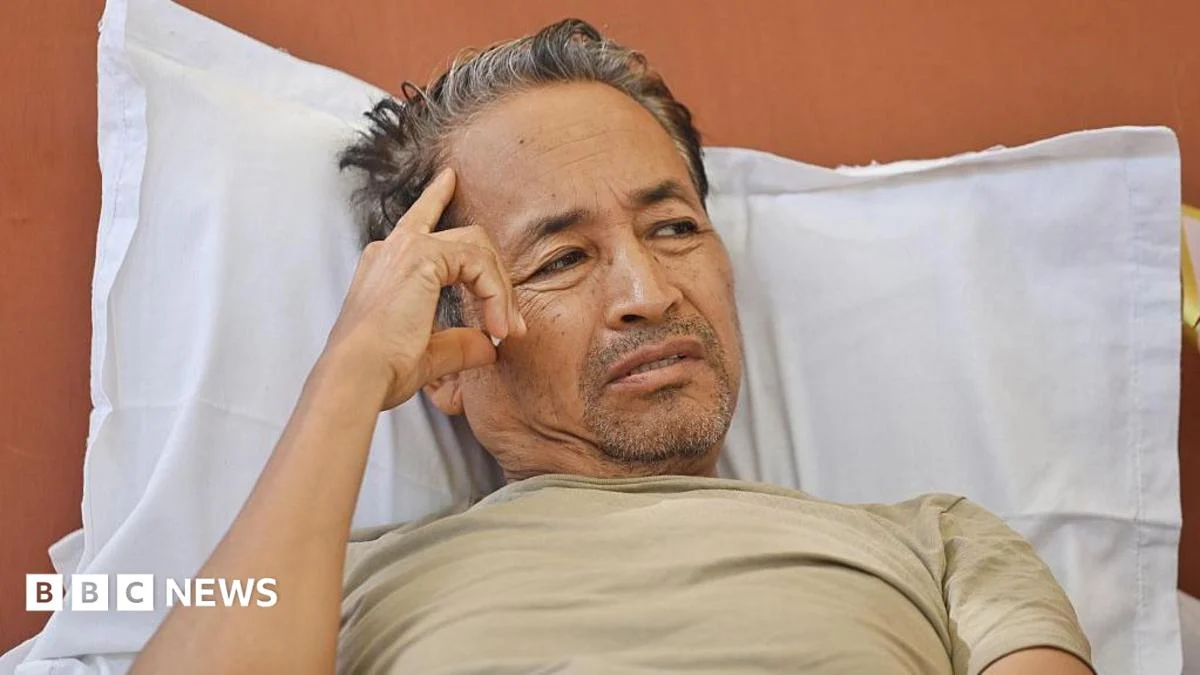
Renowned Indian activist and educationist Sonam Wangchuk, 59, was forcibly removed from his protest site in Delhi on Saturday morning after undertaking a hunger strike for 20 days. Wangchuk had been protesting in support of the Cockroach Janta Party (CJP), an online satirical movement advocating for comprehensive educational reforms in India. His removal comes just days before a planned march to India’s parliament, scheduled for Monday, July 20.
The dramatic intervention by police and paramilitary personnel occurred at Jantar Mantar, a historical protest site in the heart of the capital, where Wangchuk had been observing an indefinite fast. Consuming only salt and water under the scorching summer sun, the activist had reportedly lost more than 9 kilograms and was experiencing significant pain, according to reports from his associates. Following his removal, CJP founder Abhijeet Dipke announced he had commenced an indefinite fast in Wangchuk’s stead, vowing that the planned march to parliament would proceed as scheduled and calling for Prime Minister Narendra Modi’s resignation.
A Chronology of Dissent and Deterioration
The genesis of this heightened activism can be traced back to early May, when the Cockroach Janta Party (CJP) emerged as a satirical online movement. Initially leveraging social media platforms, the CJP gained substantial traction by highlighting systemic issues of paper leaks and other irregularities plaguing India’s crucial competitive examinations. Their unique branding, where protesters identify themselves as "cockroaches" – a symbol of resilience and omnipresence in the face of adversity – resonated with a frustrated student community.
The movement gained significant momentum after the cancellation of a key entrance examination for aspiring doctors, the National Eligibility cum Entrance Test (NEET), following widespread allegations of a paper leak. This incident, along with similar controversies surrounding other national examinations like the UGC-NET (University Grants Commission-National Eligibility Test), ignited a furious debate about the integrity of India’s examination system and the future prospects of millions of students.
Sonam Wangchuk, an acclaimed innovator and educationist whose work in Ladakh inspired the popular Bollywood film "3 Idiots," joined the CJP’s cause in late June, initiating his indefinite hunger strike at Jantar Mantar. Known for his environmental activism and educational reforms, Wangchuk’s participation immediately lent significant weight and visibility to the movement. His protest aimed to draw national attention to the plight of students affected by these irregularities and to press for urgent reforms and accountability from the government.
As his fast entered its third week, Wangchuk’s health visibly deteriorated. Despite his weakening physical state, he remained resolute, telling a cheering crowd at Jantar Mantar just days prior, "I’ve grown weak from the outside but I’m strong from within." He had insisted on participating in the upcoming march to parliament, even light-heartedly quipping that if he were to die before the march, his "ghost would join the march."
The Delhi High Court had, on Thursday, issued an order instructing the federal government to regularly monitor Wangchuk’s health and provide any necessary medical treatment. This judicial intervention underscored the growing concern over his well-being, though Wangchuk had steadfastly refused to end his strike.
The Forced Removal: A Scene of Chaos
The events leading to Wangchuk’s removal unfolded dramatically on Saturday morning. Videos from the protest site, captured around 07:30 local time (02:00 GMT), depict a chaotic scene. Dozens of police and paramilitary personnel descended upon the stage where Wangchuk lay. Protesters who attempted to intervene and prevent the removal were reportedly pushed away by the security forces.
In a swift and coordinated move, personnel covered Wangchuk with bedsheets or curtains before carefully lifting and removing him from the stage. Minutes later, an ambulance was seen speeding away from Jantar Mantar, signaling his transfer to a medical facility. The incident sparked immediate outrage among the protesters and drew sharp criticism from opposition parties.
Following the incident, Wangchuk’s wife, Gitanjali Angmo, confirmed on social media platform X (formerly Twitter) that her husband had been admitted to Safdarjung Hospital. She issued an urgent plea, stating, "Nothing should be administered to him orally or intravenous[ly] without taking consent from me, his family and his doctors who have been monitoring his health for the past 20 days." Her statement highlighted concerns about medical autonomy and the rights of a patient under state care.
Official Statements and Medical Updates
Dr. Charu Bamba, Medical Superintendent of Safdarjung Hospital, provided an update on Wangchuk’s condition, assuring the public that he was "fully alert and stable." She added, "He is somewhat weak due to prolonged fasting and is experiencing mild dehydration; otherwise, all his vital parameters are stable. He is being continuously examined and monitored, and his treatment is under way." This official medical assessment aimed to allay fears about his immediate health crisis.
Police officials, in turn, justified their actions by citing the Delhi High Court order. Sachin Sharma, Deputy Commissioner of Police, told reporters that Wangchuk had been moved "in compliance with [a court] order, and based on health conditions and medical advice." He reiterated that Wangchuk was now "under medical supervision," framing the intervention as a necessary measure for the activist’s health and in adherence to judicial directives. However, the precise interpretation of the court order – whether it mandated forced removal or simply monitoring and offering treatment – remains a point of contention among legal experts and civil liberties advocates.
The Broader Context: A Crisis of Trust in Examinations
The protests spearheaded by the CJP and Wangchuk underscore a profound crisis of public trust in India’s examination system. Competitive examinations are the gateway to higher education, government jobs, and professional careers for millions of young Indians. The stakes are incredibly high, with millions vying for a limited number of coveted positions.
For instance, the National Eligibility cum Entrance Test (NEET), a mandatory exam for admission to undergraduate medical courses, sees approximately 2.4 million candidates annually. The UGC-NET, critical for junior research fellowships and assistant professorships, attracts nearly a million applicants. When these exams are compromised by paper leaks or other irregularities, it not only shatters the dreams of countless students but also erodes faith in the meritocratic principles of the system.
In recent years, India has witnessed a disturbing frequency of such incidents. Reports indicate that dozens of competitive exams across various states and at the national level have faced allegations of leaks, cancellations, or malpractices. This systemic failure not only leads to immense emotional and financial distress for students, who often invest heavily in coaching and study materials, but also imposes significant economic costs on the exchequer due to repeated examination processes. The perceived lack of accountability for these repeated failures fuels widespread anger and frustration, making movements like the CJP increasingly relevant.
Political Fallout and Escalating Demands
The incident has swiftly escalated the political stakes surrounding the educational reform movement. Initially, the CJP and its supporters demanded the resignation of Education Minister Dharmendra Pradhan, holding him morally responsible for the integrity failures in examinations like NEET. Minister Pradhan had previously dismissed the CJP and its proponents as "the B-team of disruptive elements," and the Modi government had largely refrained from engaging directly with the protesters.
However, in the wake of Wangchuk’s forced removal, the CJP has broadened its demands. "Until now, we were demanding Dharmendra Pradhan’s resignation, but after this despicable act, we will now demand the resignation of Narendra Modi," CJP founder Abhijeet Dipke declared, signaling a significant escalation in their political objectives.
Opposition parties across the political spectrum swiftly condemned the government’s action. Members of Parliament from various opposition factions described the forced removal as "shocking coercive state violence" and "an assault on democracy." These statements reflect a broader concern about the state’s response to peaceful dissent and the shrinking space for protest in India.
There had been growing pressure from both the opposition and civil society leaders for the government to engage in dialogue with the protesters. Just days before his removal, former Delhi chief minister and leader of the Aam Aadmi Party (AAP), Arvind Kejriwal, visited Wangchuk at Jantar Mantar. In a video shared by the CJP, Kejriwal was seen greeting the activist and appealing to the government to listen to the students and Wangchuk. He pointed out the recurring issue of exam paper leaks and even suggested that Pradhan should be removed from his post and replaced by Wangchuk, highlighting the severity of the crisis and the respect Wangchuk commands.
The Future of the Movement: Unwavering Resolve
Despite Sonam Wangchuk’s physical absence from the protest site, the movement shows no signs of abating. Abhijeet Dipke, now leading the hunger strike, has reiterated the CJP’s unwavering resolve. "If they think that taking Wangchuk away will end this movement, they are mistaken. We will remain here, and will march to parliament on 20 July," Dipke affirmed, emphasizing the determination of the "cockroaches" to continue their fight for justice and reform.
The planned march to parliament on Monday, July 20, now carries an even greater symbolic weight. It will be a test of the movement’s resilience and its ability to mobilize support in the face of state action. The incident has also brought renewed scrutiny to the state of democratic freedoms in India, particularly the right to peaceful protest and the government’s handling of dissent.
The broader implications extend beyond immediate political fallout. The widespread discontent over exam irregularities demands systemic solutions – robust anti-cheating laws, transparent examination processes, and greater accountability from educational institutions and government bodies. Wangchuk’s sacrifice and the CJP’s sustained agitation aim to force a national reckoning with these critical issues, pushing for reforms that could redefine the future of education and opportunity for millions of Indian youth. The coming days will reveal whether the forced removal of a prominent activist will quell the rising tide of protest or ignite an even more determined struggle for educational justice.

Related Posts
Zambia on Edge: Opposition Leader Arrested Amid Allegations of Insurrection Plot and Election Tensions
Rescuers search for survivors of powerful Indonesia earthquake

