Santa Marta Coalition Braces for Shift as Colombias New Far-Right Government Signals Withdrawal from Fossil Fuel Phase-Out Pledges
The international climate community is closely monitoring a significant shift in Latin American geopolitics as the Santa Marta coalition—a high-level alliance of 57 governments, private sector leaders, and civil society organizations—prepares for the formal exit of one of its primary architects. Colombia, which hosted the inaugural summit for the fossil fuel transition earlier this year, is set to undergo a radical policy reversal this week as President-elect Abelardo de la Espriella takes the oath of office. The incoming administration has signaled a decisive break from the environmental priorities of the outgoing Gustavo Petro government, pledging instead to revitalize the nation’s extractive industries through expanded coal exports and the introduction of hydraulic fracturing, or fracking.
The transition marks a pivotal moment for the Santa Marta coalition, an initiative designed to accelerate the global move away from oil, gas, and coal outside the traditional, often slow-moving framework of United Nations climate negotiations. While the loss of a founding member and a leading voice from the Global South presents a diplomatic challenge, coalition leaders insist the organization’s decentralized structure—which includes subnational governments, scientific bodies, and non-governmental organizations—will allow it to persist despite the political volatility of its member states.
The Genesis of the Santa Marta Coalition and the April Summit
The Santa Marta coalition emerged from a growing consensus among climate-vulnerable nations and progressive economies that the pace of global decarbonization was insufficient to meet the 1.5°C target set by the Paris Agreement. In April, the Caribbean city of Santa Marta became the epicenter of this movement, hosting representatives from 57 nations for the first-ever dedicated conference on transitioning away from fossil fuels.
The summit was characterized by its focus on "just transitions," emphasizing that the move away from hydrocarbons must be accompanied by economic protections for workers and developing nations that have historically relied on resource extraction. Under the leadership of outgoing President Gustavo Petro and his Minister of Mines and Energy, Irene Vélez Torres, Colombia positioned itself as a moral leader in this space. Petro’s administration made the bold, and controversial, decision to halt all new exploration contracts for hydrocarbons, a move intended to signal Colombia’s commitment to a post-petroleum future.
The April summit resulted in a framework for international cooperation on renewable energy financing, technology transfers, and the management of stranded assets. However, the domestic political cost of these policies became a central theme in the subsequent Colombian general election, where economic concerns over rising energy costs and declining export revenues dominated the discourse.
Political Realignment: The Rise of Abelardo de la Espriella
In June, the Colombian electorate delivered a mandate to Abelardo de la Espriella, a far-right candidate whose platform was built on the pillars of "energy sovereignty" and "economic restoration." De la Espriella campaigned heavily against what he termed the "environmental extremism" of the Petro administration, arguing that the sudden cessation of hydrocarbon exploration threatened Colombia’s fiscal stability and national security.
Set to take office this Friday, De la Espriella has wasted little time in outlining a 180-degree turn in policy. His incoming administration views the fossil fuel industry not as a legacy to be phased out, but as a vital engine for growth. Central to his economic plan is the ramping up of coal exports—Colombia remains one of the world’s largest exporters of thermal coal—and the legalization of fracking for methane gas. The latter had been a major point of contention in Colombia for years, with the Petro government successfully maintaining a ban based on environmental and water-security concerns.
The incoming Environment Minister, Fabio Arjona, has been particularly vocal in his criticism of the previous government’s international climate diplomacy. Arjona recently characterized the Santa Marta conference as an "absolute waste of time and money," questioning the utility of spending state resources on a voluntary coalition that he argues does not serve Colombia’s immediate economic interests. This rhetoric suggests that upon taking office, the new government will not only withdraw from active participation in the coalition but may actively work to dismantle the domestic regulatory frameworks established to support the transition.
Economic Context and Supporting Data
The shift in Colombia’s stance is underpinned by significant economic pressures. According to data from the Colombian National Mining Agency (ANM), coal remains the country’s second-largest export after oil. In 2023, Colombia produced approximately 54 million tonnes of coal, with the majority destined for international markets. The Petro administration’s push to wind down this industry faced stiff resistance from labor unions and regional governments in departments like La Guajira and Cesar, where coal mining provides a substantial portion of local employment and tax revenue.
Furthermore, the fiscal implications of the Santa Marta summit have become a point of domestic controversy. While the incoming administration has claimed the costs of the event were as high as 120 billion pesos, official records cited by local investigative outlets suggest the actual expenditure was closer to 7 billion pesos. Despite this discrepancy, the narrative of "wasteful spending" on climate diplomacy has resonated with a public grappling with inflation and infrastructure deficits.
From an energy perspective, Colombia’s transition is complicated by its reliance on hydroelectric power, which accounts for roughly 70% of its electricity generation. While this makes the domestic grid relatively "green," it also leaves the country vulnerable to droughts exacerbated by El Niño cycles. The De la Espriella administration argues that expanding domestic gas production through fracking is essential to provide a reliable "bridge fuel" and ensure energy security during periods of low rainfall.
Chronology of the Transition
To understand the current crisis facing the Santa Marta coalition, a timeline of the past two years is essential:
- August 2022: Gustavo Petro is inaugurated, pledging to make Colombia a "global power for life" and announcing a halt to new oil and gas exploration.
- January 2023: At the World Economic Forum in Davos, Minister Irene Vélez Torres reaffirms Colombia’s commitment to a fossil-free future, drawing both international praise and domestic criticism.
- April 2024: The Santa Marta Summit convenes 57 governments, establishing the coalition’s foundational principles and setting a roadmap for fossil fuel phase-out.
- June 2024: Abelardo de la Espriella wins the general election on a pro-industry, far-right platform.
- July 2024: Incoming Environment Minister Fabio Arjona dismisses the Santa Marta coalition as a "waste of time."
- August 2024: Outgoing officials and coalition leaders hold briefings to ensure the initiative’s survival post-Colombia exit.
Official Responses and Coalition Resilience
Irene Vélez Torres, the outgoing Minister and a co-chair of the Santa Marta coalition, addressed the impending change in government during a press briefing last week. Her comments reflected a mixture of disappointment and pragmatic foresight. Torres acknowledged that the political shift in Colombia was a known risk from the coalition’s inception, and she emphasized that the organization was structured specifically to withstand such shocks.
"It is a shame that Colombia cannot continue with its international leadership, but it doesn’t mean that what we created as a global legacy will not continue," Torres stated. She highlighted that the coalition is not merely a "club of nations" but a diverse ecosystem including subnational governments (such as provinces and major cities), scientific institutions, and powerful civil society groups. This multi-stakeholder approach is intended to ensure that even if a national government withdraws, the momentum within that country’s private sector or local municipalities might remain.
Other member nations have expressed continued support for the coalition’s goals. Representatives from several European and Pacific island nations—groups that have been the most vocal advocates for a fossil fuel treaty—have indicated that while Colombia’s departure is a setback, the "Santa Marta spirit" remains vital for maintaining pressure on major emitters ahead of the upcoming UN climate summits (COP).
Broader Impact and Global Implications
The withdrawal of Colombia from the Santa Marta coalition carries significant implications for the Global South’s role in climate leadership. For years, the narrative has been that developing nations cannot afford to transition away from fossil fuels without risking their economic stability. The Petro government attempted to flip this narrative, arguing that developing nations cannot afford not to transition, given their heightened vulnerability to climate-related disasters.
The reversal under De la Espriella may embolden other resource-rich nations to prioritize short-term extractive gains over long-term climate commitments. It highlights the "political volatility risk" that haunts international environmental agreements: the reality that a change in domestic leadership can nullify years of diplomatic progress.
However, the Santa Marta coalition’s survival strategy may provide a blueprint for future climate initiatives. By embedding the transition goals within subnational and non-governmental frameworks, the coalition aims to create a "policy floor" that is difficult for any single administration to completely destroy. Analysts suggest that if the coalition can maintain its membership of 50+ other entities and continue to facilitate renewable energy investment, it will have proven that the global energy transition is no longer solely dependent on the whims of individual national leaders.
As Abelardo de la Espriella prepares to take office, the eyes of the world are on Colombia’s coal mines and gas fields. The new government’s attempt to revive a 20th-century energy model will serve as a high-stakes test case for whether the global momentum toward decarbonization is truly irreversible, or whether it remains a fragile construct vulnerable to the shifting winds of populist politics. For the Santa Marta coalition, the mission remains unchanged, even as it loses the very ground upon which it was founded.

Related Posts
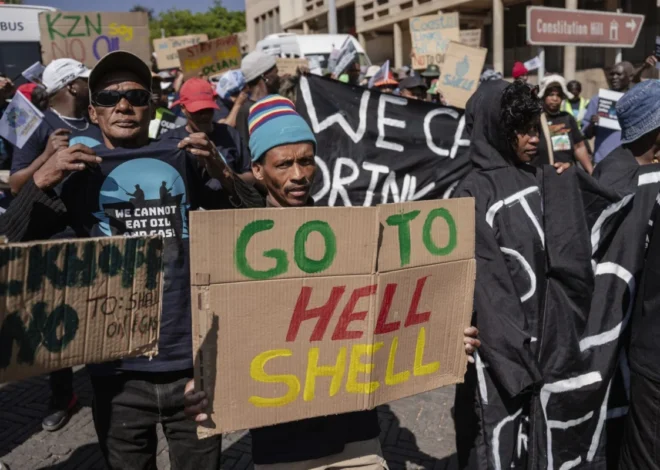
Constitutional Court of South Africa Bars Shell Oil Exploration in Landmark Victory for Environmental and Community Rights
The Battle for Saldanha Bay: South Africa’s Ambitious Ocean Economy Strategy Faces Legal and Environmental Reckoning