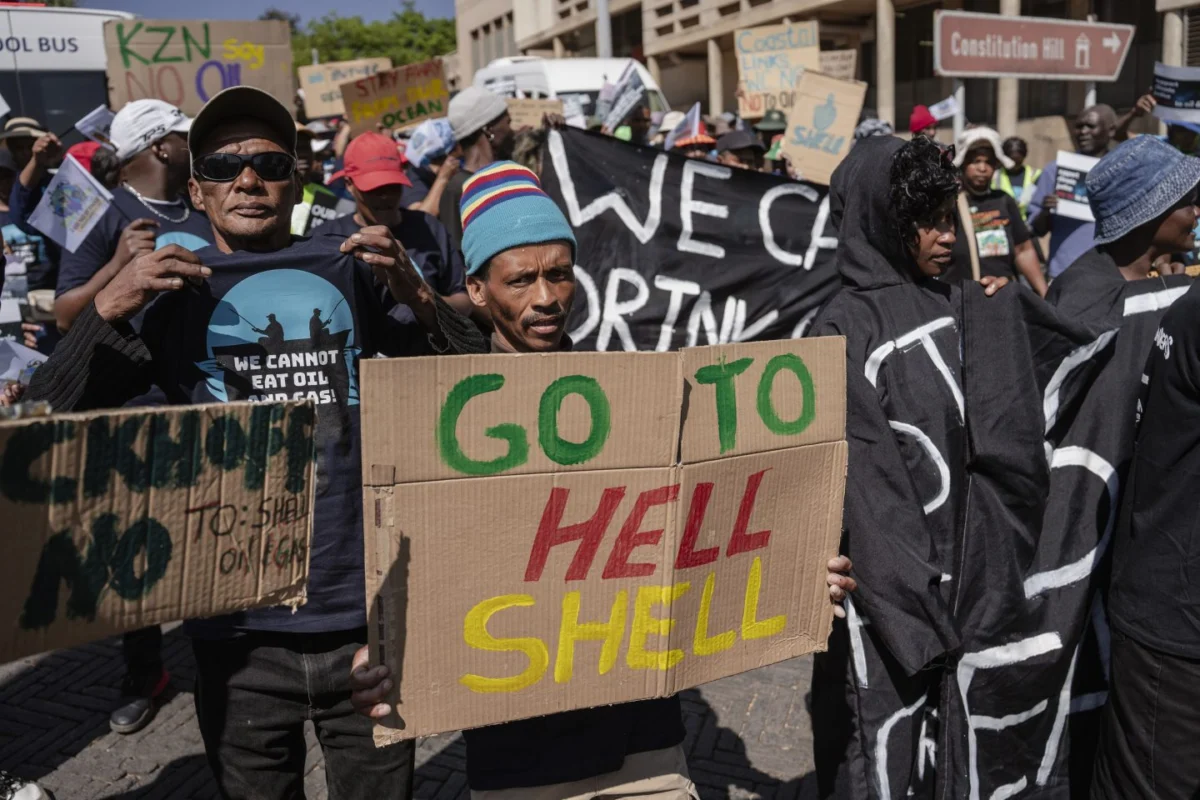
Constitutional Court of South Africa Bars Shell Oil Exploration in Landmark Victory for Environmental and Community Rights
In a definitive ruling that concludes half a decade of intense legal maneuvering, the Constitutional Court of South Africa has permanently set aside the exploration rights granted to global petrochemical giant Shell and its local partner, Impact Africa. The judgment represents a historic victory for indigenous communities, environmental activists, and civil society organizations who argued that the government’s authorization of seismic surveys off the country’s pristine Wild Coast was procedurally flawed and substantively harmful. The decision not only halts specific extraction plans for the East Coast but also establishes a rigorous legal precedent regarding the intersection of climate change, cultural heritage, and the necessity of meaningful public participation in resource governance.
The verdict follows a protracted battle that saw grassroots organizations and non-profits, including Sustaining the Wild Coast, Natural Justice, and Greenpeace Africa, challenge the South African government’s decision to allow Shell to conduct 3D seismic surveys. These surveys, which involve blasting high-decibel sound pulses into the ocean floor to locate oil and gas deposits, were met with fierce resistance from local residents who rely on the ocean for their livelihoods and spiritual practices. The Constitutional Court’s ruling confirms that the permits were issued without adequate consultation and failed to account for the long-term ecological and climate-related consequences of fossil fuel exploration.
A Chronology of the Five-Year Legal Battle
The path to the Constitutional Court was marked by several high-profile legal shifts, reflecting the complex tension between South Africa’s developmental goals and its constitutional commitments to environmental protection.
The origins of the dispute date back to 2014, when the South African Department of Mineral Resources and Energy (DMRE) initially granted exploration rights to Impact Africa, which were later transferred in part to Shell. However, the conflict reached a boiling point in late 2021 when Shell announced its intention to begin seismic blasting along the Wild Coast.
In December 2021, the Makhanda High Court issued an urgent interim interdict, successfully halting Shell’s operations just as its survey vessel was preparing to begin work. This was followed by a comprehensive review in 2022, where the High Court ruled that the exploration rights were granted unlawfully. The court cited a lack of consultation with affected communities and a failure to consider the potential harm to marine life and the constitutional rights of the local population.
Shell and the South African government appealed this decision, taking the matter to the Supreme Court of Appeal (SCA) in June 2024. While the SCA upheld the High Court’s finding that the consultation process was flawed, it initially offered a "suspended" setting aside of the rights, which would have potentially allowed Shell to rectify the procedural errors and re-apply. Dissatisfied with this compromise, community groups escalated the matter to the Constitutional Court, seeking a final and absolute cancellation of the permits. The highest court in the land has now provided that finality, ruling that the procedural and substantive failures were too severe to be simply "fixed" through a retrospective consultation.
The Mandate for Meaningful Public Participation
Central to the Constitutional Court’s judgment was the concept of "meaningful consultation." Under South African resource governance law, specifically the Mineral and Petroleum Resources Development Act (MPRDA) and the National Environmental Management Act (NEMA), companies are required to engage with stakeholders who may be affected by mining or exploration activities.
The court found that Shell and Impact Africa’s efforts were woefully inadequate. The companies had primarily advertised the project in English and Afrikaans newspapers, effectively excluding the Xhosa-speaking communities of the Wild Coast who hold communal land rights and rely on the sea. The judges emphasized that consultation must be more than a "tick-box exercise"; it must be an interactive process that allows communities to voice their concerns and influence the outcome of the decision-making process.
For the residents of the East Coast, the ocean is not merely a source of food but a site of deep cultural and spiritual significance. The court recognized that for the AmaPondo people and other coastal groups, the sea is home to ancestral spirits. By failing to consult these communities, the government and the corporations ignored the "cultural rights" enshrined in the South African Constitution, which protects the right of citizens to participate in the cultural life of their choice.
Ecological Concerns and the Impact of Seismic Blasting
The scientific basis for the opposition centered on the potential damage caused by seismic surveys. These surveys involve the use of air guns that fire loud shockwaves into the water every 10 seconds, 24 hours a day, for months at a time. Marine biologists and environmental experts provided evidence that these pulses can cause significant distress, hearing loss, and behavioral changes in marine mammals such as whales and dolphins, which use sound for navigation and communication.
The Wild Coast is a globally recognized biodiversity hotspot, serving as a critical migratory corridor for various species. The court noted that the initial environmental management programs submitted by Shell failed to provide a comprehensive assessment of the cumulative impact of these blasts on the local ecosystem, including the potential disruption of the annual "Sardine Run," one of the world’s largest marine migrations and a cornerstone of the local tourism and fishing economies.
Integrating International Climate Law into Domestic Rulings
One of the most significant aspects of the judgment is its explicit reference to international climate law. The Constitutional Court judges drew upon a landmark advisory opinion from the International Court of Justice (ICJ), which asserts that sovereign states have a legal obligation to prevent and repair damage to the global climate system.
By incorporating this international perspective, the South African court argued that climate change "transcends borders" and that domestic decisions regarding fossil fuel extraction cannot be made in isolation. The ruling highlighted that the South African government has a "duty of care" to consider how new oil and gas projects align with the nation’s commitments under the Paris Agreement and its own National Determined Contributions (NDCs).
The court criticized the DMRE for failing to consider the "downstream" climate impacts of the project. It argued that exploring for more oil and gas is fundamentally at odds with the global necessity to transition away from carbon-intensive energy sources to mitigate the catastrophic effects of global warming. This aspect of the ruling sets a powerful precedent for future litigation against fossil fuel projects in South Africa and potentially across the African continent.
Economic Implications and the "Just Transition" Debate
The South African government, led by the Department of Mineral Resources and Energy, has frequently argued that the country’s vast offshore oil and gas reserves are essential for economic growth, energy security, and job creation. Minister Gwede Mantashe has previously labeled opposition to such projects as "apartheid and colonialism of a special type," suggesting that environmental activism hinders the development of the Global South.
However, the Constitutional Court’s ruling challenges the notion that economic development can come at the expense of constitutional rights and environmental integrity. Data from South Africa’s energy sector shows a growing shift toward renewable energy, with the country receiving billions of dollars in international financing through the Just Energy Transition Partnership (JETP) to decommission coal plants and invest in green infrastructure.
Economists specializing in the transition have noted that while the oil and gas industry promises jobs, these are often specialized, temporary, and do not benefit local coastal communities. In contrast, the Wild Coast’s existing economy—based on small-scale fishing, eco-tourism, and agriculture—is sustainable and provides long-term security, provided the environment remains protected.
Reactions from Stakeholders
The reaction to the ruling has been overwhelmingly positive among environmental groups and local residents. Siyabonga Ndovela, a resident of the East Coast and a key figure in the campaign, expressed profound relief. "Today’s judgment makes me feel very happy and proud that the ocean is not for profit for mining companies," he stated. "It belongs to the people and the future generations."
Natural Justice and Greenpeace Africa released a joint statement hailing the decision as a "victory for the rule of law" and a testament to the power of community-led resistance. They emphasized that the ruling sends a clear message to multinational corporations that they cannot bypass local voices in their pursuit of profit.
Shell, on the other hand, expressed disappointment with the outcome. A spokesperson for the company indicated that Shell would review the judgment before deciding on its next steps, though the finality of a Constitutional Court ruling leaves very few legal avenues remaining for the project in its current form. The company maintained that its exploration activities are conducted with high environmental standards and that offshore gas could play a role in South Africa’s energy mix during the transition period.
A Global Precedent for Resource Governance
The implications of this ruling extend far beyond the borders of South Africa. As countries around the world grapple with the climate crisis, the role of the judiciary in holding both states and corporations accountable is becoming increasingly vital. Similar legal challenges are currently playing out in jurisdictions like Guyana, Norway, and the United Kingdom, where activists are using human rights and climate science to challenge new fossil fuel licenses.
The South African Constitutional Court has demonstrated that the "right to a healthy environment" is not a mere aspiration but a legally enforceable mandate. By linking procedural fairness (consultation) with substantive environmental protection and international law, the court has provided a blueprint for how other nations might handle the competing interests of resource extraction and ecological preservation.
Conclusion: The Future of the Wild Coast
The blocking of Shell’s permit is a definitive moment in South Africa’s post-apartheid history. It reinforces the principle that the country’s natural resources belong to its people and that the government acts only as a custodian, not an owner. For the communities of the Wild Coast, the ruling ensures that their heritage, their spiritual connection to the sea, and their sustainable livelihoods remain intact.
As South Africa continues its journey toward a "Just Transition," this case serves as a reminder that the path to a sustainable future must be inclusive. It requires a model of development that respects the rights of the marginalized, honors the limitations of the natural world, and recognizes the interconnectedness of all nations in the face of a changing climate. The Wild Coast remains wild, and for now, the sounds of the ocean will remain undisturbed by the thrum of industrial exploration.

Related Posts
The Battle for Saldanha Bay: South Africa’s Ambitious Ocean Economy Strategy Faces Legal and Environmental Reckoning

Climate Change and Rapid Urbanization Drive Catastrophic Flooding Across West Africa According to World Weather Attribution Study