
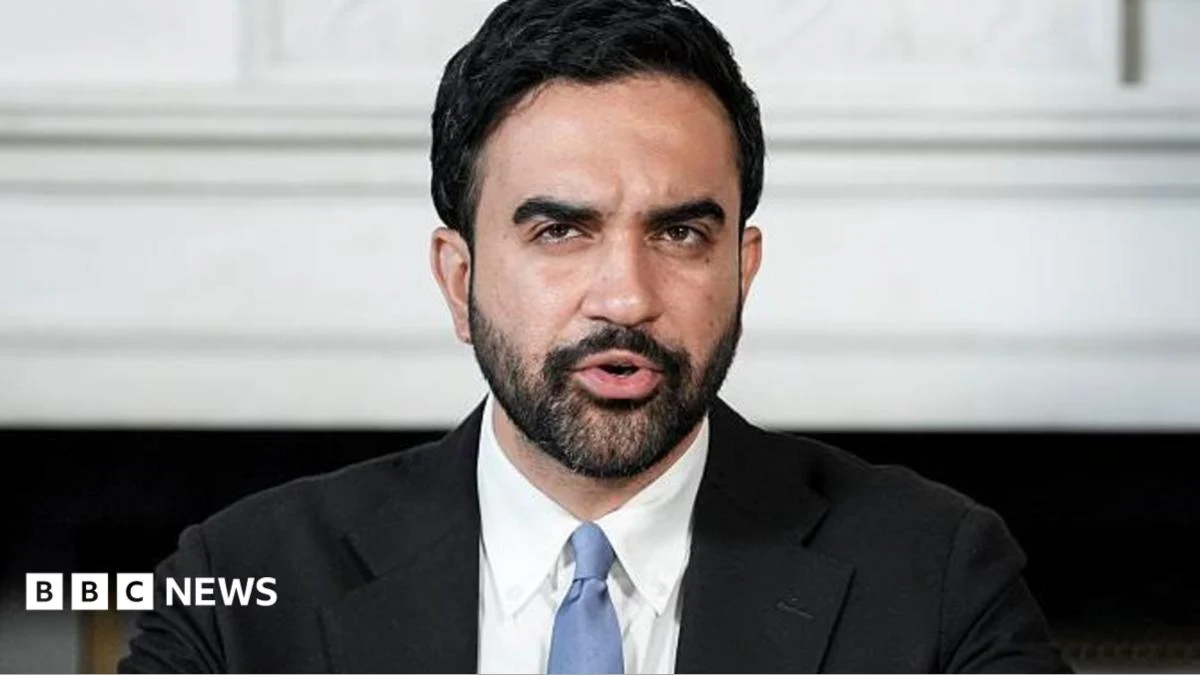
New York City Mayor Recalibrates Stance on Netanyahu Arrest, Citing Lack of Authority While Urging Federal Action on ICC Warrant
New York City Mayor Zohran Mamdani, who had previously made a high-profile pledge to order the arrest of Israeli Prime Minister Benjamin Netanyahu should he visit the city, has now publicly stated he lacks the independent legal authority to do so. This significant reversal, conveyed through a video message on social media, redirects the onus onto the United States federal government, urging it to join the International Criminal Court (ICC) and enforce the body’s arrest warrant against the Israeli leader. The mayor’s evolving position underscores the complex interplay between local political will, international legal frameworks, and national sovereignty, particularly given the United States’ non-membership in the ICC.
Mamdani’s Evolving Position: From Campaign Pledge to Legal Clarification
Mayor Zohran Mamdani, a prominent progressive voice within New York City politics, first articulated his intention to arrest Benjamin Netanyahu during his mayoral campaign. His rhetoric was consistently strong, repeatedly labeling Netanyahu a "war criminal" and the conflict in Gaza a "genocide." Speaking to the New York Times as a candidate, Mamdani had explicitly stated, "This is something that I intend to fulfill," asserting that such an arrest would honor a warrant issued by the ICC. These statements resonated with a segment of the city’s electorate increasingly critical of Israeli actions in the Palestinian territories and supportive of international accountability.
However, the practicalities of enforcing an international arrest warrant at a municipal level quickly became apparent upon closer scrutiny. On Tuesday, Mamdani released a social media video addressing the issue, revealing that his team had undertaken an extensive review of "every avenue available" under the law. This comprehensive legal assessment, likely involving consultations with legal experts and municipal counsel, led to the conclusion that the City of New York does not possess the "independent legal authority to enforce this" warrant. The mayor’s acknowledgment highlights a fundamental limitation of local jurisdiction in matters pertaining to international law and foreign policy, which typically fall under the purview of federal governments.
Despite this legal constraint, Mamdani maintained his strong disapproval of Netanyahu’s potential visit, stating unequivocally that the Israeli Prime Minister was "not welcome" in New York City. Netanyahu is widely expected to travel to the city in September for the annual United Nations General Assembly (UNGA), an event that traditionally draws world leaders and high-level diplomatic delegations. The mayor’s video concluded with a direct appeal to the federal government, urging it to "join the ICC and execute this warrant," effectively shifting the burden of enforcement from the municipal to the national level.
The International Criminal Court and the Netanyahu Warrant
The International Criminal Court, established by the Rome Statute in 2002, is a permanent international court with the mandate to prosecute individuals for the most serious international crimes: genocide, crimes against humanity, war crimes, and the crime of aggression. Its jurisdiction extends to crimes committed on the territory of states party to the Rome Statute, or by nationals of those states. It acts as a court of last resort, intervening only when national courts are unwilling or unable to genuinely investigate or prosecute such crimes.
In May 2024, the ICC’s chief prosecutor, Karim Khan, announced that he had applied for arrest warrants for Benjamin Netanyahu, as well as for Israel’s Defense Minister Yoav Gallant, and three senior Hamas leaders—Yahya Sinwar, Mohammed Deif, and Ismail Haniyeh. The warrants for Netanyahu and Gallant are based on allegations of war crimes and crimes against humanity committed in the Gaza Strip since October 7, 2023. These allegations include starvation of civilians as a method of warfare, willfully causing great suffering, willful killing, intentionally directing attacks against a civilian population, and extermination. The prosecutor emphasized that "no one is above the law" and that "the rule of law is the only way out of the current crisis."
Israel, like the United States, is not a signatory to the Rome Statute and does not recognize the ICC’s jurisdiction. Israeli officials have vehemently rejected the warrants, calling them a "moral outrage" and an act of "antisemitism." Prime Minister Netanyahu himself denounced the move as a "disgraceful" and "absurd" attempt to equate democratically elected leaders with terrorists, vowing that Israel would never accept the court’s authority. This stance aligns with Israel’s long-held position that it possesses a robust and independent judicial system capable of investigating and prosecuting alleged crimes, rendering the ICC’s intervention unnecessary and illegitimate.
The warrants against the Hamas leaders are for charges including extermination, murder, hostage-taking, rape and other forms of sexual violence, and torture. The simultaneous application for warrants against both Israeli and Hamas figures underscores the ICC’s attempt to maintain impartiality and apply its mandate to all parties alleged to have committed international crimes, regardless of their political affiliation or national origin.
The United States’ Stance and Federal Authority
The United States has a complicated and often contentious relationship with the International Criminal Court. Despite its historical support for international justice and accountability, the U.S. has consistently refused to ratify the Rome Statute, citing concerns about potential politically motivated prosecutions of American service members and officials. This position has been maintained across multiple administrations, with both Democratic and Republican presidents expressing reservations about surrendering U.S. sovereignty to an international body. The American Servicemembers’ Protection Act of 2002, for instance, even authorized the use of military force to free any U.S. or allied personnel detained by the ICC, famously dubbed the "Hague Invasion Act."
Given the U.S.’s non-membership, the federal government is under no legal obligation to enforce an ICC arrest warrant. This was emphatically reiterated by former President Donald Trump, who, in a Truth Social post, declared that Netanyahu would not be "arrested, in any way, shape or form" while in the U.S. Trump’s statement came in direct response to Mamdani’s earlier comments and sought to provide a clear federal position. Trump’s defense of Netanyahu went further, contextualizing the Israeli Prime Minister’s actions as "fighting against the Islamic Republic of Iran, which recently killed 52,000 innocent protestors [sic], and has spent the last 47 years killing American Soldiers, and others." While Iran’s human rights record and its destabilizing actions in the Middle East are well-documented, the direct linkage to Netanyahu’s alleged war crimes in Gaza is a specific framing designed to bolster his ally and critique the ICC’s intervention.
Mayor Mamdani’s call for the federal government to join the ICC and execute the warrant highlights a significant point of contention within U.S. foreign policy and domestic political discourse. Should the U.S. federal government decide to act on such a warrant, it would involve a profound shift in its international legal posture. While the federal government possesses the necessary diplomatic and law enforcement capabilities (e.g., through agencies like the FBI or State Department) to facilitate such an arrest if it chose to, such a decision would require a complete re-evaluation of its long-standing policy regarding the ICC. It would also necessitate an executive order or legislative action to enable cooperation with the court, which is currently precluded by existing U.S. law. The likelihood of such a dramatic policy reversal, especially under the current political climate, remains exceedingly low.
Political Reactions and Shifting Public Opinion
The mayor’s initial pledge and subsequent clarification have sparked a range of reactions, both domestically and internationally. Danny Danon, the Israeli Ambassador to the UN, offered a swift and sharp rebuke to Mamdani’s initial statements. "You were elected to serve New Yorkers, not Hamas’ propaganda," Danon reportedly told the mayor, encapsulating Israel’s view that such calls are politically motivated and align with anti-Israeli narratives. This response underscores the highly charged nature of the Israeli-Palestinian conflict and the sensitivity surrounding any perceived legitimization of the ICC’s actions against Israeli leadership.
Domestically, Mamdani’s stance also reflects a broader shift in public opinion, particularly within the Democratic Party. A recent poll conducted by the Associated Press and NORC Center for Public Affairs Research indicated a notable increase in the percentage of Democrats who believe the U.S. is "too supportive" of Israel. The poll, conducted in April 2024, found that 58% of Democrats now hold this view, a significant rise from 45% just a year prior. This shift is widely attributed to the intense humanitarian crisis in Gaza, the extensive civilian casualties, and widespread concerns about Israel’s military conduct following the October 7 attacks by Hamas.
The generational divide is also a critical factor, with younger Democrats and progressive voters exhibiting stronger sympathy for Palestinians and a more critical view of Israeli policies. This demographic trend has significant implications for electoral politics, particularly in cities like New York, where progressive movements hold substantial sway. Politicians like Mamdani, who align with these sentiments, often find themselves navigating a delicate balance between local constituent demands and the broader contours of U.S. foreign policy.
Legal and Diplomatic Ramifications of a Hypothetical Arrest
The question of arresting a sitting head of state, particularly one holding an ICC warrant, presents a complex web of international law, diplomatic protocol, and national sovereignty. While diplomatic immunity generally protects heads of state from arrest and prosecution in foreign countries, this immunity is often understood to be limited when it comes to allegations of grave international crimes like war crimes, genocide, or crimes against humanity. The principle of universal jurisdiction, which allows national courts to prosecute individuals for certain egregious crimes regardless of where they were committed or the nationality of the perpetrator or victim, also plays a role. However, the enforcement mechanism typically requires the cooperation of the state where the individual is present.
For a non-ICC member state like the U.S., the enforcement of an ICC warrant is not legally binding. Any action taken would be voluntary and would signify a major foreign policy decision. Should Netanyahu attend the UN General Assembly in September, he would typically be afforded diplomatic protections associated with his status as a head of state visiting the UN headquarters. However, the existence of an active ICC warrant would undoubtedly cast a shadow over his visit, potentially leading to protests and renewed calls for his arrest from various advocacy groups.
The symbolic weight of a mayor’s statement, even if legally non-binding, should not be underestimated. It contributes to the global narrative surrounding the ICC warrant, putting pressure on both the Israeli government and the U.S. federal government. It also highlights the growing international isolation of leaders facing such warrants, even when traveling to non-ICC member states.
Conclusion
Mayor Zohran Mamdani’s public retraction of his pledge to arrest Benjamin Netanyahu, while legally mandated, represents a significant moment in the ongoing debate over international justice and national sovereignty. It underscores the limitations of local authority in enforcing international law and shifts the spotlight onto the U.S. federal government, which continues to resist full engagement with the International Criminal Court. As Netanyahu prepares for his anticipated visit to the UN General Assembly, the controversy surrounding the ICC warrant and the differing stances of local and national officials serve as a stark reminder of the deeply entrenched divisions and complex legal challenges inherent in holding powerful figures accountable for alleged international crimes. The episode also reflects the broader dynamics of shifting public opinion and the increasing pressure on political leaders to address human rights concerns within the context of global conflicts.

Related Posts
Zambia on Edge: Opposition Leader Arrested Amid Allegations of Insurrection Plot and Election Tensions
Rescuers search for survivors of powerful Indonesia earthquake

