
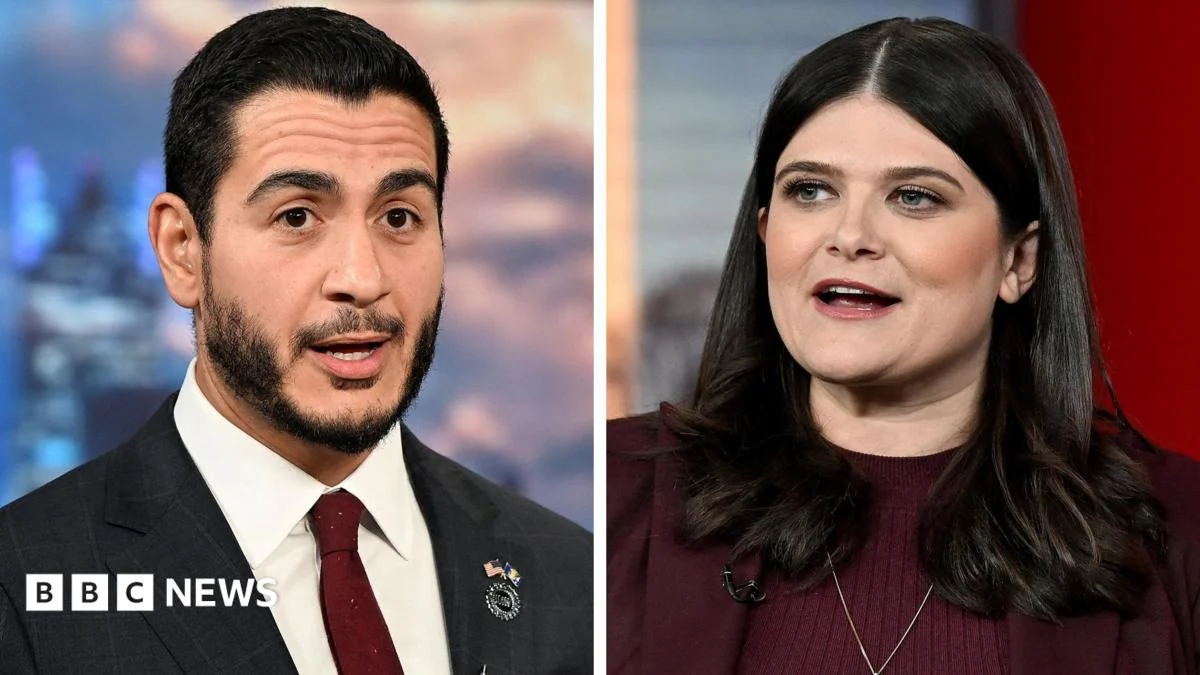
Left-wing political outsider Abdul El-Sayed wins Democratic Senate primary in Michigan
The former public health official secured a narrow victory over moderate Democratic congresswoman Haley Stevens, according to projections from CBS News, the BBC’s US partner, following a fiercely contested primary that underscored the ideological fault lines within the Democratic Party. El-Sayed’s win marks a significant moment for the progressive movement and sets the stage for a high-stakes general election battle in November. "In the words of Mohammad Ali, ‘We shook up the world,’" El-Sayed declared, echoing the legendary boxer’s iconic statement after his unexpected defeat of Sonny Liston in 1964, encapsulating the spirit of his underdog campaign. He will now face Republican Mike Rogers, a staunch ally of former President Donald Trump, in the upcoming midterm elections. If successful in November, El-Sayed would make history as the first Muslim to serve in the United States Senate, a symbolic achievement reflecting the nation’s evolving political landscape.
A Primary Defined by Ideology and a Razor-Thin Margin
The final outcome of the primary was considerably closer than anticipated by El-Sayed’s campaign, revealing the deep divisions and competitive spirit within the Michigan Democratic electorate. As of late Wednesday morning, fewer than 15,000 votes separated El-Sayed from Stevens, representing a margin of just under 1 percentage point out of more than 1.5 million ballots cast statewide. This tight result suggests a Democratic base grappling with its identity and future direction, oscillating between the pragmatic centrism advocated by Stevens and the bold progressive vision championed by El-Sayed.
Throughout his campaign, El-Sayed consistently championed a platform rooted in progressive principles, advocating for policies such as universal healthcare, often referred to as "Medicare for All," and reforms aimed at reducing the influence of corporate money in politics. "The movement to get money out of politics, put money in your pocket, and pass Medicare for All is a big movement," El-Sayed reiterated on Wednesday, underscoring the core tenets that fueled his grassroots support. His campaign successfully mobilized a coalition of younger voters, urban progressives, and activists eager for systemic change.
Conversely, Haley Stevens, a sitting U.S. Congresswoman representing Michigan’s 11th congressional district, positioned herself as the pragmatic, middle-of-the-road candidate. Her campaign focused on issues like safeguarding manufacturing jobs in Michigan, a critical economic concern in the state, and appealing to a broader spectrum of voters, including those who might be undecided or wary of more radical political shifts. Stevens garnered significant endorsements from establishment figures within the party, including Michigan Governor Gretchen Whitmer and the outgoing Senator Gary Peters, whose seat El-Sayed is now vying for.
Michigan’s Pivotal Role in National Politics
Michigan holds immense strategic importance in the national political arena, frequently serving as a crucial swing state that can determine the balance of power in Washington. Historically, the state has exhibited a tendency to shift allegiances, famously voting for Donald Trump in 2016 after decades of backing Democratic presidential candidates, only to return to the Democratic column for Joe Biden in 2020. This volatility makes the Michigan Senate race a key battleground in the broader national struggle for control of Congress.
The November midterm elections are particularly critical as they will shape the legislative environment for the remainder of President Donald Trump’s time in office, determining whether he will face a unified opposition or a divided Congress. The Senate, in particular, is a tightly contested chamber, and every seat, especially those in swing states like Michigan, carries immense weight. The current Senate seat in Michigan is held by a retiring Democrat, making its retention a top priority for the party. The last time the Midwestern state elected a Republican senator was in 1994, a historical statistic that both parties will undoubtedly leverage in their general election campaigns.
The Clash Over Foreign Policy: A Defining Rift
One of the most pronounced points of contention between El-Sayed and Stevens was their divergent stances on foreign policy, particularly regarding the United States’ relationship with Israel. El-Sayed adopted a critical posture towards U.S. involvement in the Middle East, including the provision of aid to Israel, advocating for a reevaluation of American foreign policy in the region. His position resonated with a segment of the progressive base and some within Michigan’s diverse communities.
In stark contrast, Stevens maintained a staunchly pro-Israel stance, unequivocally supporting the continuation of U.S. aid to Israel without conditions. This alignment with traditional Democratic foreign policy views on the Middle East earned her support from other factions within the party and the broader pro-Israel community. El-Sayed’s candidacy, due to his views on the US-Israel relationship, drew both strong support and opposition from Michigan’s Jewish community, highlighting the complexity and sensitivity of the issue.
El-Sayed has consistently rejected allegations of anti-Semitism, which were renewed by former President Trump in his Truth Social post following the primary results. Responding to these accusations, El-Sayed stated on Wednesday, "I stand in solidarity with my Jewish sisters and brothers. We can condemn anti-Semitism and at the same time, we can be talking about how we bring people together, and we can be talking about everybody’s pain." This nuanced position seeks to separate criticism of Israeli government policies from anti-Jewish sentiment, a distinction often blurred in political discourse.
Reactions and the Path Forward
Following the declaration of the primary results, both candidates addressed their supporters and the public, outlining their immediate responses and the path ahead. In a display of party unity, Haley Stevens graciously conceded the race and pledged her support for El-Sayed in the general election. "I want to congratulate Abdul El-Sayed on winning the Democratic nomination for US Senate," Stevens said in her statement. "He is a doctor, a community health official, a Rhodes Scholar, and a dedicated Michigander. I am proud to offer my support as he takes on Mike Rogers in the general election." Her swift endorsement is crucial for rallying moderate Democrats behind El-Sayed, a necessary step for the party to present a united front against the Republican challenger.
Abdul El-Sayed, despite the closer-than-expected margin, emphasized the need for party cohesion in the battle against Mike Rogers. Addressing his supporters on Tuesday night, even before the final outcome was known, El-Sayed hinted at bridge-building efforts: "Whatever happens tonight, we have a responsibility to ensure that we unite, unite to make sure that [Republican] Mike Rogers never sees the inside of the US Senate." This call for unity underscores the strategic imperative for Democrats to overcome internal divisions and focus on the common goal of securing the Senate seat.
The Republican camp, meanwhile, wasted no time in seizing on the primary results. Former President Donald Trump, in a characteristic move, declared the Michigan Senate result "Great news for the Republican Party." In his post on Truth Social, Trump referred to the Democratic Party as the "Dumocrats" and claimed their "crazy policies will only get worse!" He also reiterated allegations of anti-Semitism against El-Sayed, setting an aggressive tone for the upcoming general election campaign. This immediate Republican response signals that the race will likely be highly nationalized, with El-Sayed’s progressive stances and Trump’s influence on Mike Rogers becoming central themes.
The General Election: El-Sayed vs. Rogers
The November general election will pit El-Sayed’s progressive platform against the conservative agenda of Mike Rogers. Rogers, a former U.S. Representative and an intelligence professional, is a well-known figure in Michigan politics and a vocal supporter of Donald Trump. His campaign is expected to focus on traditional Republican themes, including fiscal conservatism, national security, and criticisms of what he will likely portray as El-Sayed’s "radical" policies. The contrast between the two candidates could not be starker, offering Michigan voters a clear choice between two distinct political philosophies.
For El-Sayed, the challenge will be to translate his primary victory, driven by an energized progressive base, into a broader coalition capable of winning a statewide general election in a swing state. This will require not only uniting the Democratic Party, including the moderate voters who supported Stevens, but also appealing to independent voters and disaffected Republicans. His campaign will likely emphasize his public health background, his commitment to improving the lives of working-class Michiganders, and his vision for a more equitable society. He will also need to effectively counter Republican attacks that will undoubtedly seek to paint him as too far left for Michigan.
Mike Rogers, on the other hand, will aim to capitalize on any lingering Democratic divisions and draw support from Trump’s base, while also trying to appeal to suburban voters who might be wary of extreme partisanship. The race is expected to be one of the most closely watched and expensive Senate contests in the nation, with significant outside spending from national party committees and super PACs. The outcome will not only determine a crucial Senate seat but also serve as a barometer for the national political mood ahead of future elections.
Broader National Context: A Pattern of Ideological Contests
The Michigan primary is not an isolated event but rather a reflection of broader trends in American politics. Across the country, primary elections held on the same Tuesday night showcased similar ideological battles and partisan divides. In Kansas, Democratic State Senator Cindy Holsher and Trump-backed Republican legislator Ty Masterson advanced in the governor’s race, indicating the strong influence of both progressive and Trump-aligned factions within their respective parties.
In Ohio, Congressman Wesley Bell defeated former Congresswoman Cory Bush in a Democratic primary also significantly defined by the candidates’ diverging stances on the US-Israel relationship, mirroring the debate seen in Michigan. This suggests that foreign policy, particularly concerning the Middle East, is increasingly becoming a litmus test in Democratic primaries.
Furthermore, Missouri voters rejected a Republican-backed amendment that would have made it significantly harder to change the state’s constitution by raising the bar for passing citizen-led ballot initiatives. This outcome highlights the ongoing struggle over democratic processes and the power of grassroots movements to defend direct democracy. Collectively, these primary results underscore a political landscape characterized by deep ideological chasms, intense partisan competition, and a highly engaged electorate grappling with the fundamental direction of the country. Abdul El-Sayed’s victory in Michigan is a testament to the growing influence of the progressive wing within the Democratic Party and sets the stage for a compelling and consequential general election.

Related Posts
Zambia on Edge: Opposition Leader Arrested Amid Allegations of Insurrection Plot and Election Tensions

Rescuers search for survivors of powerful Indonesia earthquake

