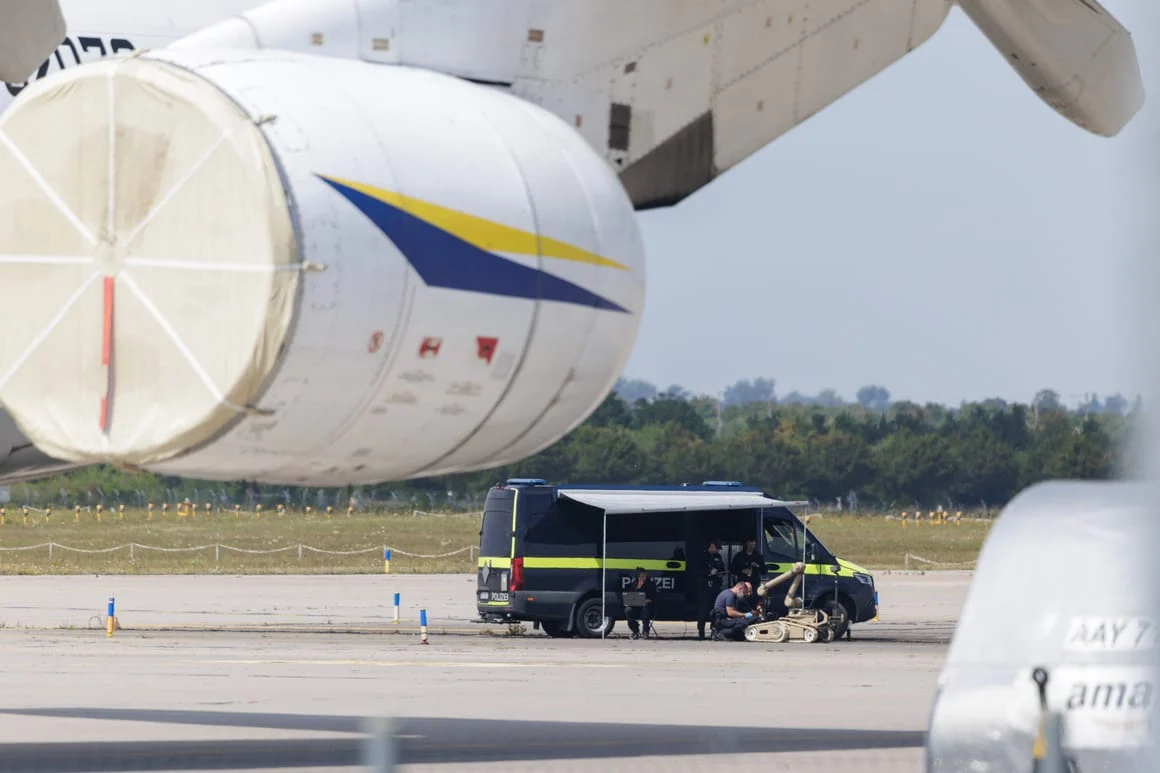
Semtex-laden drone found just meters from a Ukrainian aircraft at Leipzig airport failed to detonate
German counterterrorism authorities have launched a high-stakes investigation into a suspected sabotage attempt at Leipzig/Halle Airport after an explosive-laden drone was discovered in a restricted cargo zone late Tuesday. The incident, which triggered a significant security mobilization and forced the temporary suspension of flight operations at one of Europe’s most vital logistics hubs, has sparked intense scrutiny over the vulnerability of critical infrastructure to remote-piloted threats.
The drone, which investigators confirmed was rigged with Semtex—a potent plastic explosive historically linked to major aviation disasters—was discovered in the immediate vicinity of a Ukrainian Antonov transport aircraft. While official sources indicate that a malfunction in the device’s detonator prevented a catastrophe, the proximity of the explosive to a high-value aviation asset has led security officials to categorize the event as a deliberate attempt to cause significant destruction and loss of life.
A Chronology of the Security Breach
The sequence of events began late Tuesday, August 5, 2026, when an airport employee identified a suspicious object within the restricted cargo perimeter. Upon the alarm being raised, the Dresden Public Prosecutor’s office and the Saxony State Police were immediately dispatched to the scene.
Specialized bomb disposal units deployed a remote-controlled robot to inspect the device. Upon confirming the presence of volatile explosives, officers successfully neutralized the threat by removing the detonator. This discovery forced an immediate shift in airport operations. During the ensuing scramble to secure the facility, several flights were diverted to alternative airports, including Hanover.
The chaos of the diversion led to a secondary, though less lethal, incident. A DHL cargo aircraft, while climbing away from the airport during the suspension of normal traffic, reportedly struck an unidentified flying object. Upon landing safely in Hanover, ground crews discovered structural damage to the aircraft’s nose, suggesting a collision that may have been related to the unauthorized drone activity occurring in the airspace above the facility.
The Nature of the Explosive Threat
The use of Semtex in this attempted attack carries significant psychological and tactical weight. As a plastic explosive, Semtex is notoriously difficult to detect and possesses a high degree of stability, making it a preferred choice for state-sponsored or high-level insurgent actors. Its historical association with the 1988 bombing of Pan Am Flight 103 over Lockerbie serves as a grim reminder of the catastrophic potential of such devices when utilized against civilian aviation.
Security experts note that the deployment of a drone capable of carrying such a payload requires more than basic hobbyist knowledge. The technical sophistication required to navigate restricted airspace, evade detection, and approach a specific target like a stationary Antonov transport implies a high degree of planning and reconnaissance.
Official Responses and Political Repercussions
The gravity of the situation prompted a swift response from the highest levels of the German government. Interior Minister Alexander Dobrindt cut short his vacation in Italy to coordinate directly with local authorities in Leipzig. Meanwhile, Saxony’s Interior Minister, Armin Schuster, characterized the event as a “very serious security incident,” reflecting the growing anxiety within the German administration regarding the integrity of its transportation network.

Diplomatic tensions have also flared in the wake of the discovery. Ukraine’s ambassador to Germany, Oleksii Makeiev, did not shy away from pointing fingers at the Kremlin. In a public statement, Makeiev questioned the likelihood of any other actor possessing the motivation and capability to execute such a precise strike against Ukrainian-linked assets on German soil. "I hope that all the authorities in Germany will now establish the facts as well," Makeiev stated on WELT TV. "But who else could it have been besides Russia?"
The Russian embassy in Berlin has maintained silence regarding the allegations, offering no immediate comment to the media. This absence of denial, while not an admission of guilt, has done little to assuage the fears of European security analysts who have long warned that the ongoing war in Ukraine could spill over into the form of hybrid warfare, sabotage, and covert operations across the continent.
Leipzig Airport: A Strategic Target
Leipzig/Halle Airport is far more than a regional transit point; it is a linchpin of European supply chains. As the primary European hub for DHL, the airport processes millions of tons of cargo annually. Furthermore, it serves as a critical maintenance and logistical base for Ukrainian Antonov aircraft, which are vital for transporting heavy-lift equipment, humanitarian aid, and defense-related materials.
The choice of target is unlikely to be coincidental. By attempting to sabotage a Ukrainian aircraft at a German facility, the perpetrators may have been seeking to achieve three objectives: disrupt the logistical support chain for Ukraine, sow terror within a NATO-member state, and demonstrate the vulnerability of critical European aviation infrastructure to small, unmanned aerial systems (UAS).
Broader Implications for Aviation Security
The incident in Leipzig represents a dangerous escalation in the use of drones for asymmetrical warfare. For years, European security agencies have been upgrading their radar systems and anti-drone protocols to account for the proliferation of consumer-grade and militarized UAVs. However, the success of the drone in reaching the cargo area highlights significant gaps in the current defensive posture.
Following this breach, several implications for the future of aviation security have emerged:
- Hardening of Cargo Zones: Airports are likely to transition toward more stringent perimeter security, including the installation of localized drone jamming technology and expanded low-altitude radar coverage specifically designed to detect small, low-radar-cross-section targets.
- Increased Surveillance of Ukrainian-linked Assets: Given the geopolitical climate, assets associated with the Ukrainian military or logistical effort are likely to receive elevated security status, potentially requiring dedicated air-side protection.
- Policy Shifts: The incident will almost certainly accelerate legislative efforts in the Bundestag to provide law enforcement with broader powers to intercept, jam, or neutralize unauthorized drones, even in civilian airspace.
- Heightened Alert for Sabotage: European intelligence services are expected to increase monitoring of suspicious activity near critical infrastructure, as the "low-cost, high-impact" nature of drone-based sabotage becomes a standard threat profile.
As of Wednesday evening, the investigation remained in its early stages. No suspects had been detained, and police are currently analyzing flight logs, drone telemetry, and surveillance footage to determine the launch point of the device. The failure of the detonator remains the only factor that prevented a potentially mass-casualty event, a realization that has left local communities and aviation authorities on high alert.
The investigation is being treated as a matter of national security, with the German Federal Criminal Police Office (BKA) expected to play a larger role in the coming days. For now, the events at Leipzig stand as a stark, chilling warning: the theater of modern conflict is no longer confined to the front lines, but has expanded to the very gates of the world’s most vital logistical hubs. As investigators comb the cargo apron for forensic evidence, the shadow cast by this attempted attack will likely force a fundamental reassessment of how Europe protects its skies in an era of unmanned, invisible, and explosive threats.