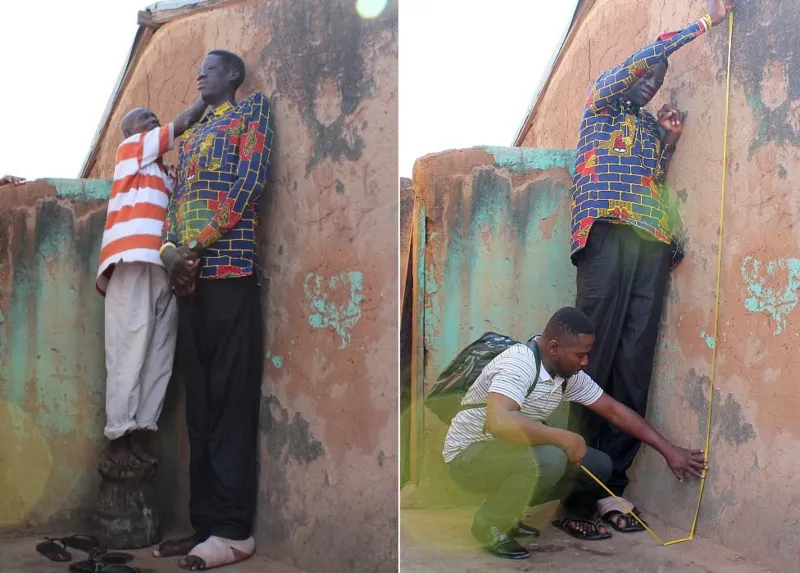
Ghana’s tallest man Sulemana Abdul Samed popularly known as Awuche has died at the age of 33.
The passing of the iconic figure, who became a symbol of resilience and local pride in northern Ghana, was confirmed on Tuesday evening. Sulemana Abdul Samed, affectionately known to his community as Awuche—a Hausa term translating to "Let’s Go"—breathed his last on Monday morning at the Tamale Teaching Hospital. His death marks the end of a long, arduous struggle with a rare genetic condition that fundamentally altered his life trajectory, turning him from an aspiring driver into a national celebrity whose height captured the curiosity and sympathy of the world.
The Final Days and Medical Struggle
Awuche’s final weeks were spent under medical observation at the Tamale Teaching Hospital, approximately 160 kilometers from his home village of Gambaga. He had been admitted to the facility to receive specialized treatment for severe, infected sores on his legs. These complications, while not directly caused by Marfan syndrome—the underlying genetic disorder he was diagnosed with in his early 20s—were identified by medical professionals as secondary complications arising from the physiological strain the condition placed on his body.
Despite initial reports suggesting he was responding well to the medical regimen provided by the hospital staff, his condition deteriorated rapidly. The loss has left the Gambaga community in a state of profound shock and mourning. Sulemana Abdul Kudus, a close relative, expressed the sentiment of a community that saw in Awuche not just a man of extraordinary proportions, but a beacon of kindness. "Everyone knew how generous and kind he was. From when he died until now, a lot of people are still coming to the house to find out what exactly happened," Kudus stated, reflecting on the vacuum left by the gentle giant.
A Life Defined by Rapid Transformation
To understand the life of Awuche, one must look at the timeline of his physiological transformation, which began abruptly when he was 22 years old. Before this period, he was an active, healthy young man working in the bustling environment of a butcher’s shop in Accra, Ghana’s capital. He harbored ambitions of becoming a professional driver, a goal that required mobility and physical stamina.
The turning point occurred with alarming speed. Awuche once recounted the frightening onset of his symptoms to the BBC, describing a sensation of his tongue expanding within his mouth to the point where he struggled to breathe. Within a matter of days, the growth accelerated throughout his body. This rapid, uncontrolled expansion of limbs and stature led to his diagnosis with Marfan syndrome. The condition is a genetic disorder that affects the connective tissue, providing structural support to the body’s organ systems. In the case of Marfan syndrome, the lack of proper protein in the connective tissue often leads to excessive height and skeletal abnormalities.
The diagnosis necessitated a complete abandonment of his life in Accra. Nine years ago, he returned to his roots in Gambaga, as his condition rendered him unable to pursue the career he had once envisioned. The physical toll was immense; once an avid footballer who enjoyed the agility of youth, he eventually found himself unable to traverse even short distances without significant pain and exhaustion.
Marfan Syndrome and Gigantism: Medical Context
The medical community identifies Marfan syndrome as a condition that affects approximately one in every 5,000 people. While many individuals with the syndrome live full lives with proper management, severe cases—like that of Awuche—can result in dramatic growth spurts, cardiovascular issues, and complications in the joints and extremities.
When measured by the BBC in late 2022, Awuche stood at an imposing 7ft 4in (223cm). However, there is a widely held belief among those close to him that he may have continued to grow in the months leading up to his death, potentially pushing his stature to even greater heights. This, combined with the weight of his own body and the stress placed on his circulatory system, made his daily existence a constant medical challenge. The sores on his legs, which ultimately led to his hospitalization, are common in individuals with such extreme stature, as the body struggles to provide adequate blood circulation to the lower limbs.

Public Support and the Role of Philanthropy
The logistical and financial burden of managing such a rare, complex condition proved too much for a single family. In recent months, Awuche’s medical journey became a subject of public concern, drawing the attention of notable figures in Ghanaian society.
The financial strain of his medical bills was significantly eased through the intervention of businessman Ibrahim Mahama, the brother of former Ghanaian President John Dramani Mahama. Mr. Mahama’s support allowed for sustained care at the Tamale Teaching Hospital. Earlier this month, prior to his passing, reports indicated that there were ongoing discussions regarding the next steps for his treatment. His benefactor had been actively involved in ensuring that Awuche received the best possible care, highlighting the broader societal responsibility often triggered by cases of extreme medical need in developing regions.
A Legacy Beyond Physical Stature
For the people of Gambaga, Awuche was more than just a medical anomaly; he was a local ambassador. His family noted that his fame provided the village with a distinct identity. Whenever he traveled within the country, he was a walking billboard for his home, proudly identifying as a son of Gambaga.
"Anywhere he found himself in the country and they asked him, he would say he is from Gambaga, and people knew that was where the tallest man was from," Kudus noted. This sense of pride was mutual. Despite the isolation often brought on by his condition, Awuche embraced his celebrity status with a positive demeanor. He became a figure of curiosity that bridged the gap between his small rural community and the wider world, demonstrating a grace and humor that endeared him to those who met him.
Funeral Arrangements and Community Impact
The logistics of laying such a unique individual to rest have proven as complex as his life. The family has made the difficult decision to bury him in Tamale, rather than returning his body to his hometown of Gambaga. This decision was driven by practical concerns regarding the massive influx of mourners expected to pay their final respects.
Local authorities and community leaders anticipate that a funeral in Gambaga would be overwhelmed by the sheer volume of people wishing to see the "gentle giant" one last time. By choosing a location in Tamale, the family hopes to maintain some level of order and solemnity during the interment process.
Broader Societal Implications
The death of Sulemana Abdul Samed serves as a poignant reminder of the health disparities and the challenges faced by those living with rare genetic disorders in parts of the world where specialized, long-term care is difficult to access. His journey from a thriving worker in the capital to a home-bound man in the north highlights the need for better diagnostic awareness and more robust support systems for individuals with complex, chronic conditions.
Furthermore, his story brings into focus the importance of community and familial support in the face of insurmountable medical odds. While his life was cut short at 33, his legacy remains etched in the collective memory of his village and the national consciousness of Ghana. As the community prepares to lay him to rest, they do so not just for the tallest man in the country, but for a man who, despite his physical struggles, stood tall in the hearts of those who knew him.
The story of Awuche is one of struggle, dignity, and the enduring human spirit. His life challenges the public to look past the superficial—in his case, his extraordinary height—and recognize the humanity and the challenges faced by individuals living with invisible or, in his case, highly visible medical burdens. As the dust settles on the streets of Gambaga, the absence of the man who put the village on the map will be felt deeply, marking the end of an era for a community that had come to view him as one of their own greatest, and most resilient, icons.