EU: Tunisia Migration Deal Worsening Human Rights Violations
A coalition of 46 leading human rights and humanitarian organizations issued a comprehensive joint statement today, calling on the European Union and its member states to immediately cease funding for migration control activities in Tunisia and publicly denounce a mounting wave of human rights violations. The collective demand marks the three-year anniversary of the Memorandum of Understanding (MoU) signed on July 16, 2023, a deal brokered by the European Commission to secure Tunisia’s cooperation in preventing migrant departures toward European shores. The organizations, which include Human Rights Watch, Amnesty International, and SOS Humanity, argue that the agreement has not only failed to protect human lives but has actively fueled a "system of abuse" characterized by torture, racial profiling, and collective expulsions.
The joint statement, titled "A Blueprint for Complicity," highlights a stark disconnect between the European Union’s stated values and its operational reality in North Africa. According to the signatories, the EU has effectively externalized its border enforcement to Tunisian security forces that have been documented engaging in reckless conduct at sea and violent repression on land. By providing financial and technical support to these entities, the organizations assert that the EU and its member states are legally and morally complicit in the resulting atrocities.
The Evolution of the EU-Tunisia Migration Partnership
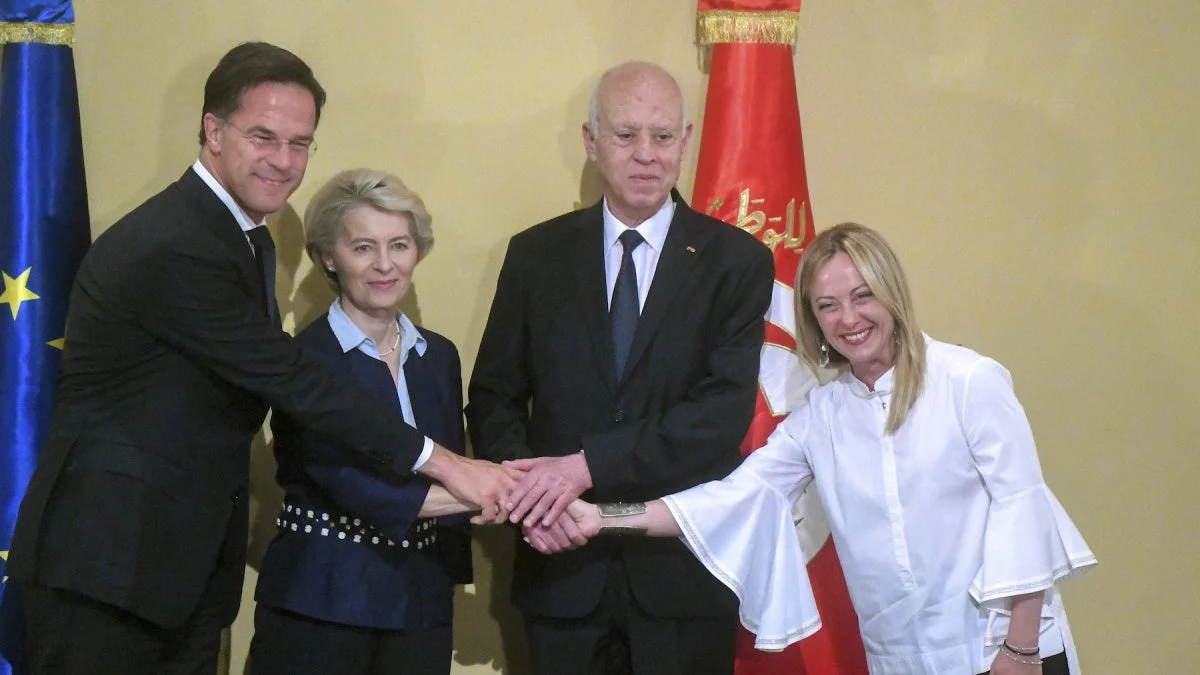
The current friction between humanitarian groups and the European Commission traces back to the rapid negotiation of the MoU in mid-2023. At the time, the "Team Europe" delegation—comprising European Commission President Ursula von der Leyen, Italian Prime Minister Giorgia Meloni, and then-Dutch Prime Minister Mark Rutte—sought a strategic partnership to stabilize the Mediterranean migration route. The deal promised Tunisia hundreds of millions of euros in financial aid, including a specific tranche of EUR 105 million dedicated to border management and anti-smuggling operations.
However, this partnership was forged against a backdrop of deteriorating democratic norms in Tunisia. Since President Kais Saied’s consolidation of power in July 2021, the country has witnessed a systematic dismantling of judicial independence and the criminalization of political dissent. The human rights organizations note that the same security apparatuses receiving EU funds—specifically the Tunisian National Guard and the police—are the primary instruments used by the state to crush domestic opposition and target marginalized migrant communities.
In early 2023, months before the MoU was finalized, President Saied delivered a controversial speech portraying sub-Saharan migration as a "criminal plan" to alter Tunisia’s demographic composition. This rhetoric sparked a surge in racist violence and arbitrary arrests, yet the EU proceeded with the migration deal, prioritizing the reduction of arrivals in Italy over the safety of those seeking international protection.
Financial Support and the Militarization of the Coast Guard
The financial architecture of the EU-Tunisia deal is a central point of contention for the 46 organizations. Of the EUR 105 million allocated for migration, at least EUR 65 million has already been contracted to provide training and equipment to the Tunisian Coast Guard and the Tunisian Maritime Rescue Coordination Centre. This equipment includes patrol boats, thermal imaging cameras, and other surveillance technology intended to increase the rate of interceptions at sea.
Humanitarian groups operating in the Mediterranean, such as SOS Humanity, report that these interceptions are frequently conducted with extreme violence. Marie Michel, a policy expert at SOS Humanity, stated that rescued individuals have shared harrowing accounts of "torture, sexualized violence, and racist abuse" experienced at the hands of Tunisian authorities. Rather than being brought to a place of safety, those intercepted at sea are often forced back into a system of abuse, where they face the risk of being trafficked into Libya or abandoned in the desert regions bordering Algeria and Libya.
The organizations argue that the European Commission has failed to implement effective monitoring mechanisms to ensure that EU-funded equipment is not being used to commit human rights violations. Despite warnings from the European Ombudsman and the European Court of Auditors in 2024 regarding the lack of human rights safeguards in EU funding instruments, the flow of capital and equipment to Tunisian security forces has continued unabated.
The Dismantling of the Asylum System and Civil Society Crackdowns
One of the most alarming developments highlighted in the joint statement is the effective elimination of the right to asylum within Tunisia. In June 2024, Tunisian authorities suspended the activities of the United Nations High Commissioner for Refugees (UNHCR) regarding refugee status determinations. This move has left thousands of asylum seekers in a legal vacuum, trapped in a country that no longer recognizes their status or provides a path to safety.
Simultaneously, the Tunisian government has intensified its crackdown on civil society organizations that provide essential humanitarian aid. Activists and lawyers assisting migrants have faced arrest, prosecution, and administrative harassment. Emma Cabrol, Euro-Mediterranean Regional Director at Avocats Sans Frontières, noted that requests for legal assistance have surged as migrants are subjected to large-scale security operations, arbitrary evictions, and violence from both state and non-state actors.
"The testimonies we collect reveal unprecedented levels of violence," Cabrol said. "With growing barriers to housing, employment, and safe pathways out of the country, many migrants describe their situation as an open-air prison."
The "Safe Country" Designation and International Law
The controversy reached a new peak in February 2026, when the European Union officially added Tunisia to its list of "safe countries of origin." This designation allows EU member states to process asylum claims from Tunisians more quickly and facilitates easier deportations. However, the human rights coalition argues that this classification is a "legal fiction" that ignores the documented reality on the ground.
Under international maritime law, a "place of safety" is defined as a location where rescue operations are considered to terminate, and where the survivors’ safety of life is no longer threatened and their basic human needs can be met. UN experts, the World Organisation Against Torture (OMCT), and various investigative journalists have repeatedly concluded that Tunisia does not meet these criteria. The organizations contend that by labeling Tunisia as "safe," the EU is attempting to bypass its non-refoulement obligations—the international principle that forbids a country from returning asylum seekers to a country where they would likely face persecution.
Documented Abuses: A Pattern of Systemic Violence
The joint statement consolidates evidence from three years of reporting to illustrate a pattern of systemic violence against migrants and refugees. Key violations documented include:
- Reckless Interceptions: Tunisian Coast Guard maneuvers that involve ramming boats, using live ammunition, and seizing engines at sea, leaving passengers adrift.
- Collective Expulsions: The forced transportation of hundreds of Black Africans to remote desert zones without food, water, or medical care, often resulting in deaths from dehydration and exposure.
- Arbitrary Detention and Torture: Reports of sexualized violence and physical abuse within detention centers and during security sweeps in urban centers like Sfax and Tunis.
- Racial Profiling: Systematic targeting of Black individuals, including legal residents and Tunisian nationals, based on the government’s xenophobic rhetoric.
These abuses are not isolated incidents but are viewed by the 46 organizations as the direct consequence of a policy that prioritizes "border externalization" at any cost.
Institutional Critique and Calls for Policy Reversal
The European Commission’s adherence to the MoU has drawn criticism from within the EU’s own institutional framework. In 2024, the European Court of Auditors warned that the EU’s migration funding lacked transparency and that the impact on human rights was not being adequately assessed. Similarly, the European Ombudsman opened an inquiry into how the Commission ensures that human rights are respected in the context of the Tunisia deal.
Despite these internal alarms, the Commission has maintained that cooperation with Tunisia is essential for managing migration and preventing loss of life at sea. Critics, however, point out that the number of deaths on the Mediterranean route remains high, and the "prevention" of departures often simply means pushing the violence further from European eyes.
The coalition of organizations is now demanding a fundamental shift in the EU’s engagement with Tunisia. They are calling for:
- Immediate Suspension of Funding: A halt to all financial and operational support for Tunisian border control until human rights benchmarks are met.
- Public Denunciation: A clear and public condemnation of the crackdown on civil society and the abuse of migrants by Tunisian authorities.
- Human Rights Benchmarks: The establishment of transparent, enforceable criteria for any future cooperation, including the restoration of UNHCR’s mandate and the protection of NGOs.
- Accountability Mechanisms: Independent investigations into the use of EU-funded equipment in the commission of human rights violations.
Conclusion: The Choice Between Control and Values
As the EU-Tunisia deal enters its fourth year, the joint statement by these 46 organizations serves as a severe indictment of European migration policy. The coalition argues that the EU cannot continue to portray itself as a champion of human rights and the rule of law while simultaneously bankrolling an authoritarian regime that utilizes violence as a tool of migration management.
"The EU cannot pretend to champion human rights while deepening cooperation with Tunisian authorities responsible for crushing dissent and abusing migrants," said Friederike Mager, Senior Coordinator for EU Advocacy at Human Rights Watch. The organizations conclude that without a radical change in direction, the EU risks not only its moral standing but also its legal integrity, as it becomes increasingly entrenched in a system that sacrifices human lives for the sake of border security.
The situation in Tunisia remains a critical test for the European Union’s foreign policy. Whether the EU will heed the warnings of the humanitarian community or continue to prioritize its migration deal with President Saied will likely define its relationship with the broader North African region for years to come. For the thousands of migrants and refugees currently trapped in what they describe as an "open-air prison," the outcome of this policy debate is a matter of life and death.

Related Posts
Human Rights Watch Calls for Investigation into Death of Detainee Following Removal from Najaf Hospital by Iraqi Drug Police
Human Rights Watch Urges UN Security Council to Extend Lebanon Peacekeeping Mission Amid Escalating Conflict and Humanitarian Crisis