Argentine Couple in Ceuta Describes Unprecedented Migratory Surge, Highlighting Humanitarian Concerns Amidst Political Tensions
The clock strikes eight in the evening, and the voices of Rosario Álvarez Gaona and Miguel Palomo Montero, an Argentine couple who have resided in Ceuta for 23 years, carry a palpable sense of urgency over the telephone. Their distress is understandable. Despite having witnessed two previous significant migratory influxes that profoundly impacted the small Spanish enclave – one in 2005 and another in May 2021 – they assert to LA NACION that nothing could have prepared them for the scale of the events unfolding in recent days.
"It has never been this overwhelming. The intensity has been steadily increasing, the numbers have been climbing," states Miguel, a 56-year-old native of Lomas de Zamora, who now holds dual Argentine and Spanish nationality. He and his wife Rosario, originally from Mendoza, have lived in Spain since 2000 and in Ceuta since 2003. The Argentine community in Ceuta is small, estimated at around twenty individuals. Miguel works in the city’s public lighting department, while Rosario is employed at the local bar association.
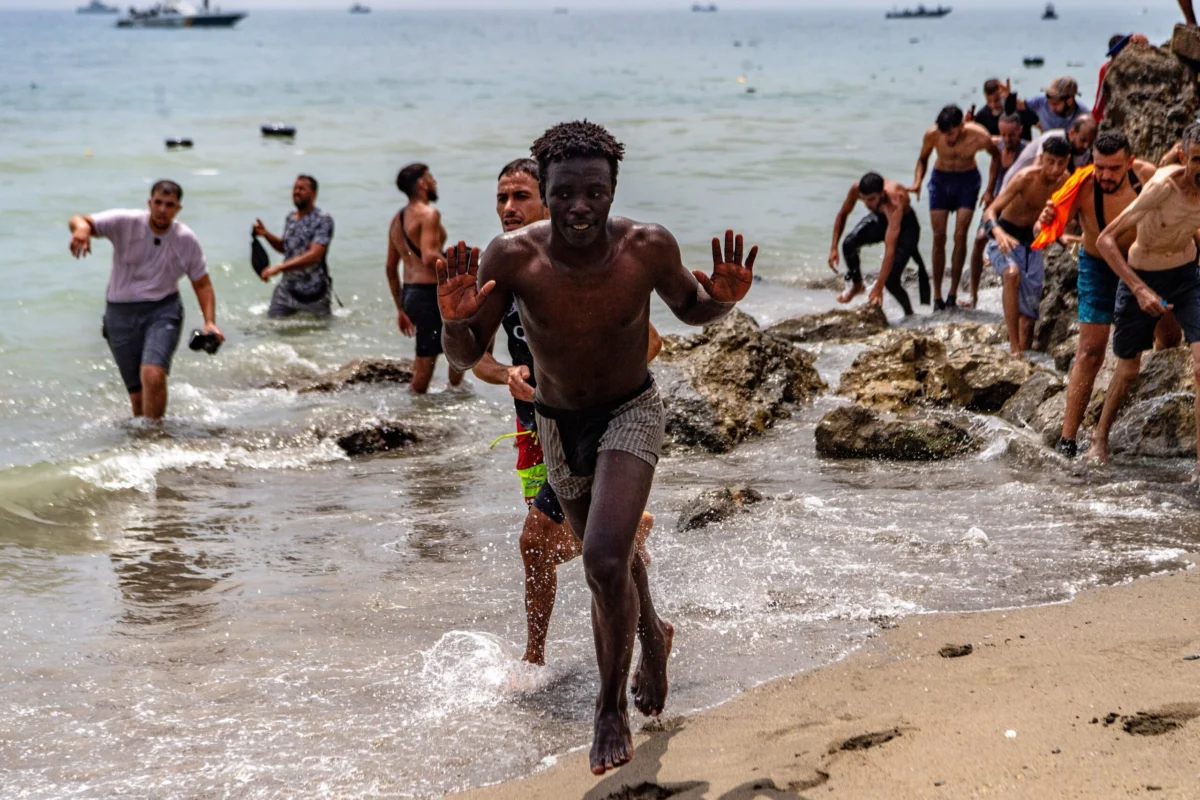
"We’ve never seen anything like this, such an impressive quantity. In 2021, it was brutal, 10,000 people in one day. But yesterday, it was 60,000 people," they repeat, their astonishment evident. "What is important to highlight, however, is that despite how impressive and shocking it may be, there have been no conflicts. The people entered peacefully and behaved with considerable civility within the limitations of this very small city, with many ending up on the streets, with nowhere to go."
According to their observations, over 48,000 individuals have already returned to Morocco. "Essentially, almost everyone has gone back. We might have around 10,000 people still circulating. It’s a very small city for the number of people moving around. But of course, we’re talking about a sixth of the number that were here this morning," they clarify.
"People are leaving because of hunger, thirst, the heat, because they have nothing. They are returning because after 24 hours, they realize that if they arrive here without a clear objective, without a pre-conceived plan, and without anyone truly waiting for them, the city cannot offer them any support whatsoever, and they have to go back. They have no prospects here. But they are returning naturally. It’s not that they are returning because the government has offered a solution," they remark, their criticism sharp regarding the management of Spanish Prime Minister Pedro Sánchez, which they describe as "abysmal."
During the telephone conversation, the faint sound of police sirens can be heard in the background. "This is constant because, after a virtual standstill, efforts are now being made to begin evacuating those who are unwilling to leave voluntarily with a bit more persuasion," they explain. "The state forces have acted as if welcoming them, and are now beginning to fulfill their defensive role, evacuating those who are not leaving willingly, who are not returning of their own accord," they add.
Multiple Causative Factors Behind the Surge
When questioned about how such an event could occur, they are unequivocal that this latest migratory avalanche was the result of a confluence of political factors.
"Several things have happened. Last week, Sánchez traveled to Algeria to attempt to mend relations that were broken by Algeria after Spain recognized Western Sahara as part of Morocco. This happened five years ago, precisely after the last ‘invasion.’ And of course, that led to a rupture in relations and in the commercial flow of gas supplied by Algeria, which is so crucial after the outbreak of the war between Russia and Ukraine in 2022," they indicate.
In addition to the attempt to mend relations with Algeria not being well-received by Morocco, Rosario and Miguel highlight another significant factor. "The Spanish Supreme Court last week ruled that a person entering by sea is not violating a border because the sea is not a physical border; water is not a physical border. Therefore, immediate returns are not accepted, which paved the way for tens of thousands of people to begin entering by swimming," they point out.
In the context of a migratory crisis that pushed Ceuta to the brink of collapse, they state that they did not feel "fear." Although they admit to experiencing significant "uncertainty and anguish" in the preceding days and hours, during which, furthermore, food stores and supermarkets were closed to prevent looting, they themselves ran out of provisions.
"The most problematic situation we have found ourselves in is that supermarkets and food stores have been closed since yesterday. And, of course, neither we nor anyone else had anticipated this conflict, so we did not have a reserve of food for many days," Miguel shares. "In fact, as an anecdote, some neighbors invited us to lunch," Rosario adds with a laugh.
As essential workers, despite the chaos, they had to continue working in Ceuta. The city-enclave, however, demonstrated solidarity in the face of the influx of desperate individuals. "Indeed, I worked until 1 AM in a provisional camp set up to receive a small portion of those who were entering," Miguel recounts.
"It was incredible to see so many people wandering the streets. They slept at the door of our house. Imagine, in a city of 80,000 people, 60,000 people on the streets, without rooms, without a place to live. Imagine a town of 80,000 people with 60,000 more people on those same streets. Even though you feel invaded, you feel pity. When I returned last night from the makeshift camp, I saw two young men eating a sandwich, sitting at our doorstep. I went up, grabbed two cans of 7-Up, and took them to them," he adds.
"So, it’s not that we experienced it as an invasion and went after them; no, it’s just heartbreaking to see all of that," he elaborates. "Within the discomfort we have felt and the consequences we are suffering, we have also shown solidarity with them," Rosario agrees, highlighting the efforts of organizations like Cáritas, Cruz Blanca, the Red Cross, the Food Bank, and even the military who began distributing water rations from trucks amidst scorching heat.
Still incredulous about what they are experiencing – something of such magnitude they never could have imagined – Miguel and Rosario, who have no children but a dog named Bobby and travel to Argentina every two years, hope for a return to normalcy. "If this were to extend for too long, we don’t know how it would end."
A Crisis of Unprecedented Scale in Ceuta
The recent events in Ceuta represent a humanitarian crisis of staggering proportions, characterized by an unprecedented influx of migrants. Between Monday, May 10th, and Tuesday, May 11th, 2021, an estimated 8,000 to 10,000 individuals, predominantly young men from Morocco, managed to enter the Spanish enclave, many by swimming across the relatively short distance from the Moroccan coast. This figure dwarfs previous migratory surges, including the significant events of 2005 and the May 2021 incident that the couple referenced. The sheer volume of people arriving in such a short period overwhelmed the limited resources and infrastructure of Ceuta, a city with a population of approximately 85,000.
The immediate aftermath saw streets, parks, and public spaces inundated with exhausted and disoriented migrants. Many lacked basic necessities such as food, water, and shelter. Images of young people sleeping on sidewalks and huddled together in makeshift encampments circulated widely, drawing international attention to the dire humanitarian situation.
Chronology of the Surge and Response
The surge began in the early hours of Monday, May 10th, with thousands of individuals, some as young as teenagers, reportedly using inflatable rings, makeshift rafts, and even swimming the approximately 14-kilometer strait. This rapid and unexpected arrival overwhelmed border control and local authorities.
By Monday evening, Spanish authorities had deployed additional police and civil guard units to manage the situation. The Spanish government, under Prime Minister Pedro Sánchez, swiftly mobilized the military to assist in managing the influx and providing logistical support. This included the establishment of temporary reception centers and the distribution of essential supplies.
The following days saw a concerted effort to process the arrivals, identify minors, and facilitate the return of those who did not qualify for asylum or protection. The Spanish government engaged in diplomatic discussions with Moroccan authorities to manage the flow of migration and to facilitate the repatriation of individuals back to their country of origin.
Supporting Data and Context
Ceuta, along with the Spanish enclave of Melilla, lies on the northern coast of Africa, bordering Morocco. These territories represent the only land borders of the European Union within Africa, making them focal points for irregular migration attempts from sub-Saharan Africa and the Maghreb region.
The primary drivers for migration to Ceuta are multifaceted, including economic hardship, political instability, conflict, and the pursuit of better opportunities in Europe. The geographical proximity to Spain, coupled with the perceived possibility of reaching the EU, makes it a target for many seeking to leave their home countries.
The events of May 2021 were particularly noteworthy due to the sheer speed and scale of the influx, as well as the method of entry, with a significant number arriving by swimming. This highlighted the desperation of those attempting the crossing and the challenges faced by border authorities in preventing such mass arrivals.
Official Responses and Diplomatic Maneuvers
The Spanish government’s response has been characterized by a dual approach: humanitarian aid and border control. Minister of the Interior Fernando Grande-Marlaska described the situation as a "serious crisis" and emphasized the need for cooperation with Morocco. The deployment of military personnel underscored the gravity of the situation and the government’s commitment to securing the border.
Diplomatic efforts have been crucial. Spain has consistently sought to work with Morocco to manage migration flows, recognizing the North African kingdom’s role as a key partner in border control and regional stability. The underlying geopolitical dynamics, including Spain’s recognition of Western Sahara as part of Morocco, have often influenced these bilateral relations and, consequently, migration policies.
The European Union has also been monitoring the situation closely, with the European Commission expressing solidarity with Spain and offering support. The events in Ceuta serve as a stark reminder of the ongoing challenges faced by the EU in managing its external borders and addressing the root causes of migration.
Broader Impact and Implications
The Ceuta crisis has far-reaching implications, both domestically and internationally. For Spain, it has reignited debates about immigration policy, border security, and the integration of migrants. The strain on local resources in Ceuta has been immense, highlighting the need for sustainable solutions and increased support for border enclaves.
Internationally, the events underscore the persistent issue of irregular migration and the complex interplay of political, economic, and social factors that drive it. The crisis has also drawn attention to the humanitarian plight of migrants and the ethical considerations surrounding border management and repatriation.
The experience of Rosario and Miguel, as long-term residents caught in the midst of this unprecedented event, offers a unique perspective. Their observations on the civility of the migrants, their own feelings of uncertainty and anguish, and their eventual acts of solidarity paint a picture of a community grappling with an extraordinary challenge. Their narrative highlights not only the scale of the migratory surge but also the human element – the desperation of those arriving and the compassion of those witnessing it. The situation in Ceuta remains a critical focus, demanding continued attention and multifaceted solutions to address the ongoing humanitarian and security challenges.

Related Posts

The Electric Vehicle Battery Health Debate Emerges as Argentina’s EV Market Accelerates

President Donald Trump Confirms Secret Departure from Turkey Amidst Assassination Threat