Makinde, Fayemi, and Oyinlola hold strategic consultations with Obasanjo in Abeokuta
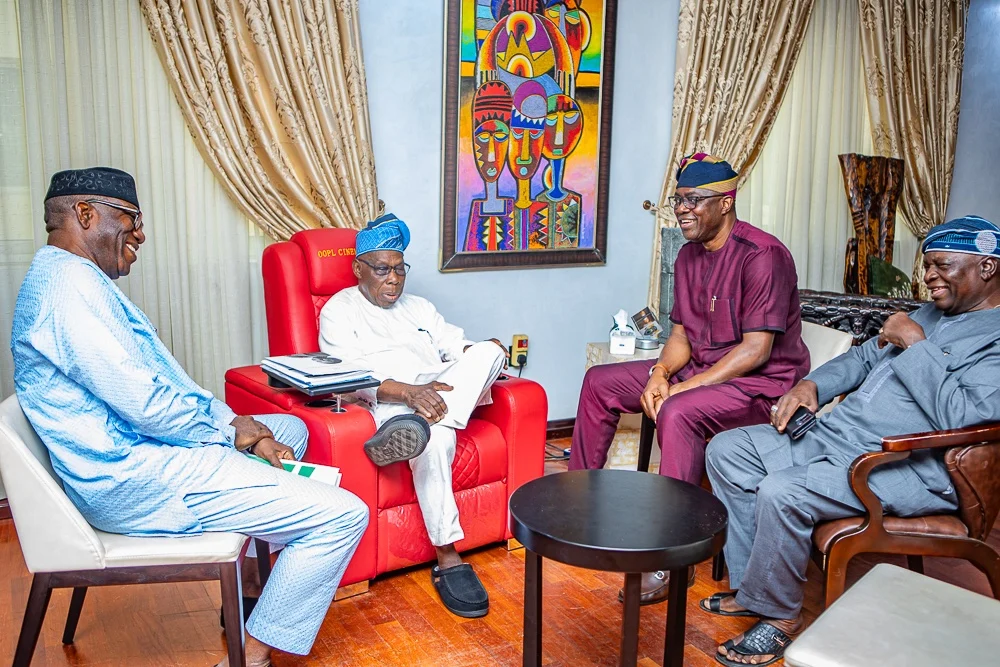
In a significant political development that signals an intensification of backroom negotiations ahead of the 2027 general election, Oyo State Governor Seyi Makinde, former Ekiti State Governor Dr. Kayode Fayemi, and former Osun State Governor Prince Olagunsoye Oyinlola paid a high-profile visit to former President Olusegun Obasanjo at his residence within the Olusegun Obasanjo Presidential Library (OOPL) in Abeokuta, Ogun State. The meeting, which took place on Sunday, has ignited widespread discourse regarding the evolving alliances among Nigeria’s political elite as the country begins to navigate the early stages of its next electoral cycle.
The Context of the High-Level Engagement
The convergence of these influential figures at the hilltop residence of the former President is widely viewed by political analysts as more than a mere courtesy call. Governor Seyi Makinde, a prominent figure within the opposition Peoples Democratic Party (PDP), was joined by Dr. Kayode Fayemi, a former Chairman of the Nigeria Governors’ Forum and a stalwart of the ruling All Progressives Congress (APC), and Prince Olagunsoye Oyinlola, an experienced political tactician who has served in various capacities, including as the former National Secretary of the PDP.
The presence of political heavyweights from diverse party backgrounds—spanning both the ruling APC and the opposition PDP—highlights a growing trend of cross-party consultations. As Nigeria grapples with significant socio-economic challenges, including inflation, fiscal policy adjustments, and structural reforms, leaders are increasingly seeking the counsel of elder statesmen like Chief Obasanjo, whose influence remains a cornerstone of the nation’s political landscape.

A Chronology of Recent Political Consultations
The visit to Abeokuta fits into a broader timeline of strategic meetings that have characterized the post-2023 election era. Since the inauguration of the current administration, the Olusegun Obasanjo Presidential Library has frequently served as a neutral ground for governors, party leaders, and aspirants to calibrate their political trajectories.
In the months leading up to the 2023 general election, similar consultations were held as stakeholders sought to navigate the complexities of power rotation and party primaries. By mid-2024, the frequency of such meetings increased, with various interest groups attempting to forge consensus on national development agendas. The recent visit by Makinde, Fayemi, and Oyinlola suggests that the urgency of these deliberations has shifted toward the anticipated realignment for 2027. Historically, such gatherings in the lead-up to election years often precede formal shifts in party affiliations or the emergence of new political coalitions aimed at addressing perceived governance gaps.
Insights into the National Discussion
Governor Makinde, utilizing his official X (formerly Twitter) account, provided a glimpse into the nature of the deliberations. While the specifics of the conversation remain behind closed doors, the Governor explicitly stated that the discourse was centered on "important national issues in view of the upcoming general election."
The emphasis on "wise counsel" from the former President suggests that the visitors were seeking guidance on navigating the current volatile political and economic climate. Given Obasanjo’s long history of intervention in national crises—ranging from the management of the economy to regional security concerns—the visitors likely sought his perspective on how current governance strategies might be improved or how political stability could be maintained as the nation approaches another transition cycle.

Supporting Data and Political Landscape Analysis
To understand the significance of this meeting, one must examine the current political demographics of the Southwest region. The region, which is home to the current President, is also a critical battleground for political influence. The presence of Governor Makinde, who currently holds the only PDP gubernatorial seat in the region, alongside APC figures like Dr. Fayemi, indicates a potential move toward a more collaborative approach to regional governance.
Data from the Independent National Electoral Commission (INEC) regarding the 2023 elections underscores the volatility of the Southwest, where electoral outcomes were highly competitive across various states. As of mid-2026, the political landscape is marked by:
- Economic Reform Pressures: The ongoing implementation of fiscal reforms has created a complex environment for incumbent governors, who are balancing federal directives with state-level economic realities.
- Internal Party Friction: Both the APC and the PDP are currently navigating internal power struggles, with factions emerging in several state chapters, necessitating the intervention of elder statesmen to prevent fragmentation.
- Regional Security Concerns: Collective security initiatives, such as the South-West Governors’ Forum, remain a priority, and the alignment of these leaders suggests a coordinated effort to address regional stability independent of federal friction.
Official Statements and Public Reception
While the visit was documented through official photographs, there has been no formal communiqué released by the participants. However, the tone of the communication from the Governor’s office was one of profound respect for the former President’s institutional memory. The inclusion of photographs showing Governor Makinde engaged in leisure activities with the former President served to humanize the meeting, signaling a cordial relationship that transcends the rigid confines of partisan politics.
Political observers note that such meetings are essential in the Nigerian context to lower the temperature of political rhetoric. By engaging across party lines, these leaders demonstrate a commitment to democratic continuity, even when they occupy opposing sides of the aisle on specific policy issues.

Broader Implications for the 2027 General Election
The meeting in Abeokuta has several implications for the Nigerian political trajectory:
1. The Search for Consensus: There is a growing consensus among political elites that the current economic strain requires a more unified approach to governance. The presence of both APC and PDP leaders at the table suggests a possible push for a "National Interest" coalition that could influence the selection of candidates and policy directions in 2027.
2. Regional Power Dynamics: The participation of influential Southwest leaders suggests that the region is positioning itself to play a decisive role in the next election. By coordinating their interests now, these leaders are likely attempting to avoid the internal conflicts that hampered political stability in the past.
3. The Role of Elder Statesmen: Chief Obasanjo continues to serve as an indispensable arbiter in the Nigerian political theater. His ability to draw leaders from across the political spectrum to his residence underscores his enduring relevance. For the visitors, the meeting serves as a form of "political validation," allowing them to align themselves with the legacy and experience that the former President represents.

Fact-Based Assessment of Future Trends
As the nation moves closer to the next election cycle, political analysts anticipate an increase in such consultative meetings. The current trend suggests a shift away from the highly polarized campaigns of the past toward more negotiated settlements. If the discussions held in Abeokuta are indicative of a broader trend, it is highly probable that the 2027 election will be defined by strategic alliances rather than rigid party-based ideological battles.
Furthermore, the involvement of figures like Dr. Kayode Fayemi, who has consistently championed the restructuring of the Nigerian federation, combined with the practical governance challenges faced by Governor Makinde, points to a potential convergence on constitutional reform and fiscal federalism as key talking points for the next election.
Conclusion
The visit of Governor Seyi Makinde, Dr. Kayode Fayemi, and Prince Olagunsoye Oyinlola to Chief Olusegun Obasanjo is a manifestation of the ongoing search for stability and direction in the Nigerian political space. As the nation prepares for the challenges of 2027, the role of experienced leaders in providing counsel and facilitating dialogue cannot be overstated. Whether this meeting will translate into a formal political realignment or simply serve as a platform for collaborative governance remains to be seen. However, the optics of the event confirm that the process of preparing for the next general election has officially transitioned from the periphery to the center of national discourse.