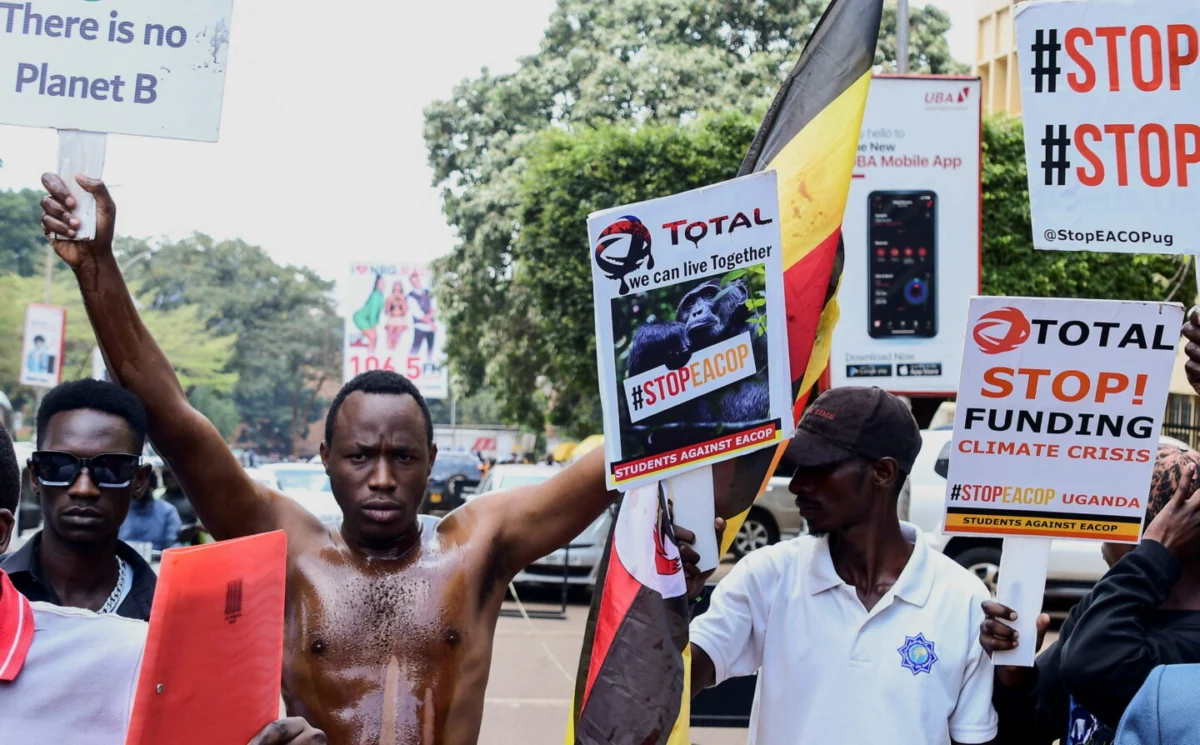
Ugandan Farmers File Landmark Lawsuit in London High Court to Halt East African Crude Oil Pipeline Operations
Four Ugandan farmers have initiated a high-stakes legal challenge in London’s High Court, seeking to prevent the East African Crude Oil Pipeline (EACOP) from commencing operations by invoking Ugandan environmental laws against a UK-registered entity. This legal action, filed on Tuesday, represents a significant escalation in the international opposition to what is slated to become the world’s longest heated crude oil pipeline. The claimants, supported by the global advocacy group Avaaz and represented by the renowned London-based law firm Leigh Day, argue that the project’s developer, EACOP Ltd, has breached fundamental rights enshrined in the Ugandan Constitution, specifically the right to a clean and healthy environment.
The lawsuit targets the UK-registered EACOP Ltd, a subsidiary established to manage the massive 1,443-kilometre (897-mile) infrastructure project. If completed, the pipeline will transport heavy crude oil from the Tilenga and Kingfisher oil fields in the Lake Albert region of western Uganda to the Port of Tanga on Tanzania’s Indian Ocean coast. The project is a joint venture primarily owned by the French energy titan TotalEnergies (62%), the China National Offshore Oil Corporation (CNOOC) (8%), the Uganda National Oil Company (UNOC) (15%), and the Tanzania Petroleum Development Corporation (TPDC) (15%). With approximately 80% of the construction already completed, the developers are racing toward a target export date of October 2026.
The Basis of the Legal Challenge
The core of the farmers’ claim rests on the principle of corporate accountability and the extraterritorial application of law. By filing the case in London, the claimants are utilizing a legal pathway that allows foreign nationals to hold UK-domiciled companies or their subsidiaries accountable for actions taken abroad. The legal team at Leigh Day argues that although the physical activity occurs in East Africa, the corporate governance and decision-making processes tied to the UK-registered EACOP Ltd must adhere to the legal standards of the country where the impact is felt.
The claim asserts that the development and eventual operation of the pipeline violate Article 39 of the Ugandan Constitution, which guarantees every citizen the right to a clean and healthy environment. The farmers allege that the project has already caused irreparable harm to local ecosystems and that its continued operation poses an existential threat to their livelihoods and the regional climate. Racheal Tugume, one of the four claimants, testified during a press conference that the construction has already resulted in the displacement of families and the degradation of local water sources. According to Tugume, the destruction of wetlands and forests has not only affected biodiversity but has also stripped communities of their natural defenses against the increasingly erratic weather patterns driven by global climate change.
Project Background and Technical Specifications
The EACOP project is inextricably linked to the discovery of an estimated 6.5 billion barrels of oil—of which about 1.4 billion barrels are recoverable—in the Lake Albert rift basin in 2006. For nearly two decades, the Ugandan government under President Yoweri Museveni has championed the project as a catalyst for national economic transformation, promising thousands of jobs and billions in tax revenue.
Technically, the pipeline is a complex engineering feat. Because the crude oil found in Uganda is highly viscous and "waxy," it solidifies at room temperature. To ensure the oil flows through the 1,443-kilometre route, the pipeline must be heated to a constant temperature of at least 50 degrees Celsius (122 degrees Fahrenheit). This requirement makes EACOP the longest electrically heat-traced pipeline in the world. Critics point out that the energy required to maintain this heat, combined with the carbon emissions from the eventual combustion of the exported oil, will result in a massive carbon footprint.
A Chronology of the EACOP Development
The path to the current legal standoff has been marked by years of negotiation, environmental assessments, and escalating protests.
- 2006: Commercial quantities of oil are discovered in the Lake Albert region of Uganda.
- 2013: The Ugandan government signs a Memorandum of Understanding with oil majors to develop the fields and an export pipeline.
- 2017: Uganda and Tanzania sign the Inter-Governmental Agreement (IGA), formalizing the route of the pipeline through Tanzania to the Port of Tanga.
- 2021: The Final Investment Decision (FID) is delayed due to environmental concerns and financing hurdles but is eventually moved forward by TotalEnergies and CNOOC.
- September 2022: The European Parliament passes a resolution calling on TotalEnergies and the governments of Uganda and Tanzania to halt the project over human rights and environmental concerns.
- January 2023: Construction officially commences following the issuance of a license by the Ugandan government.
- November 2024: Four farmers file a lawsuit in London’s High Court to stop the project, citing violations of Ugandan law by the UK entity.
Supporting Data and Environmental Impact
The environmental and social data surrounding EACOP has been a focal point for international monitors. According to reports from various NGOs, including Human Rights Watch and Global Witness, the project will affect more than 12,000 households across Uganda and Tanzania. While developers claim that compensation has been fair and comprehensive, many local residents report that they were coerced into signing agreements or received payments that did not reflect the true value of their ancestral lands.
From an ecological perspective, the pipeline route traverses several sensitive areas. In Uganda, it passes through the Murchison Falls National Park and near the shores of Lake Victoria, the world’s second-largest freshwater lake. A leak or spill in these areas could contaminate water supplies for millions of people across East Africa. Furthermore, the campaign group Avaaz estimates that the pipeline will facilitate the release of up to 34 million tonnes of carbon dioxide equivalent per year at peak production—significantly more than the current annual emissions of Uganda and Tanzania combined.
The financial data also reveals a project under pressure. Due to intense campaigning by environmental groups, more than 20 major global banks and over 10 international insurance companies have publicly distanced themselves from EACOP, citing climate commitments. This has forced the developers to seek alternative financing, reportedly from Chinese and Middle Eastern institutions, and has increased the overall project cost to an estimated $5 billion.
Official Responses and Reactions
The developers of EACOP have consistently defended the project’s standards. TotalEnergies has frequently stated that the project is being executed with the highest regard for environmental and social safeguards, adhering to the Equator Principles and International Finance Corporation (IFC) standards. In previous statements, the company emphasized that the pipeline route was carefully selected to minimize impact on sensitive ecosystems and that 90% of the affected landholders have already received compensation.
The Ugandan government has reacted sharply to international legal challenges in the past, viewing them as "economic imperialism." President Museveni has argued that Western nations, which built their economies on fossil fuels, have no right to prevent African nations from utilizing their own natural resources to alleviate poverty. Government spokespeople have reiterated that the oil project is essential for Uganda’s "Vision 2040" development plan, which aims to transition the country to a middle-income economy.
Conversely, the Avaaz campaign group views the London lawsuit as a critical intervention. "This is one final chance to stop one of the worst oil pipelines on the planet," the group stated. They argue that the legal system in the UK offers a level of impartiality and corporate oversight that is difficult to achieve within the domestic courts of the developing nations involved.
Legal and Broader Implications
The filing of this case in the High Court of London follows a growing trend of "climate litigation" and transnational corporate liability. It mirrors previous landmark cases, such as Vedanta v. Lungowe and Okpabi v. Royal Dutch Shell, where the UK Supreme Court ruled that UK parent companies could be held liable for the environmental and human rights failings of their foreign subsidiaries.
If the High Court agrees to apply Ugandan law against EACOP Ltd, it could set a profound precedent. It would signify that UK-registered companies cannot escape the stringent environmental protections of host countries simply by virtue of their corporate structure. For the energy industry, a ruling in favor of the farmers would create a significant legal risk for any major infrastructure project involving UK entities in jurisdictions with strong constitutional environmental rights.
Furthermore, the case highlights the tension between national development goals and global climate obligations. As the world moves toward the targets set by the Paris Agreement, projects like EACOP become lightning rods for the debate over "just transitions." For the four Ugandan farmers, however, the case is less about global politics and more about the immediate survival of their communities. The outcome of the London proceedings will determine whether the pipeline’s first oil exports in October 2026 will proceed as planned or be derailed by a judicial mandate to uphold the environmental rights of those living in its path.
As the legal process unfolds, the international community will be watching closely. The High Court must now decide on the admissibility of the case and whether the UK is the appropriate forum for such a dispute. Regardless of the immediate outcome, the lawsuit has already succeeded in bringing the grievances of local Ugandan farmers to the heart of the global financial and legal system, ensuring that the human and environmental costs of the EACOP project remain under intense scrutiny.

Related Posts
Constitutional Court of South Africa Bars Shell Oil Exploration in Landmark Victory for Environmental and Community Rights
The Battle for Saldanha Bay: South Africa’s Ambitious Ocean Economy Strategy Faces Legal and Environmental Reckoning