
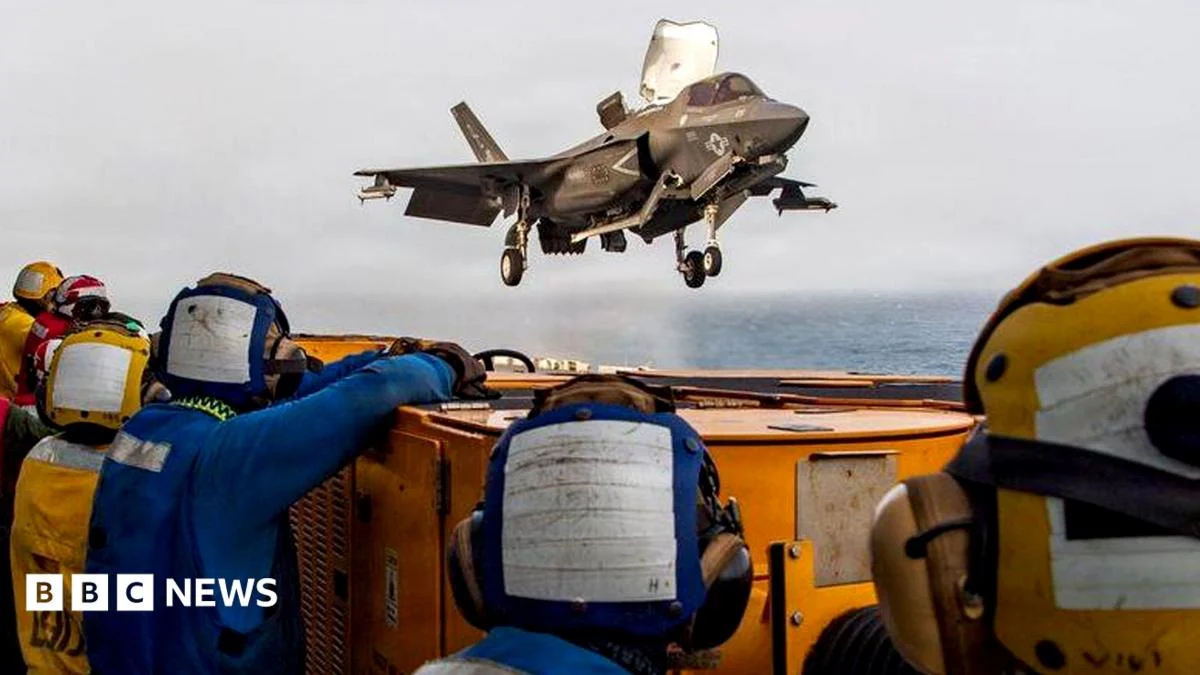
US launches fresh strikes on Iran, as Trump warns of retaliation for deaths of soldiers
The US military has confirmed another significant round of strikes against Iranian targets, marking the tenth consecutive night of operations aimed at "further degrading" Tehran’s capacity to threaten international shipping lanes in the critical Strait of Hormuz. This intensified campaign follows a direct vow from US President Donald Trump to punish Iran for the recent deaths of American service members in the region, a pledge he reiterated by stating Iran had been hit "very hard" in previous nights "in honour" of the fallen.
In a swift and defiant response, Iran’s state news agency IRNA reported that the Islamic Republic had launched its own retaliatory strikes, targeting two oil tankers attempting to transit the Strait of Hormuz, as well as American military assets stationed in Bahrain and Kuwait. Iranian President Masoud Pezeshkian, addressing the escalating tensions, declared that Iran was now engaged in a "full-scale war" with the United States, signalling a profound shift in rhetoric and potentially in strategic posture. Despite this declaration of open conflict, Tehran also indicated that diplomatic messages were still being exchanged between both sides through intermediaries, even as a fragile ceasefire framework had seemingly collapsed.
Escalation in Context: The Jordan Attack and US Casualties
The current surge in hostilities traces its immediate origins to a drone attack on the Muwaffaq Salti Air Base in Jordan, often referred to as Tower 22, located near the Syrian border. This deadly incident, which occurred over the weekend, resulted in the tragic deaths of three US soldiers and injured dozens more, marking the first time US service members had been killed by enemy fire in the Middle East since the early stages of the Iraq War. On Tuesday night, the Department of Defense officially confirmed the identities of two of the fallen: Private First Class Isabella Gonzales, 19, from Texas, and First Lieutenant Tyler James Feehan, 25, from Hawaii. US Central Command (Centcom) had earlier reported that a third service member was initially missing in action after the attack, with unidentified remains subsequently discovered in the vicinity, confirming the third fatality.
The attack on Tower 22, which US intelligence quickly attributed to Iranian-backed militias operating in the region, served as a potent catalyst, drawing an immediate and forceful pledge of retribution from President Trump. The incident underscored the perilous proximity of US forces to various Iran-aligned proxy groups operating across Iraq, Syria, and Yemen, highlighting the increasingly complex and volatile security landscape.
A Decade of Retaliation: US Operations Against Iran
The series of US strikes, now spanning ten nights, represents a sustained and deliberate campaign designed to diminish Iran’s military infrastructure and its ability to project power, particularly in maritime domains. Centcom, the operational command responsible for US military activities in the Middle East, detailed on its official X (formerly Twitter) account that the latest strikes had specifically targeted Iranian "military command centres, maritime capabilities, missile and drone launch sites, and air defense systems." The stated objective is to "further degrade" these capabilities, thereby reducing Iran’s capacity to threaten commercial shipping and US interests.
While specific details of all ten nights of strikes remain partially undisclosed by US officials, Iran’s semi-official Tasnim news agency provided some insight into the previous night’s operations. It reported that several Iranian cities had been hit, including Tabriz, a major industrial hub in northwestern Iran; Chabahar and Konarak, both critical port cities on Iran’s southeastern coast; and Bandar Mahshahr and Bandar Imam Khomeini, significant oil and petrochemical ports in the southwestern province of Khuzestan. The breadth of these reported targets suggests a concerted effort to impact diverse aspects of Iran’s military and logistical infrastructure, extending beyond its immediate naval assets.
Tehran’s Counter-Offensive: Tankers and Regional Targets
Iran’s response to the US military pressure has been both rhetorical and kinetic. The declaration of a "full-scale war" by President Pezeshkian marks a significant escalation in diplomatic language, moving beyond previous warnings of retaliation. Simultaneously, IRNA’s reports of Iranian forces striking two oil tankers in the Strait of Hormuz introduce a new and dangerous dimension to the conflict, directly impacting global energy supply routes.
According to Iranian state media, these tankers "exploded and were brought to a halt" while attempting to traverse what the Islamic Revolutionary Guard Corps (IRGC) termed an "unsafe and hazardous southern route" of the strait. Centcom, however, swiftly disputed these claims, indicating a potential information warfare component to the unfolding crisis. While Centcom maintained that commercial vessels were continuing to pass through the Strait of Hormuz largely unhindered, the United Kingdom Maritime Trade Operations agency (UKMTO), a crucial monitor of maritime security in the region, issued its own advisory. UKMTO reported that a tanker in the Strait of Hormuz had indeed reported being struck by an "unknown projectile," forcing its crew to abandon the vessel and board a lifeboat. It remained unclear whether the incident reported by UKMTO directly corresponded to one of the tankers cited by Iran, adding to the fog of war. IRNA later claimed that Iranian rescue teams were actively engaged in removing the crews from the two oil tankers it had struck, further emphasizing the gravity of their asserted actions.
Beyond the maritime domain, Iran also claimed to have targeted US military assets in Bahrain and Kuwait. These claims were partially corroborated by regional security forces. Jordan’s military stated late on Monday that it had successfully shot down three Iranian missiles, which had triggered air raid sirens across the country. Earlier in the day, Kuwait’s armed forces confirmed they had intercepted Iranian drones. Bahrain, a key US ally hosting the US Navy’s Fifth Fleet, reported that drones launched by Iran had targeted its air navigation systems. However, Bahraini authorities assured the public that air traffic remained unaffected, indicating successful countermeasures or minimal impact. These incidents underscore the regional contagion of the conflict, drawing in multiple Gulf states that host significant US military contingents.
The Strategic Chokepoint: Strait of Hormuz
The Strait of Hormuz, a narrow waterway separating Iran from the Arabian Peninsula, is arguably the most strategically important chokepoint for global oil transit. Approximately 20% of the world’s total petroleum liquids consumption and about one-third of the world’s liquefied natural gas (LNG) pass through this strait daily. Any significant disruption to shipping in this vital artery has immediate and profound implications for global energy markets, often leading to spikes in oil prices, increased shipping insurance premiums, and broader economic instability.
Historically, the Strait has been a flashpoint in US-Iran tensions, particularly during the "Tanker Wars" of the 1980s, a phase of the Iran-Iraq War where both sides attacked neutral shipping. Iran has repeatedly threatened to close the Strait in response to sanctions or military pressure, a threat that global powers view with extreme concern. Centcom’s assertion that commercial vessels continue to pass through the Strait is a crucial detail, aiming to reassure international markets and prevent panic. However, the UKMTO report and Iran’s claims of striking tankers inject significant uncertainty and underscore the fragility of freedom of navigation in this critical waterway. The potential for miscalculation or accidental escalation in this confined space is extremely high, with consequences that would ripple across the global economy.
A "Full-Scale War": Rhetoric and Reality
President Pezeshkian’s declaration of a "full-scale war" with the US is a notable departure from previous Iranian official statements, which often spoke of "resistance" or "retaliation" within defined limits. This rhetoric could signal a more aggressive posture from Tehran, potentially authorizing broader and more direct engagement against US interests and assets, both militarily and through its regional proxy network. However, the simultaneous acknowledgement of ongoing diplomatic messages through intermediaries suggests that even amid declarations of war, channels for de-escalation or negotiation might still be cautiously maintained. This paradox highlights the complex and often contradictory nature of Middle Eastern geopolitics, where fiery rhetoric can coexist with back-channel communications.
Such diplomatic efforts, often facilitated by countries like Oman, Qatar, or Switzerland (which represents US interests in Iran), aim to prevent uncontrolled escalation by clarifying intentions and setting boundaries. The collapse of an unspecified "ceasefire" mentioned in the original report further complicates this picture, implying that previous attempts at de-escalation had failed, pushing both sides closer to a more direct confrontation.
Broader Geopolitical Backdrop: US-Iran Relations
The current crisis is not an isolated event but rather the latest manifestation of decades of deep-seated antagonism between the United States and Iran, dating back to the 1979 Islamic Revolution and the subsequent hostage crisis. Relations deteriorated significantly after the US withdrawal from the Joint Comprehensive Plan of Action (JCPOA), the international nuclear agreement with Iran, in 2018 under the Trump administration. The US then re-imposed and intensified sanctions under a "maximum pressure" campaign, aiming to curb Iran’s nuclear program, ballistic missile development, and its support for regional proxy groups.
Iran, in turn, has steadfastly pursued a regional strategy of asymmetric warfare, leveraging its network of proxies—including Hezbollah in Lebanon, various Shiite militias in Iraq and Syria, the Houthis in Yemen, and Hamas in Gaza—to challenge US influence and Israeli security. This proxy strategy allows Iran to exert pressure without direct military engagement, creating a complex web of conflicts. The recent Houthi attacks on international shipping in the Red Sea, for example, are widely seen as part of this broader Iranian-backed campaign, further destabilizing global trade routes and exacerbating regional tensions. The deaths of US soldiers in Jordan represent a critical threshold, crossing a red line that has historically triggered significant US military responses.
International Reactions and Calls for De-escalation
The escalating crisis has drawn urgent calls for de-escalation from the international community. The United Nations Secretary-General’s office is expected to issue statements urging all parties to exercise maximum restraint, adhere to international law, and protect civilian lives and infrastructure. The European Union and major European powers, consistently advocating for diplomatic solutions, are likely to express deep concern over the spiralling violence and reiterate the need for dialogue to prevent a broader regional conflict.
Regional allies of the US, such as Saudi Arabia, the UAE, and Qatar, are closely monitoring the situation. While generally supportive of efforts to secure maritime navigation and counter Iranian aggression, they also harbour concerns about the potential for the conflict to engulf the entire Gulf region, threatening their own stability and economic prosperity. Their public statements typically call for calm and support international efforts to restore stability.
Global financial markets, particularly the oil and gas sectors, are reacting with apprehension. Initial reports of tanker strikes and declarations of war could lead to immediate price increases, reflecting fears of supply disruptions. Shipping and insurance companies are likely to reassess risk levels for vessels transiting the Persian Gulf, potentially leading to higher freight costs and increased premiums, which would ultimately impact global trade and consumer prices.
Pathways Forward and Risks of Miscalculation
The immediate future of US-Iran relations appears fraught with peril. The declaration of "full-scale war" by Iran, even if partially rhetorical, raises the specter of direct military confrontation. The challenge lies in finding a pathway to de-escalation amidst active military exchanges and heightened rhetoric. The continued existence of diplomatic channels, however tenuous, offers a glimmer of hope that a complete breakdown of communication can be averted.
The primary risk remains miscalculation—an unintended strike, an overreaction, or an error in judgment that could trigger a wider, uncontrollable conflict. Such a conflict would have devastating humanitarian, economic, and geopolitical consequences, destabilizing the entire Middle East and sending shockwaves across the globe. For the US administration, navigating this crisis requires a delicate balance of demonstrating resolve to protect its forces and interests, while simultaneously seeking to prevent a full-blown war. For Iran, the challenge is to assert its defiance and retaliate without inviting an overwhelming response that could cripple its economy and military capabilities. The world watches with bated breath as these two adversaries teeter on the brink of an even more dangerous confrontation.

Related Posts
Zambia on Edge: Opposition Leader Arrested Amid Allegations of Insurrection Plot and Election Tensions
Rescuers search for survivors of powerful Indonesia earthquake

