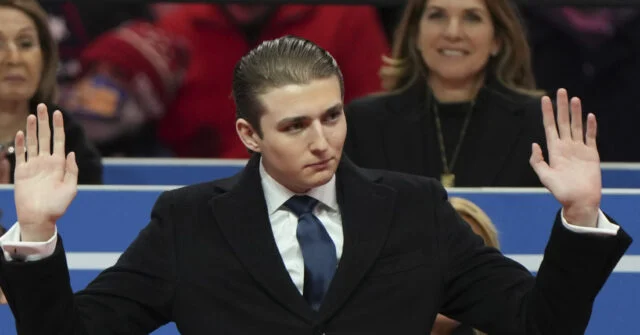
Russian Citizen Jailed for Four Years After Assault on Barron Trump’s Close Friend in London, Prompting High-Profile Intervention
A 22-year-old Russian citizen, Matvei Rumiantsev, has been sentenced to four years in prison in London following his conviction for the assault of a close female friend of Barron Trump, son of the former U.S. President. The incident, which garnered international attention due to Barron Trump’s direct intervention in reporting the crime, also sees Rumiantsev facing deportation from the United Kingdom upon completion of his sentence. The London court found Rumiantsev guilty of one count of assault and one count of attempting to pervert the course of justice, while acquitting him of other more severe charges including multiple alleged rapes, strangulation, and further assaults, as reported by The Times.
The case brought into sharp focus the alarming intersection of personal relationships, international attention, and the complexities of reporting serious crimes across continents. The assault came to global prominence earlier this year when Barron Trump, during a video call with the young woman in London, found his call answered by Rumiantsev, who then proceeded to physically attack the woman. This disturbing event unfolded in real-time, witnessed by the President’s son, who immediately contacted London police, potentially saving the victim from further harm.
The Traumatic Incident and Barron Trump’s Crucial Intervention
The harrowing assault, which occurred in London, was described in court as a calculated act of violence driven by jealousy and a desire to assert dominance. The court heard that Matvei Rumiantsev’s violent behaviour towards the unnamed female victim had escalated over several months, fueled by his apparent jealousy over her close friendship with Barron Trump. The victim and Barron Trump were described as "very close," a relationship that reportedly incited Rumiantsev’s aggression.
The specific incident that led to Rumiantsev’s conviction involved him deliberately ensuring the assault was captured on camera. During the attack, he subjected the woman to a barrage of demeaning and abusive language, calling her a "slut," a "whore," and asserting that she was "not worth anything." This verbal abuse accompanied the physical violence, highlighting the psychological torment inflicted alongside the physical harm. The victim, whose identity has been protected throughout the proceedings, later testified to the profound impact of the assault and her belief that Barron Trump’s timely intervention was nothing short of miraculous. "That call was like a sign from God at that moment," she stated, expressing her conviction that Barron calling the police had saved her life.
Barron Trump’s immediate response was pivotal. Despite the geographical distance and the shock of witnessing such an event unfold remotely, he acted swiftly and decisively. He contacted London police without hesitation, reporting that he had witnessed a girl "getting really badly beat up." However, his efforts were met with an unexpected and concerning reception from a police dispatcher, who reportedly accused him of being "rude." This interaction, highlighted during the trial, drew implicit criticism from the presiding judge. In his remarks, the judge commendably stated that Barron Trump — who was not present in court — had acted "properly and responsibly," tacitly admonishing the dispatcher’s initial handling of the distressed caller. This official commendation underscored the critical nature of Barron Trump’s actions and the importance of professional conduct in emergency services.
The Legal Proceedings and Verdict
The judicial process in London meticulously examined the evidence presented against Matvei Rumiantsev. He faced a range of serious allegations, reflecting the severity and nature of the violence described by the victim. Ultimately, the court delivered a split verdict. Rumiantsev was convicted of one count of assault and one count of attempting to pervert the course of justice. The latter charge suggests that he took steps to interfere with the investigation or judicial process, further compounding the gravity of his actions. However, he was found not guilty of other significant charges, including multiple alleged rapes, strangulation, and additional assaults. These acquittals indicate that while the court found sufficient evidence for the assault and perverting justice charges, the prosecution did not meet the higher burden of proof required for the more severe allegations.
Following his conviction, Rumiantsev was sentenced to four years in prison. This sentence reflects the seriousness with which the UK legal system views acts of violence and attempts to obstruct justice. Beyond his incarceration, Rumiantsev, as a Russian citizen, faces the additional consequence of deportation from the United Kingdom once he has served his time. This standard procedure for foreign nationals convicted of serious crimes in the UK underscores the principle that residency in the country is contingent upon adherence to its laws.
Background and Context: Transatlantic Justice and High-Profile Involvement
The involvement of Barron Trump, the son of a U.S. President, undeniably elevated the profile of this case from a local London crime to an international news story. The unique circumstance of a high-profile American citizen witnessing a crime against another individual in a foreign country via modern communication technology highlights several important facets.
Firstly, it demonstrates the global interconnectedness facilitated by technology, where events unfolding thousands of miles away can be witnessed and acted upon in real-time. This real-time witnessing by Barron Trump was crucial, providing immediate corroboration and prompting an urgent police response that might otherwise have been delayed.
Secondly, the incident underscores the challenges and protocols involved when an international call is made to report a crime. While emergency services are designed to handle calls from anyone, the initial reaction from the dispatcher, as described, serves as a stark reminder of the need for consistent training in handling distressed callers, irrespective of their perceived demeanor or public status. The judge’s subsequent praise for Barron Trump’s actions implicitly reinforced the principle that the content of an emergency call, rather than the caller’s tone, should be the primary focus.
Moreover, the case briefly touched upon the broader issue of violence against women. While the specific dynamics of Rumiantsev’s relationship with the victim were subject to legal scrutiny, the court heard that his actions were motivated by jealousy and a desire for control – patterns often associated with abusive behaviors. Statistics from organizations like the Office for National Statistics (ONS) in the UK consistently show that a significant proportion of violent crimes, particularly those involving female victims, occur within the context of relationships or by individuals known to the victim. For instance, in England and Wales, a substantial number of assaults recorded by the police involve domestic abuse-related incidents, underscoring the pervasive nature of such violence. While Rumiantsev was not convicted of domestic abuse specifically, the reported motivations align with elements seen in broader patterns of interpersonal violence.
Chronology of Events
The events unfolded over a period, culminating in the recent sentencing:
- Months Prior to the Assault: Violence by Matvei Rumiantsev against the unnamed female victim reportedly begins, driven by jealousy over her friendship with Barron Trump.
- Earlier This Year: The specific assault takes place in London. Barron Trump video-calls the victim, but Rumiantsev answers and proceeds to assault the woman, ensuring the act is witnessed.
- Immediate Aftermath: Barron Trump contacts London police to report the ongoing assault, encountering an initially dismissive dispatcher.
- Police Investigation: London Metropolitan Police launch an investigation based on Barron Trump’s report and the victim’s account.
- Charges Filed: Matvei Rumiantsev is arrested and charged with multiple offenses, including assault, alleged rapes, strangulation, and attempting to pervert the course of justice.
- Court Proceedings: The trial takes place in a London court, with evidence and testimony presented by both the prosecution and defense.
- Verdict and Sentencing (Recent): Rumiantsev is convicted of assault and attempting to pervert the course of justice, sentenced to four years in prison, and faces deportation.
Official Responses and Legal Implications
Beyond the direct statements from the victim and the judge’s commendation of Barron Trump, the case elicits broader official responses and carries significant legal implications.
The London Metropolitan Police, while not issuing specific comments on the dispatcher’s interaction, typically emphasize their commitment to thoroughly investigating all reports of serious assault and ensuring victim safety. The very fact that an investigation was launched and pursued to conviction, despite the initial reported hiccup, demonstrates the police’s ultimate dedication to justice. This case, however, may serve as an internal learning point for emergency service call handlers regarding the importance of empathetic and professional engagement with all callers, especially those reporting distressing and urgent situations.
For legal experts, Rumiantsev’s sentence of four years for assault and perverting the course of justice is consistent with UK sentencing guidelines for such offenses, which consider factors like the severity of injury, premeditation, and attempts to obstruct justice. The subsequent deportation order for a foreign national convicted of a serious crime is a standard legal consequence, reinforcing immigration laws and the expectation that those residing in the UK abide by its legal framework. This dual consequence serves both as punishment for the crime and as a measure to protect public safety.
Broader Impact and Implications
The Matvei Rumiantsev case carries several broader implications, extending beyond the immediate individuals involved.
Firstly, it underscores the evolving role of technology in crime prevention and reporting. Video calls, while primarily tools for social connection, can unexpectedly become crucial conduits for witnessing and reporting crimes, especially when geographical distances separate individuals. This incident highlights the potential for remote witnessing to be a powerful deterrent and a vital source of evidence, emphasizing the importance of digital connectivity in modern justice.
Secondly, the case reinforces the critical importance of witnesses coming forward, regardless of their connection to the event or their public profile. Barron Trump’s courageous and responsible actions set a powerful example of civic duty. His intervention, despite the potential scrutiny associated with his family name, demonstrates that acting responsibly in the face of injustice is paramount.
Finally, the incident with the emergency dispatcher, while a minor aspect of the overall case, sparks important discussions about police training and protocols. It serves as a reminder that the initial point of contact for victims or witnesses of crime must always be handled with the utmost professionalism, empathy, and urgency. Any perception of dismissiveness can deter future reports and undermine public trust in emergency services. This incident may prompt internal reviews or reinforce existing training modules within emergency call centers to ensure consistent and appropriate responses to all reports of serious crime.
In conclusion, Matvei Rumiantsev’s conviction and sentencing mark the legal resolution of a deeply disturbing incident. The case, propelled into the international spotlight by Barron Trump’s timely and responsible intervention, serves as a poignant reminder of the pervasive nature of violence, the critical role of witnesses, and the complexities involved in pursuing justice across borders in an increasingly interconnected world.

Related Posts
Democratic Candidates Must Moderate to Win General Elections, Says Rep. Greg Stanton

Lisa Demuth Secures Republican Gubernatorial Nomination in Minnesota, Defeating Trump-Endorsed Mike Lindell