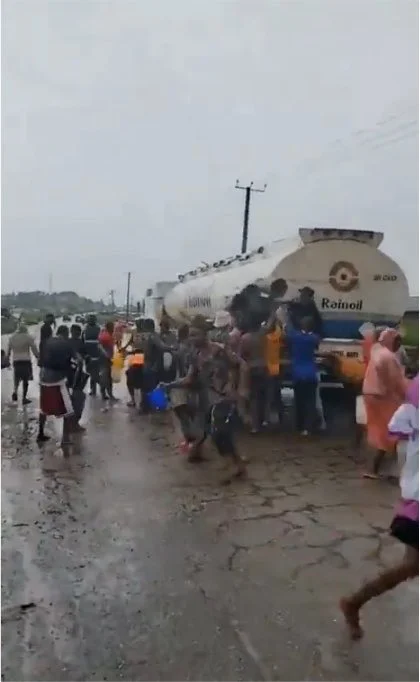
Residents scramble to scoop fuel from leaking tanker in Delta State despite explosion risk
The City Gate area of Asaba, Delta State, became the scene of a precarious public safety emergency on Thursday, July 30, 2026, as dozens of residents rushed to harvest petroleum products spilling from a compromised fuel tanker. Despite the well-documented history of lethal tanker explosions across Nigeria, men, women, and youths were observed maneuvering with jerrycans, buckets, and various makeshift containers to siphon the leaking fuel. The incident, which occurred in broad daylight, has reignited urgent debates regarding public awareness, economic desperation, and the enforcement of safety protocols surrounding the transportation of hazardous materials on public highways.
Chronology of the Asaba Incident
The alarm was raised shortly before midday on Thursday when a tanker, traversing the busy City Gate axis of Asaba, began leaking its volatile cargo. As the liquid hit the pavement, word spread rapidly through the immediate vicinity. Within minutes, the roadway was transformed into a site of frantic activity.
Eyewitness accounts and video footage circulated on social media platforms, including X, confirmed that the crowd grew exponentially as the leak continued. The participants appeared undeterred by the presence of other motorists or the evident danger posed by the high concentration of flammable fumes. Local traffic was severely disrupted, and the potential for a catastrophic ignition source—such as a discarded cigarette, an engine spark from a passing vehicle, or a static discharge—was dangerously high throughout the duration of the spill.
The Economic Context of Hazardous Scavenging
The behavior observed in Asaba is not an isolated phenomenon but rather a recurring symptom of broader economic pressures. With the rising cost of living and the fluctuating price of petroleum products in Nigeria, the opportunity to acquire "free" fuel often clouds the collective judgment of residents.
Sociological analysts note that when the disparity between the cost of essential commodities and the average household income widens, individuals are more likely to engage in high-risk behaviors for immediate gain. In the context of fuel scarcity or high pump prices, a leaking tanker represents a localized windfall that residents feel compelled to exploit, often ignoring the grim reality that such incidents have historically claimed hundreds of lives.
Historical Precedents and Safety Statistics
Nigeria has struggled for decades with the management of petroleum distribution, particularly concerning the transit of fuel tankers through densely populated areas. Data from the Federal Road Safety Corps (FRSC) and various disaster management agencies indicate that tanker-related accidents are among the leading causes of fire-related fatalities in the country.
Notable historical tragedies, such as the 2018 Otedola Bridge fire in Lagos, which resulted in multiple deaths and the destruction of dozens of vehicles, serve as stark reminders of the volatility of petrol. In many of these cases, the initial spill was exacerbated by the presence of civilians rushing to the scene. The thermal radiation from a fuel fire can reach temperatures exceeding 800 degrees Celsius within seconds, leaving virtually no window for escape once ignition occurs.
Official Safety Protocols and Regulatory Challenges
The transportation of petroleum products is governed by strict regulations enforced by the Nigerian Midstream and Downstream Petroleum Regulatory Authority (NMDPRA) and the FRSC. These regulations require tanker owners to ensure that vehicles are roadworthy, possess valid safety certifications, and are equipped with fire suppression systems.

However, the enforcement of these standards remains a logistical challenge. Experts argue that the prevalence of aged vehicles on Nigerian roads—many of which lack modern safety valves and leak-prevention mechanisms—contributes significantly to these incidents. Furthermore, the lack of immediate emergency response infrastructure at the municipal level often means that by the time fire services arrive, the situation has already escalated beyond control.
Analytical Perspectives: The Need for Behavioral Change
Public safety advocates emphasize that the primary issue is a lack of institutionalized disaster preparedness. When a spill occurs, the standard operating procedure should involve the immediate cordoning off of the area by law enforcement, followed by the evacuation of nearby residents. Instead, in many Nigerian cities, the arrival of law enforcement is often delayed, allowing the "scavenging" culture to take root.
"The psychological drive to scavenge during a spill is a manifestation of systemic desperation," says a safety consultant based in Abuja. "When people see fuel, they don’t see a ticking time bomb; they see a commodity that helps them get to work or power their homes. To change this behavior, we need not only stricter enforcement of road safety but also a comprehensive public education campaign that treats these spills as mass-casualty events in the making."
Broader Implications for Infrastructure and Policy
The Asaba incident raises critical questions regarding the infrastructure of fuel distribution. As the government continues to debate the deregulation of the downstream sector, the reliance on road transport for petroleum products remains a bottleneck. Infrastructure experts have long advocated for the revival of the national pipeline network to reduce the number of tankers on the road. By transporting fuel via pipelines rather than heavy-duty trucks, the risk of road-based spills—and the subsequent opportunities for public endangerment—would be significantly mitigated.
Furthermore, the role of local government authorities in disaster management cannot be overstated. Municipalities must develop rapid-response protocols that prioritize the dispersal of crowds and the stabilization of hazardous spills. This includes equipping local traffic management agencies with the training to identify the early warning signs of a failing tanker and the authority to shut down affected routes immediately.
Public Reaction and Future Prevention
The footage from Asaba has sparked a wave of condemnation from the public, with many calling for harsher penalties for both the transport companies whose vehicles are found to be leaking and the individuals who risk their lives to siphon the fuel. However, legal experts warn that criminalizing such behavior may not address the root causes. Instead, there is a push for a multi-stakeholder approach involving oil marketing companies, the transport unions, and community leaders.
As the authorities in Delta State assess the aftermath of the City Gate incident, the focus must shift toward prevention. This includes the mandatory installation of modern telematics and leak-detection sensors on all tankers, alongside a rigorous vehicle inspection regime that removes compromised trucks from the road before they reach urban centers.
Conclusion: A Call to Vigilance
The incident at Asaba serves as a sober reminder of the fragility of public safety in the face of industrial accidents. While the residents involved in the incident were fortunate to escape without an explosion, the outcome could have easily been a national tragedy. The recurring nature of these events demands a concerted effort from policymakers, transport regulators, and the general public to move away from the culture of dangerous scavenging.
Until the structural issues regarding vehicle maintenance and fuel distribution are addressed, and until there is a fundamental shift in how the public perceives the dangers of chemical spills, the risk of a major disaster remains ever-present on Nigerian highways. Protecting lives in such scenarios requires more than just warning signs; it requires a culture of safety that values human life above the fleeting, dangerous gain of a few liters of fuel.