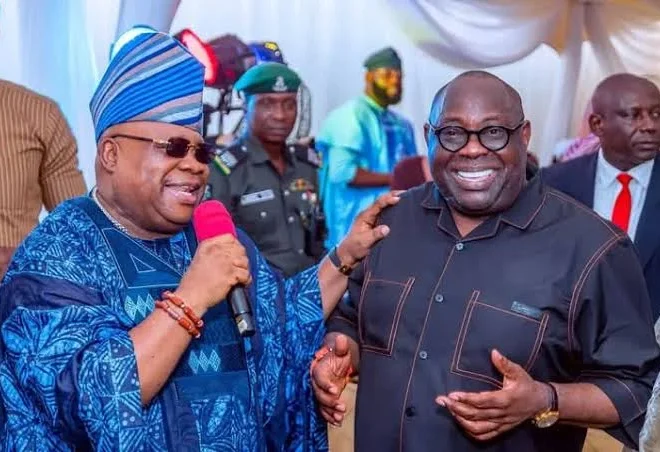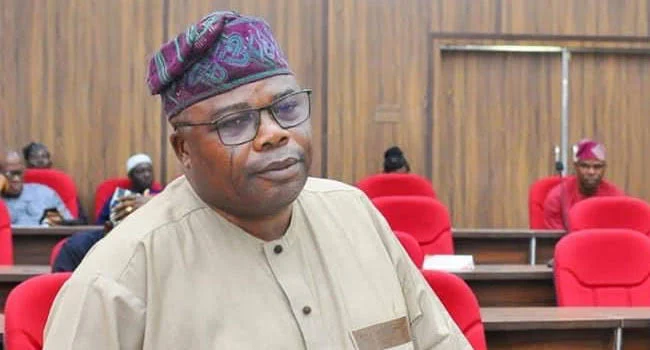
Political tension intensifies in Ondo State as lawmakers clash with Governor Aiyedatiwa over the impeachment of Speaker Olamide Oladiji
The legislative stability of Ondo State is currently facing its most significant test in recent years, as a deep-seated rift between the state executive and the legislature has paralyzed the normal operations of the Ondo State House of Assembly. At the heart of the crisis is a move by 21 out of the 26 members of the Assembly to remove the Speaker, Olamide Oladiji, from office. The rebellion, which has now entered a critical phase, is rooted in allegations of financial impropriety and a loss of confidence in the Speaker’s leadership capabilities.
Allegations of Financial Misconduct
The primary catalyst for the impeachment push centers on the alleged misappropriation of N44 million. According to the aggrieved lawmakers, the funds were earmarked for the reordering of the budget of the Ondo State Oil Producing Areas Development Commission (OSOPADEC). The lawmakers contend that these funds were diverted without following due process or legislative oversight, a claim that has sparked outrage within the hallowed chambers of the Assembly.
The OSOPADEC budget is a sensitive issue in the state, given that the commission is tasked with the development of oil-producing communities. Any mismanagement of funds allocated to this agency often carries significant political weight, as it directly impacts the welfare of a key constituency. Speaker Oladiji has vehemently denied these accusations, dismissing them as baseless attempts to tarnish his reputation and force his exit from the seat of power.
A Chronology of the Legislative Standoff
The brewing discontent reached a boiling point when a supermajority of the House members signed an impeachment notice. Initially, the lawmakers demanded an immediate resignation, setting a deadline for the Speaker to vacate his office. However, following behind-the-scenes negotiations and the intervention of external stakeholders—including, according to lawmakers, Governor Lucky Aiyedatiwa—the timeline was extended.
The progression of the crisis can be summarized as follows:
- The Initial Notice: 21 out of 26 lawmakers formally signed the impeachment notice, citing financial misconduct and a breach of trust.
- The First Deadline: Lawmakers issued an ultimatum for the Speaker to resign by a specific Sunday.
- The Extension: Following reported pressure from the executive arm, the deadline was extended to July 2.
- The Current Status: The House remains in a state of flux as members await the expiration of the second grace period, with accusations of gubernatorial interference heightening the stakes.
Legislative Autonomy vs. Executive Influence
The crux of the current dispute lies in the perceived interference of the executive branch in the internal affairs of the legislative arm. Olatunji Fabiyi, the Chairman of the House Committee on Information, has emerged as the voice of the dissenting lawmakers. In a series of pointed remarks, Fabiyi questioned the "special interest" the Governor might have in shielding a Speaker who has lost the confidence of his colleagues.
Fabiyi emphasized that the impeachment process is an internal legislative matter, governed by the standing orders of the House and the Nigerian Constitution. He argued that the intervention of the Governor is not only inappropriate but potentially unconstitutional, suggesting that it undermines the principle of separation of powers. "It’s exclusively a private affair of the House," Fabiyi stated. "If there is no hidden agenda, I see no reason why the governor should be protecting the Speaker."
The lawmakers claim that the Governor initially requested a seven-day grace period, which was later revealed to be a 14-day window. This perceived deception has only served to harden the resolve of the 21 members who remain committed to the removal of the Speaker.
Official Stance of the Governor’s Office
Responding to the mounting criticism, the Chief Press Secretary to Governor Aiyedatiwa, Ebenezer Adeniyan, has categorically denied that the executive is interfering in the legislative process. Adeniyan stated that the Governor maintains a neutral stance, with his primary interest being the preservation of peace, law, and order within the state.
"Mr. Governor has nothing to do with what is happening in the House of Assembly, and he has not prevented members from carrying out their legislative duties," Adeniyan stated. He further clarified that the Governor is not opposed to the lawmakers performing their statutory responsibilities, provided that the process remains orderly and within the bounds of the law. The executive position effectively places the burden of proof on the lawmakers to justify their actions through proper procedure rather than political maneuvering.
Implications for Governance and Stability
The ongoing crisis carries profound implications for the governance of Ondo State. A House of Assembly in turmoil often leads to a standstill in legislative business, including the screening of appointees, the passage of crucial state budgets, and the oversight of government projects.
If the impasse is not resolved by the July 2 deadline, the state could face several potential outcomes:
- Forced Impeachment: The 21 members may proceed to formally impeach the Speaker on the floor of the House, likely triggering a legal battle over the validity of the proceedings.
- Increased Executive-Legislative Friction: Should the Governor continue to be accused of interference, the relationship between the two arms of government could deteriorate further, potentially leading to a constitutional crisis.
- Political Realignment: The crisis may force a realignment within the ruling party in the state, as factions emerge based on support for or opposition to the current legislative leadership.
Contextualizing the Power Struggle
In the context of Nigerian state politics, the Ondo State House of Assembly has a history of robust and sometimes volatile political engagement. The current standoff highlights the fragile nature of legislative coalitions. When a supermajority (in this case, 80% of the house) moves against a leader, the political capital of that leader is typically considered exhausted. However, the involvement of the Governor’s office suggests that the Speaker may still command the support of the executive, complicating what would otherwise be a straightforward internal disciplinary process.
Public analysts have noted that such conflicts often arise during periods of political transition or when there is a perceived need to recalibrate power dynamics ahead of future electoral cycles. Whether the resolution comes through a resignation, an impeachment, or a forced reconciliation, the events in Akure this week will serve as a bellwether for the state’s political stability for the remainder of the current administration.
Moving Forward
As the July 2 deadline approaches, the attention of the public and political observers remains fixed on the House of Assembly. For the citizens of Ondo, the priority remains the continued delivery of public services, which could be negatively impacted if the legislative stalemate continues to consume the energy of their representatives.
The lawmakers have maintained that their resolve is firm and that they are acting in the best interest of the institution. As Fabiyi stated, "Somebody is leading us astray, and we say we don’t want him again." The next few days will determine whether this internal legislative revolt succeeds or if the influence of the executive branch will prevail in maintaining the status quo. In the final analysis, the situation underscores the ongoing struggle to define the boundaries between the executive and the legislature in Nigeria’s evolving democratic dispensation.