
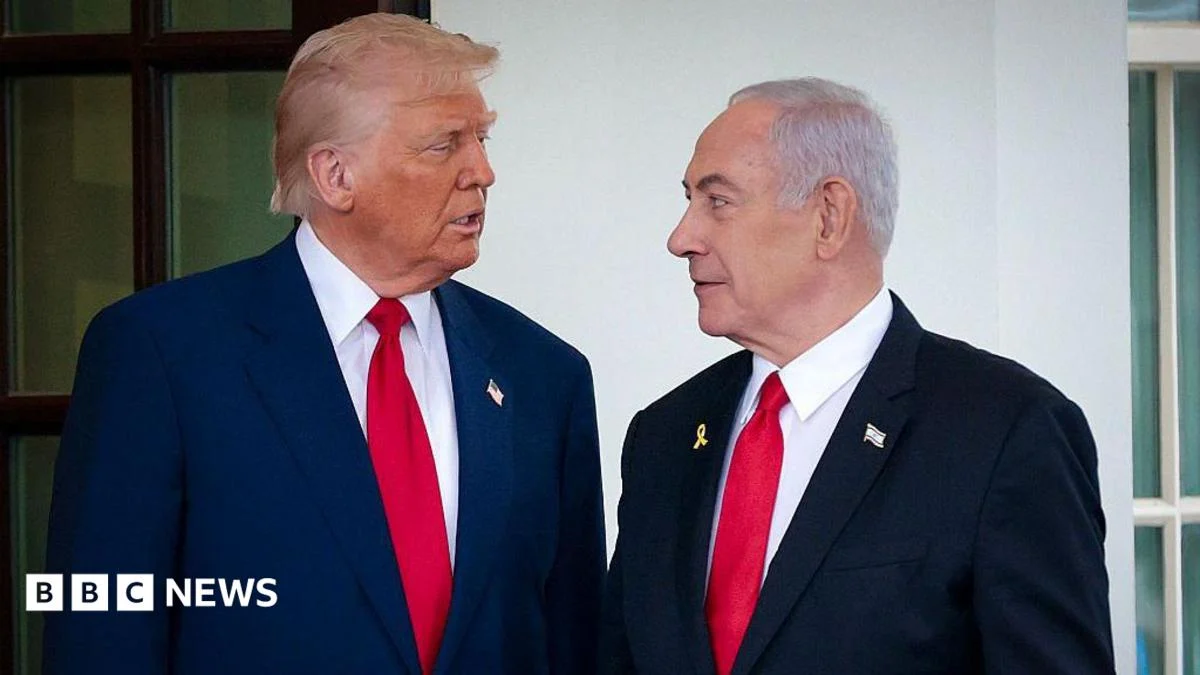
Netanyahu Rejects Trump’s Gaza Peace Plan, Demanding ‘Genuine’ Hamas Disarmament Before Israeli Withdrawal
Israeli Prime Minister Benjamin Netanyahu has unequivocally rejected a 15-point peace plan for Gaza proposed by US President Donald Trump, asserting that no military withdrawal will commence until Hamas is "genuinely" disarmed. This declaration on Sunday marks a significant setback for the Trump administration’s latest diplomatic initiative in the volatile Israeli-Palestinian conflict, casting a shadow over prospects for de-escalation and long-term stability in the besieged enclave.
The rejection comes despite an earlier announcement by Trump’s "Board of Peace" last month, which claimed to have secured an agreement for the "complete disarmament" of Hamas and other armed factions operating within Gaza. This agreement, hailed by President Trump as "a monumental step toward lasting peace and security," appeared to offer a rare glimmer of hope in a region accustomed to protracted conflict. However, Hamas had immediately qualified its acceptance, stating that the handover of its heavy weaponry was strictly contingent upon Israel ending "all forms of aggression" and a full withdrawal of its forces from Gaza. This fundamental divergence in the sequencing of actions has proven to be an insurmountable hurdle, at least for now.
The Disputed Peace Proposal and Its Genesis
The Trump administration’s broader "Gaza peace plan," initially unveiled in September of last year, aimed to address the chronic instability and humanitarian crisis plaguing the Gaza Strip. The proposal reportedly encompassed several key pillars: the establishment of a "Board of Peace" to oversee the agreement’s implementation, the complete disarmament of Hamas and other militant groups, a phased withdrawal of Israeli troops from the territory, and a comprehensive plan for the reconstruction of Gaza’s devastated infrastructure and economy. The vision articulated by Washington sought to transform Gaza from a flashpoint of conflict into a zone of economic opportunity, contingent upon the cessation of hostilities and the demilitarization of militant factions.
The "Board of Peace," an entity whose composition and specific mandate have not been fully disclosed, was intended to serve as a neutral arbiter, facilitating the intricate process of disarmament and reconstruction. Its announcement last month that an agreement had been reached with Hamas on disarmament was met with cautious optimism by some international observers, though skepticism remained high given the deep-seated mistrust between the parties. The very notion of Hamas, an organization designated as a terrorist group by Israel and the United States, agreeing to dismantle its military capabilities without significant concessions from Israel was viewed as ambitious, if not unrealistic, by many.
Netanyahu’s Unyielding Stance
Speaking at a cabinet meeting on Sunday, Prime Minister Netanyahu left no room for ambiguity regarding Israel’s position. "Israel rejects the 15-point document," Netanyahu stated firmly. He elaborated that the Israeli military "will not carry out any withdrawal until Hamas is genuinely disarmed and will continue to thwart threats against our forces and our citizens." The Prime Minister emphasized that Israel would not accept what he termed "fictitious disarmament," underscoring his demand for a verifiable and irreversible process that would neutralize Hamas’s military capabilities entirely.
Netanyahu confirmed that discussions with US officials regarding the path forward were ongoing, indicating a continued engagement despite the rejection of the current document. "They have ideas; some of them are acceptable to us and some are not, and we know how to stand our ground on these matters," he asserted, signaling Israel’s determination to protect its security interests. This statement highlights the intricate dance of diplomacy between two close allies, where shared strategic goals often intersect with divergent tactical approaches and domestic political realities.
Chronology of Key Events
To fully appreciate the gravity of Netanyahu’s rejection, it is essential to trace the recent timeline of events:
- September Last Year: US President Donald Trump’s administration formally announces its "Gaza peace plan," outlining its broad objectives, including the disarmament of militant groups and the reconstruction of the Strip. This plan was part of a larger, much-anticipated "Deal of the Century" that aimed to resolve the broader Israeli-Palestinian conflict, though its details remained largely under wraps and it was met with immediate skepticism and rejection by the Palestinian Authority.
- October Last Year: An initial ceasefire agreement is reached in the Gaza Strip following a period of heightened cross-border violence. While offering a temporary respite, this ceasefire proved fragile, with Israel continuing to carry out targeted strikes in Gaza in response to perceived threats, and sporadic rocket fire from Gaza persisting.
- Last Month: The US "Board of Peace" announces a breakthrough, stating it had secured an agreement for the "complete disarmament" of Hamas and other armed groups in Gaza. President Trump publicly hails this as a major diplomatic achievement, paving the way for lasting peace. Hamas, however, immediately clarifies its position, linking disarmament to a complete cessation of Israeli aggression and a full withdrawal of Israeli forces.
- This Sunday: Israeli Prime Minister Benjamin Netanyahu formally rejects the 15-point document, which presumably detailed the implementation steps of the disarmament plan. He reiterates Israel’s non-negotiable demand for genuine, verifiable disarmament of Hamas before any Israeli military withdrawal.
Historical Context: A Cycle of Conflict and Failed Initiatives
The current impasse is deeply rooted in the complex history of the Israeli-Palestinian conflict, particularly concerning the Gaza Strip. Gaza, a densely populated coastal enclave home to over two million Palestinians, has been under an Israeli and Egyptian blockade since 2007, when Hamas seized control from the Fatah-led Palestinian Authority (PA) following a bloody internal conflict. This blockade, imposed by Israel ostensibly for security reasons to prevent the smuggling of weapons and dual-use materials, has crippled Gaza’s economy and led to a severe humanitarian crisis, with high unemployment rates, widespread poverty, and dilapidated infrastructure.
Hamas, an Islamist movement, came to power after winning the 2006 Palestinian legislative elections. Its refusal to recognize Israel, renounce violence, and accept past agreements has been a consistent point of contention. Over the years, Gaza has been the epicenter of several major military confrontations between Israel and Hamas (e.g., Operation Cast Lead in 2008-09, Operation Pillar of Defense in 2012, Operation Protective Edge in 2014), along with countless smaller skirmishes. Each conflict has resulted in significant casualties, particularly among Palestinians, and further destruction of Gaza’s already fragile infrastructure.
Previous attempts at achieving a lasting peace or even a stable ceasefire have often stumbled over fundamental disagreements, primarily regarding security for Israel and an end to the occupation and blockade for Palestinians. The core issue of disarmament has always been central to Israeli security demands, while Palestinian factions view their armed resistance as a legitimate response to occupation and a deterrent against Israeli aggression. The Trump administration’s "Board of Peace" initiative sought to bridge this divide, but the inherent sequencing problem – who moves first – remains unresolved.
The Domestic Political Calculus in Israel
Netanyahu’s firm stance is not merely a reflection of Israel’s security doctrine but also a strategic move within the complex landscape of Israeli domestic politics. With Israeli elections just months away, the Prime Minister is under immense pressure from his right-wing and far-right allies to project an image of strength and unyielding commitment to national security. Making concessions on issues perceived as vital to Israel’s defense, especially concerning Hamas’s military capabilities, could severely undermine his political standing and alienate his voter base.
National Security Minister Itamar Ben Gvir, a prominent figure on the far-right and a key coalition partner, has been particularly vocal in his opposition to any plan that does not guarantee absolute Israeli security. He reportedly dismissed the draft plan as "not acceptable" and has called for a new cabinet vote to formally end any consideration of the Gaza plan. This pressure from within Netanyahu’s own government coalition limits his flexibility and reinforces his hawkish position. For Netanyahu, who faces ongoing legal challenges and a highly competitive election, maintaining the support of his right-wing base is paramount. A perceived softening on security issues could be politically fatal.
Reactions from Related Parties and International Implications
Netanyahu’s rejection will undoubtedly elicit a range of reactions from key regional and international actors:
- Hamas: The militant group is likely to perceive Netanyahu’s statement as a confirmation of Israeli intransigence and a justification for maintaining its armed capabilities. Their conditional acceptance of disarmament was always predicated on an immediate end to Israeli "aggression" and withdrawal, which Israel has rejected. This could harden their stance and lead to a resumption or intensification of low-level hostilities.
- Palestinian Authority (PA): The PA, led by President Mahmoud Abbas, has largely been sidelined by the Trump administration’s peace efforts, which it views as biased towards Israel. The PA would likely reiterate its position that any lasting peace must be negotiated within the framework of a two-state solution, involving East Jerusalem as its capital, and must not bypass its legitimate leadership. They would likely view the collapse of this specific Gaza plan as further proof of the futility of US unilateral initiatives.
- United States: While the rejection is a blow to the Trump administration’s diplomatic efforts, it is unlikely to lead to an immediate rupture in US-Israeli relations. US officials will likely continue discussions, attempting to find common ground or revise the plan. The administration’s "Deal of the Century" has faced numerous obstacles, and this latest development adds to the challenge of achieving any significant breakthrough.
- Regional Actors: Countries like Egypt and Qatar, which often play mediating roles in Gaza, will likely express concern over the renewed deadlock. They have invested diplomatic capital in facilitating ceasefires and delivering humanitarian aid. Jordan, a key US ally with a significant Palestinian population, will also be wary of any developments that could destabilize the region further.
- International Community: The United Nations and European Union will likely reiterate calls for de-escalation, adherence to international law, and a renewed commitment to a two-state solution based on pre-1967 borders. They will also likely emphasize the urgent need for humanitarian assistance in Gaza, which remains on the brink of collapse.
Broader Impact and Implications
The Israeli Prime Minister’s rejection of the Trump administration’s 15-point Gaza plan carries significant implications across several fronts:
- Future of the Peace Plan: This rejection effectively puts the specific 15-point document in jeopardy, if not entirely dismantling it. It highlights the fundamental chasm between Israeli and Hamas demands, particularly concerning the sequence of disarmament and withdrawal. Without a mutually acceptable framework for these critical steps, any peace initiative remains stillborn.
- Regional Stability: The failure to advance a diplomatic solution for Gaza increases the risk of renewed violence. The cycle of strikes and counter-strikes, though currently at a lower intensity than past escalations, can quickly spiral out of control. Continued instability in Gaza also has ripple effects on regional security, impacting Egypt and other neighboring states.
- US Foreign Policy: For the Trump administration, this represents another hurdle in its ambitious, albeit controversial, Middle East peace efforts. It underscores the difficulty of imposing solutions without the full buy-in of all principal parties and without addressing their core demands and fears. It may force the US to re-evaluate its approach or increase pressure on both sides.
- Israeli Politics: Netanyahu’s strong stance solidifies his image as a staunch defender of Israeli security, a crucial asset as he heads into elections. It sends a clear message to his right-wing base and potential voters that he will not compromise on what he deems essential security interests.
- Gaza’s Humanitarian Crisis: Without a political resolution, the humanitarian situation in Gaza is likely to remain dire. The blockade will persist, hindering reconstruction and economic development. The people of Gaza, who have borne the brunt of successive conflicts and deprivation, face a continued struggle for basic necessities and a dignified life.
- Disarmament vs. Withdrawal Dilemma: The core of the problem lies in the irreconcilable demands: Israel insists on verifiable, genuine disarmament of Hamas before any withdrawal, while Hamas demands an end to aggression and Israeli withdrawal before it considers laying down its heavy weapons. This creates a perpetual stalemate, as each side views the other’s initial move as a prerequisite for its own.
In conclusion, Prime Minister Netanyahu’s unequivocal rejection of the US-backed Gaza peace plan underscores the deep-seated challenges in resolving the Israeli-Palestinian conflict. Rooted in security imperatives, domestic political pressures, and historical grievances, the decision effectively halts the momentum of the Trump administration’s latest diplomatic push. As discussions between US and Israeli officials continue, the immediate future for Gaza appears to remain one of ongoing tension, humanitarian strain, and the elusive quest for a genuine and lasting peace.

Related Posts
Zambia on Edge: Opposition Leader Arrested Amid Allegations of Insurrection Plot and Election Tensions

Rescuers search for survivors of powerful Indonesia earthquake

