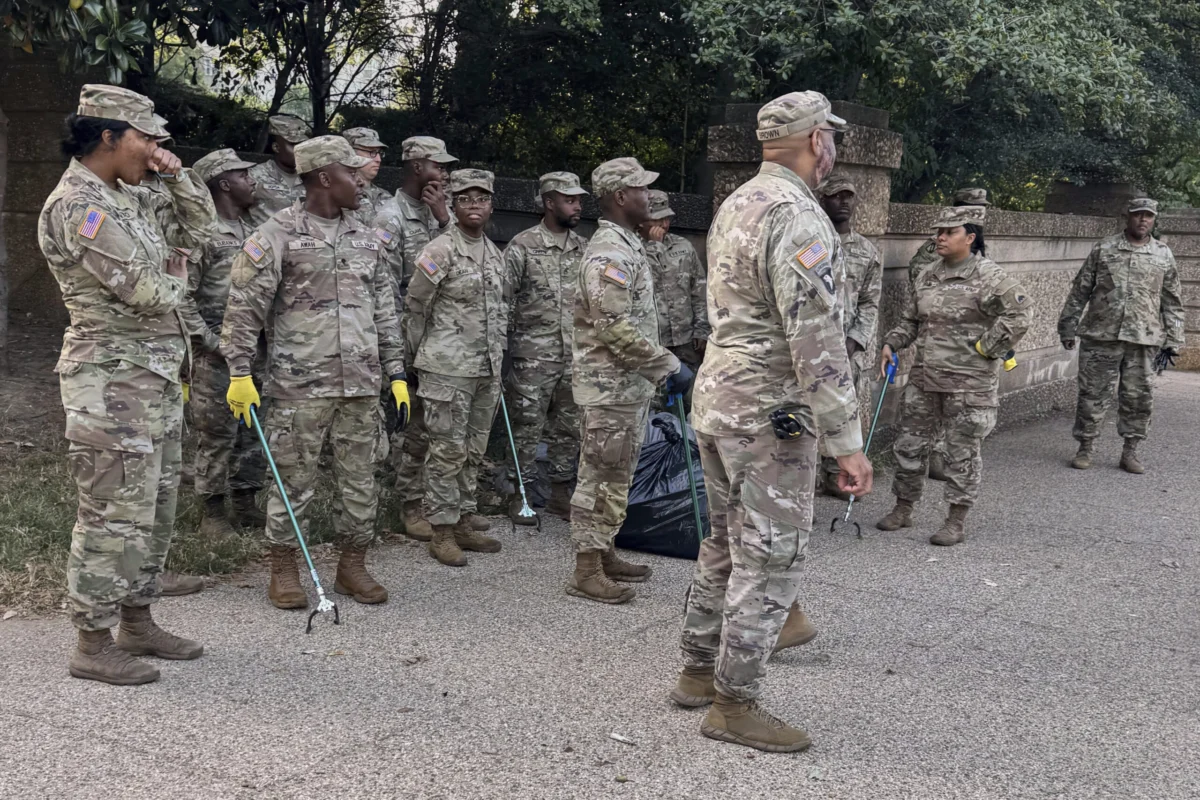
National Guard Marks One Year of Make DC Safe and Beautiful Mission Amid Questions Over Cost and Efficacy
As the "Make DC Safe and Beautiful" mission approaches its first anniversary, the presence of thousands of National Guard troops across Washington, D.C., remains a focal point of both administrative pride and fiscal scrutiny. Initiated on August 11, 2025, by order of President Donald Trump, the mission has seen nearly 9,700 National Guard personnel from various states rotated into the nation’s capital. The operation, which was originally framed as a short-term surge to bolster public order and urban aesthetics, is now projected to continue through the end of the current presidential term in January 2029.
Brig. Gen. Leland Blanchard, the interim commanding general of the D.C. National Guard, held a round-table discussion with reporters on Monday to assess the mission’s progress. During the briefing, Blanchard emphasized that the metric for success should not be limited to raw statistics but should also include the psychological impact of a visible security presence. However, as the mission enters its second year, lawmakers and policy analysts are increasingly weighing the tangible public safety benefits against a monthly price tag that exceeds $55 million.
Evolution of the Mission: A One-Year Chronology
The "Make DC Safe and Beautiful" mission began in late summer 2025, following a period of heightened concern regarding urban crime rates and public maintenance in the District of Columbia. The initial deployment focused on high-visibility areas, including the National Mall, the downtown business district, and major transit hubs.
By late 2025, the mission expanded its scope to include the "Ride the Rail" initiative, which placed Guard teams on D.C. Metro trains and platforms to deter harassment and ensure commuter safety. This phase was followed in early 2026 by a shift toward neighborhood-level patrols in areas identified as "hot spots" for narcotics activity and property crime. In May 2026, a significant study from the Niskanen Center provided the first independent look at the mission’s impact, noting a decline in certain crime categories while others remained stubbornly high.
In July 2026, the Department of Defense signaled a commitment to the long-term nature of the mission by awarding a $292 million contract to Placemakr, a corporate lodging company. This contract facilitates the transition of Guard members from commercial hotels to 2,000 apartment-style units, a move intended to institutionalize the Guard’s presence while reducing the overhead costs associated with tourism-rate hotel stays. As of August 2026, the mission is transitioning into "Phase Two," which will see personnel reallocated to specific high-crime neighborhoods, including Ward 8 and the Trinidad area, even as the overall troop count fluctuates following the conclusion of the United States’ 250th-anniversary celebrations.
Quantifying the Impact: Medical Assists and Law Enforcement Support
Throughout the first year of the deployment, National Guard members have functioned as a multi-purpose force, often acting as first responders in medical emergencies. Brig. Gen. Blanchard reported that Guardsmen have provided 788 medical assists over the past 12 months. These interventions have ranged from life-saving measures such as the administration of CPR and the application of tourniquets for gunshot victims to more routine emergency aid.
One of the most frequent types of intervention involves the opioid crisis. Guard members have administered the overdose-reversal drug Narcan to 325 individuals since the start of the mission. Blanchard highlighted a recent incident at Starburst Plaza in Northeast D.C., a location notorious for open-air drug activity, where an Air National Guard member successfully revived an individual experiencing an overdose.
The Guard’s presence has also been utilized to resolve social and interpersonal conflicts. Data provided by the D.C. National Guard indicates that troops have:
- Reunited 43 lost children with their families.
- Intervened in 262 physical altercations to prevent further escalation.
- Stopped at least one attempted sexual assault in progress on the D.C. Metro.
- Disarmed a knife-wielding individual threatening pedestrians.
Despite these figures, the Guard’s direct support of law enforcement has been relatively infrequent when compared to the size of the deployment. Troops have supported law enforcement agencies—including the Metropolitan Police Department (MPD) and federal entities—a total of 479 times. This averages out to approximately 1.3 law enforcement assists per day across the entire 4,600-to-9,700-man force.
The Fiscal Debate: Costs Versus Outcomes
The financial sustainability of the "Make DC Safe and Beautiful" mission has become a point of contention on Capitol Hill. According to estimates from the Congressional Budget Office (CBO), the deployment costs the federal government approximately $55 million per month. When these costs are weighed against specific outcomes, the figures become a lightning rod for criticism. For example, based on the 325 Narcan administrations reported, the cost of the mission equates to roughly $2 million per overdose reversal.
A new estimate provided to the office of Senator Elizabeth Warren (D-Mass.) suggests that the mission will require an additional $1.4 billion to sustain operations through January 2029. Critics argue that these funds could be more effectively utilized by increasing the budgets of permanent local law enforcement or investing in social services and mental health infrastructure within the District.
In response to these concerns, Brig. Gen. Blanchard pointed to the new $292 million housing contract as a major cost-saving measure. By moving troops into apartment-style units, the Guard expects to save approximately $90 million over the life of the contract. Blanchard also argued that this move would improve operational efficiency. "It allows our troops to be closer and more responsive to their mission areas," he stated, suggesting that the reduction in travel time from suburban hotels to city centers would enhance the "visibility" that the mission prioritizes.
Analyzing the Crime Data: The Niskanen Center Study
To understand whether the Guard’s presence is truly making D.C. "safe and beautiful," many have looked to a May 2026 study conducted by the Niskanen Center, a nonpartisan think tank. The study analyzed crime trends in the months following the August 2025 deployment and found a nuanced correlation between the military presence and public safety.
The research indicated a sharp decrease in "opportunistic property crime." This category includes vehicle theft, larceny from autos, and smash-and-grab robberies in commercial corridors. The authors concluded that the National Guard deployment served as a powerful deterrent for crimes that are sensitive to visible, high-presence enforcement. In areas where Guardsmen were stationed on street corners or patrolling in uniform, property offenders were significantly less likely to strike.
However, the study also found that "violent crime was unmoved." Robberies, aggravated assaults, and homicides did not see a statistically significant decline correlated with the Guard’s deployment. This suggests that while the military presence can secure property and provide a sense of order in public squares, it has yet to address the underlying drivers of violent crime that often occur in private spaces or among individuals with pre-existing disputes.
Blanchard acknowledged the study’s findings but maintained a positive outlook. He noted that the report confirmed a "positive impact where the Guard is located" and suggested that by shifting resources to neighborhoods like Ward 8, the Guard could begin to see a greater impact on the violent crime statistics that have remained stagnant.
Public Perception and Tactical Shifts
The "beautiful" aspect of the mission’s title is often reflected in the maintenance and cleanliness of the areas where the Guard is stationed. Blanchard recounted an anecdote from a visit to Starburst Plaza where a local teenager commented on the area being the "cleanest" he had ever seen it. This suggests that the Guard’s presence may be deterring littering, loitering, and public vandalism, contributing to an improved quality of life for residents in historically neglected neighborhoods.
As the mission enters its second year, the D.C. National Guard is preparing for a tactical reallocation of personnel. While maintaining a baseline presence in the downtown tourist corridors, more resources will be directed toward the Trinidad neighborhood and other parts of Southeast D.C. This "Phase Two" approach is designed to tackle the "hot spots" where drug activity and violent crime are most prevalent.
Blanchard emphasized that the Guard would continue to work in close coordination with the Metropolitan Police Department and federal law enforcement. "We’ll still be downtown, and we’ll still be in the neighborhoods that we’re in right now," Blanchard said. "We’ll just shift some of those resources… reallocate and repurpose some of those personnel."
Broader Implications of Domestic Military Deployment
The prolonged use of the National Guard for urban policing and maintenance in the nation’s capital raises significant questions about the role of the military in domestic life. While the Guard has historically been used for short-term disaster relief or to quell civil unrest, the "Make DC Safe and Beautiful" mission represents a shift toward a semi-permanent auxiliary police force.
Supporters of the mission argue that the unique status of Washington, D.C., as a federal district justifies extraordinary measures to ensure safety and order. They point to the 788 medical assists and hundreds of averted fights as evidence that the Guard is filling a critical gap in the city’s emergency response capabilities.
Conversely, civil liberties advocates and some local officials express concern that the militarization of city streets may have long-term social costs. There are concerns regarding the training of Guard members—who are primarily trained for combat and logistics—for the nuances of community policing and social service intervention. Furthermore, the $1.4 billion projected cost remains a significant hurdle for those who believe the mission is an inefficient use of taxpayer dollars.
As the deployment continues toward its 2029 conclusion, the balance between visible security and fiscal responsibility will likely remain a central theme of the D.C. political landscape. For now, the thousands of troops stationed in the city serve as a constant reminder of a federal administration’s commitment to a specific vision of urban order, even as the debate over the mission’s long-term value intensifies.

Related Posts
Pentagon Forges Landmark Seven-Year Agreements with Boeing and RTX to Accelerate Standard Missile-3 Production and Stabilize Defense Supply Chains
Boeing Unveils Ultra Low-Cost Seeker to Enhance Missile Inventory and Combat Cost Challenges in Modern Warfare