
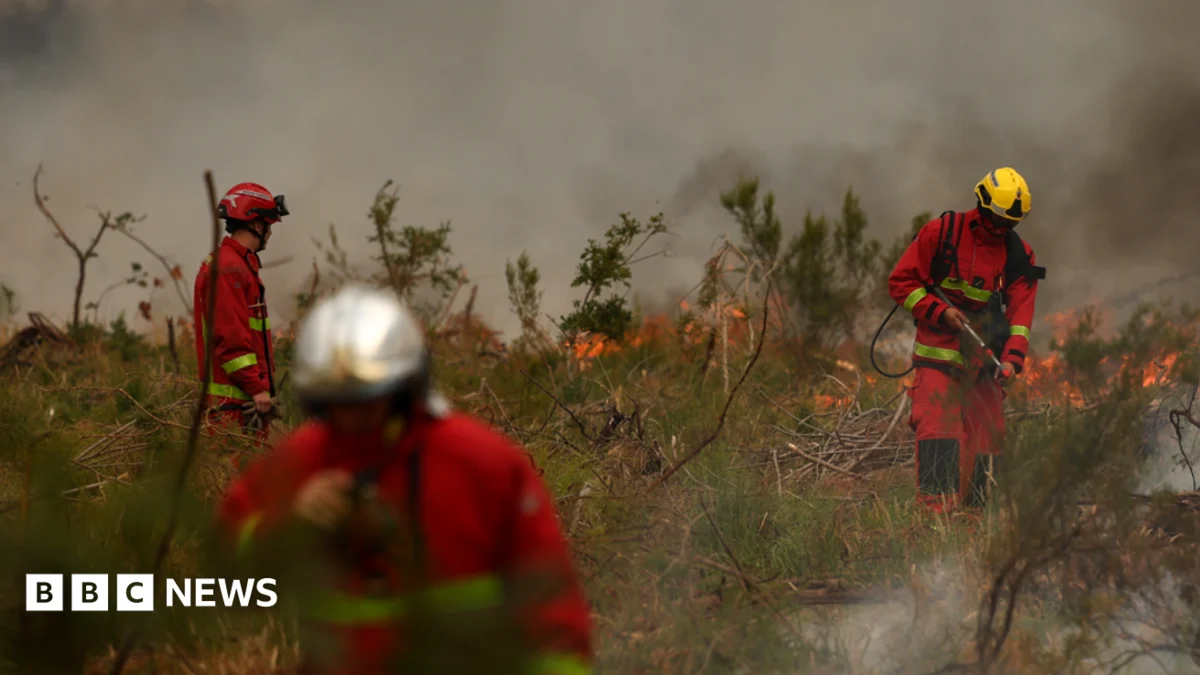
Massive Wildfires Ravage Southwestern Europe, Forcing Widespread Evacuations and Straining Emergency Services Amidst Unprecedented Heat.
Wildfires of unprecedented scale and intensity are tearing across southwestern Europe, particularly in France and Spain, leading to the evacuation of hundreds of thousands of residents and pushing emergency services to their absolute limits. The region around Bordeaux, France, a global hub for viticulture, has become a focal point of the crisis, as raging infernos threaten its periphery, prompting one of the largest civilian evacuations in recent French history. Simultaneously, Spain is grappling with multiple colossal blazes, some described as the largest in the nation’s modern record, exacerbating a continent-wide struggle against extreme heatwaves and drought.
The Unfolding Crisis in France: Gironde at the Epicenter
The French department of Gironde, famed worldwide for its prestigious vineyards and picturesque landscapes, finds itself at the heart of a devastating wildfire crisis. Firefighters are engaged in a relentless battle to contain blazes that have consumed vast tracts of land, forcing mass evacuations and raising concerns for urban areas. On Sunday, Bordeaux’s Mayor, Thomas Cazenave, confirmed the fires were approximately 15 kilometers (9 miles) from the city’s wider regional outskirts and 25 to 30 kilometers (15 to 19 miles) from its historic center. While Mayor Cazenave sought to temper fears of an imminent evacuation of Bordeaux itself, the proximity of the infernos underscored the gravity of the situation.
Overnight into Sunday, a staggering 55,000 people were compelled to evacuate from villages situated to the south of Bordeaux within the Gironde region. These pre-emptive measures aimed to safeguard lives as the unpredictable fires advanced, driven by persistent dry conditions and volatile winds. The scale of the destruction in southwestern France is stark: an estimated 42,000 hectares have been scorched, marking it as one of the most extensive forest fires the country has witnessed since the end of World War Two. This figure contributes to a grim national total of approximately 98,000 hectares burned across France since the beginning of the year, highlighting an exceptionally severe fire season. In total, more than 220,000 people have been evacuated from the country’s southwest alone since the crisis began to escalate.
Describing the formidable challenge faced by emergency personnel, Captain Nicolas Braz, a leader in the firefighting operation, stated that the fire had developed "its own winds – complete with whirlwinds," rendering it "erratic and unmanageable." This phenomenon, where intense heat creates localized wind systems that can dramatically alter a fire’s direction and speed, underscores the extreme conditions confronting responders. France’s Interior Minister, Laurent Nunez, echoed these concerns on Sunday, characterizing the situation in the region as "very unfavorable" and confirming that the wildfire was "moving erratically towards the Bordeaux metropolitan area," a statement that amplified the sense of urgency and threat.
A Massive Coordinated Response
The response to the wildfires in Gironde has been a monumental multi-agency effort, demonstrating the serious nature of the threat. The rescue operation mobilizes a vast contingent of 2,500 firefighters, a force augmented by an international Swiss team providing specialized assistance. They are supported by 1,500 military personnel, deploying their resources and logistical capabilities, and nearly 1,200 police and gendarmes, who are crucial for coordinating and executing complex evacuation procedures, maintaining public order, and securing affected zones.
The logistical challenges posed by the fires have extended to critical infrastructure. A 60-kilometer (37-mile) stretch of the A63 motorway, a vital artery connecting France with Spain, was closed to ensure public safety and facilitate emergency vehicle access. Air travel has also been significantly impacted. On Sunday afternoon, Bordeaux Airport experienced widespread delays across its departures and arrivals boards from 17:15 onwards. At least 28 Easyjet flights alone faced delays, many without updated departure or arrival times, and five flights, including some bound for the UK, were canceled. Bordeaux Airport communicated to BBC News that these air traffic control restrictions were implemented specifically "to facilitate the work of the emergency services" in combating the fires, affecting all commercial flights. The duration of these disruptions remained uncertain.
In a striking demonstration of national prioritization, the final stage of the prestigious Tour de France cycling race, scheduled for Sunday in Paris, was notably shortened from 133 kilometers to 89 kilometers (from 82 miles to 55). This adjustment was made to allow security forces, typically deployed for such high-profile events, to be redeployed to the critical firefighting efforts in the southwest. French President Emmanuel Macron acknowledged the severity of the crisis and offered a resolute message of national solidarity, stating that France would "rebuild" and that his government would "be there for as long as is needed," signaling a long-term commitment to recovery.
Spain’s Fiery Ordeal: Multiple Fronts Erupt
Across the Pyrenees, Spain is battling its own catastrophic wildfire season, characterized by numerous, large-scale blazes that have prompted widespread evacuations and caused immense environmental damage. More than 90,000 people have been evacuated from regions surrounding Madrid and Ávila, as fires threaten populated areas and rural communities.
The scale of destruction in Spain is equally staggering, with Sara Aagesen, the Minister for Ecological Transition, reporting on Sunday that approximately 77,000 hectares have been affected by the fires. Particularly alarming is the wildfire burning in the Ávila region, which she identified as the largest in the country’s recent history, underscoring the extraordinary nature of the current crisis. Adding to the nation’s woes, a new fire front erupted overnight into Sunday near the coastal city of Valencia, a popular tourist destination. Valencia’s regional President, Juanfran Pérez Llorca, conveyed a grim assessment to reporters late on Saturday, stating, "The fire is beyond our capacity to extinguish," a candid admission reflecting the immense power and spread of the blaze.
Pilar Bernabe, the central government’s delegate to Valencia, warned that conditions in the region were projected to deteriorate throughout Sunday, with forecasts of high temperatures and low humidity creating an optimal environment for further fire propagation. The human toll of the fires has also been tragic. On Saturday, one civilian tragically lost their life in a smaller fire in the Valencia region, marking the only civilian fatality reported so far in Spain. This followed the earlier deaths of two firefighters who succumbed to their injuries while battling the blaze near Bordeaux in France earlier in the week. Late on Saturday, at least eight municipalities near Toledo were also ordered to evacuate, though the precise number of affected residents was not immediately clear.
Visiting an area ravaged by wildfires to the west of Madrid on Sunday, Spain’s Prime Minister Pedro Sanchez acknowledged the severity of the situation, stating that "difficult hours lie ahead." However, he also offered a glimmer of hope, noting "positive" indications overnight towards containing some of the blazes. Crucially, Prime Minister Sanchez used the platform to advocate for a broader societal shift, calling for "a major public pact on the climate emergency," linking the current crisis directly to the imperative for climate action. Echoing the sentiment of historical significance, Madrid’s regional president, Isabel Díaz Ayuso, described the situation as the "worst fire in the history of the region," reflecting the profound impact on local communities and ecosystems.
Chronology of a Crisis: Escalation and Response
The current wave of wildfires represents an alarming escalation of a fire season that has been building across Europe for weeks, exacerbated by successive heatwaves. The initial outbreaks in France’s Gironde region began to intensify significantly roughly a week prior to the major evacuations, with dry conditions and high winds quickly fanning smaller fires into uncontrollable infernos. The situation reached a critical point by the weekend, with the decision to evacuate 55,000 people from villages south of Bordeaux overnight into Sunday, marking a major turning point in the French response. This was swiftly followed by the implementation of air traffic restrictions at Bordeaux Airport and the adjustment to the Tour de France schedule, signaling a national emergency.
In Spain, the timeline mirrored a similar pattern of rapid escalation. While individual fires had been active for some time, the past week saw multiple fronts expand dramatically. The Ávila region fire, now recognized as Spain’s largest in recent memory, grew exponentially, leading to the large-scale evacuations of over 90,000 people in the Madrid and Ávila areas. The tragic civilian fatality in Valencia on Saturday highlighted the immediate dangers posed by the fires, preceding the grim assessment by President Pérez Llorca that the Valencia fire was beyond control. The call for evacuations in Toledo late on Saturday underscored the widening geographical scope of the crisis. Throughout this period, emergency services in both nations have been in a continuous state of high alert, responding to new outbreaks and attempting to contain existing ones amidst extremely challenging conditions.
Underlying Factors: Drought, Heatwaves, and Climate Change
The unprecedented scale and intensity of these wildfires are not isolated incidents but rather the devastating culmination of several interconnected environmental factors, profoundly exacerbated by climate change. Southwestern Europe has endured a prolonged period of severe drought, leaving forests and scrubland exceptionally dry and combustible. This "fuel" for fires has been primed by successive, record-breaking heatwaves that have gripped the continent, pushing temperatures into the high 30s and even 40s Celsius for extended durations. The scorching heat desiccates vegetation, turning vast areas into tinderboxes.
Compounding these conditions are persistent, often strong winds, which act as a powerful accelerator for wildfires. These winds not only spread embers over vast distances, creating new fire fronts, but also increase oxygen supply to the flames, intensifying their heat and speed. Captain Braz’s observation of the fires generating "their own winds" is a critical indicator of a "megafire" scenario, where the sheer energy released by the blaze creates a self-sustaining and highly unpredictable dynamic.
Scientific consensus overwhelmingly links the increasing frequency and intensity of such extreme weather events – prolonged droughts, intense heatwaves, and severe fire weather – to anthropogenic climate change. A warmer planet leads to more evaporation, drier soils, and higher atmospheric temperatures, creating a perfect storm for wildfires to ignite more easily, spread faster, and burn more fiercely. The concept of "fire season" is evolving, becoming longer and more severe, particularly in regions like the Mediterranean basin, which are identified as climate change hotspots. This context provides a crucial backdrop to Prime Minister Sanchez’s urgent call for a "major public pact on the climate emergency," emphasizing the need for systemic solutions beyond immediate firefighting efforts.
Economic and Ecological Repercussions
The immediate and long-term repercussions of these wildfires are profound, spanning economic, ecological, and social spheres. Economically, the impact on agriculture is immense, particularly in Gironde, where the world-renowned wine industry faces an existential threat. The destruction of vineyards, beyond the immediate financial loss, represents a blow to cultural heritage and a multi-generational investment. Similarly, agricultural regions in Spain, including those producing olives, cereals, and other crops, face devastating losses.
The summer tourism season, a vital economic driver for both France and Spain, especially along their popular coasts and rural areas, will undoubtedly suffer. Airport disruptions, road closures, and the general perception of danger deter visitors, leading to significant revenue losses for businesses reliant on tourism. The cost of rebuilding homes, infrastructure, and restoring public services will run into billions of euros, placing a heavy burden on national and local budgets and potentially driving up insurance premiums.
Ecologically, the damage is catastrophic. Vast swathes of forests, which act as crucial carbon sinks, are being incinerated, releasing stored carbon back into the atmosphere and exacerbating global warming. The loss of biodiversity is immense, with countless species of plants and animals perishing or losing their habitats. Soil erosion becomes a severe problem in burnt areas, particularly with subsequent rainfall, leading to desertification and further ecological degradation. Air quality is also severely impacted across broad regions, posing health risks to residents far from the immediate fire zones. The long-term recovery of these ecosystems will take decades, if not centuries.
The Broader Call for Climate Action
The current wildfire crisis serves as a stark and undeniable manifestation of the climate emergency, prompting renewed and intensified calls for immediate and decisive action. Prime Minister Pedro Sanchez’s plea for "a major public pact on the climate emergency" reflects a growing political understanding that these events are not anomalies but symptoms of a larger, systemic problem. There is increasing pressure on governments, both nationally and at the European Union level, to implement more ambitious climate policies, accelerate the transition to renewable energy, and invest in climate adaptation and resilience strategies.
The EU’s Civil Protection Mechanism has been activated, allowing for cross-border aid and coordination, highlighting the shared nature of the challenge. Beyond mitigation, there is a recognized need for enhanced fire prevention strategies, including improved forest management, creation of firebreaks, early warning systems utilizing advanced technology, and public education campaigns to reduce human-caused ignitions. The sheer scale of the current devastation underscores that firefighting alone, however heroic, is insufficient without addressing the root causes.
Future Outlook and Resilience
As firefighters continue their heroic efforts to contain the current blazes, the immediate future remains precarious, with weather forecasts in some areas predicting continued high temperatures and dry conditions. The focus will remain on preventing new ignitions, protecting communities, and providing support to the hundreds of thousands displaced.
Looking further ahead, the wildfires of 2024 will undoubtedly serve as a critical turning point for policy-makers, scientists, and communities alike. The concept of resilience – the ability of societies and ecosystems to adapt and recover from such shocks – will be paramount. This includes investing in robust early warning systems, strengthening emergency response capacities, rethinking urban planning in fire-prone areas, and fundamentally altering land use practices to reduce vulnerability. The psychological toll on affected populations, many of whom have lost homes, livelihoods, and cherished landscapes, will also require significant long-term support. The current crisis is not merely a regional disaster but a stark warning for a continent grappling with the accelerating impacts of a changing climate, demanding a unified and enduring commitment to adaptation and mitigation.

Related Posts
Zambia on Edge: Opposition Leader Arrested Amid Allegations of Insurrection Plot and Election Tensions
Rescuers search for survivors of powerful Indonesia earthquake

