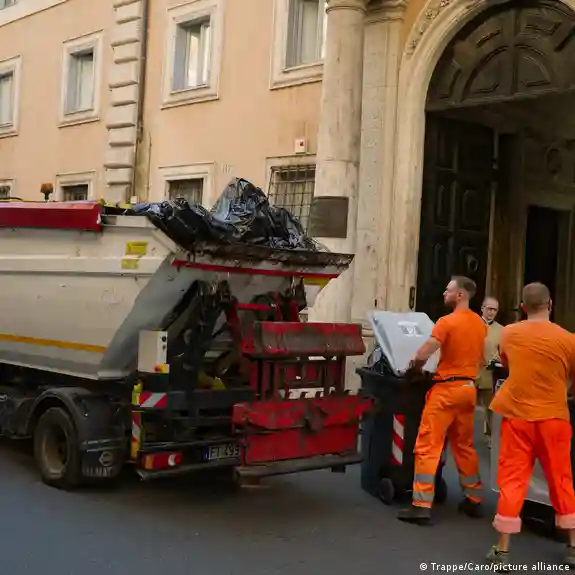
Italian garbage workers recover €1m lottery ticket win from trash
In an extraordinary turn of events that underscores the intersection of human error, municipal efficiency, and sheer fortune, a team of sanitation workers in Bitonto, Italy, successfully retrieved a €1 million winning lottery ticket from a mountain of refuse. The incident, which began with a simple misunderstanding of lottery protocols, culminated in an exhaustive, day-long search operation that has since captured international attention for its improbable success.
The saga began on a Saturday, when an unnamed resident of the southern Italian city participated in her routine lottery draw. Like many consistent players, the woman relied on a set of numbers that held deep personal significance, linked to a deceased loved one. Following the draw, she visited a local retailer on Sunday to verify her ticket. Upon scanning the slip, the lottery terminal displayed a message indicating that the ticket was “non-payable.” In the context of the Italian lottery system, this is a standard notification meant to signal that the prize amount exceeds the threshold that a local retail shop is authorized to pay out in cash.
Misinterpreting this prompt as a declaration that her ticket was a loser, the woman discarded the document into a household trash bin. It was only after a family member reviewed the winning numbers—2, 4, 8, 10, and 51—and compared them against the ticket’s digits that the magnitude of the error became clear. By the time the realization struck, the refuse had already been collected by a local municipal truck, destined for the city’s waste management system.
A Race Against the Rubbish Stream
The subsequent recovery mission was coordinated by Roberto Nicola Toscano, the administrator of the waste management firm SANB. Upon receiving a frantic call from the ticket holder, Toscano and his team were forced to act with extreme urgency. The primary objective was to intercept the specific garbage collection vehicle before its contents were offloaded into a larger processing center or incinerator, where the ticket would have been rendered irrecoverable.
Toscano’s team utilized the company’s logistical tracking data to pinpoint the exact route and location of the truck that had serviced the woman’s neighborhood. The operation required a high degree of precision; once the vehicle was identified, it was diverted away from standard processing facilities to a specialized, secure location where the waste could be manually sorted. This decision was driven not only by the need to find the ticket but also by the necessity of ensuring worker safety, as sifting through municipal waste involves exposure to hazardous materials, sharp objects, and unsanitary conditions.
The Logistics of a Miracle
The search process was a grueling ordeal that lasted an entire business day. According to accounts provided to local media, including the Italian newspaper Corriere della Sera, the sanitation workers tasked with the recovery operated under difficult conditions. The task was effectively a "needle in a haystack" scenario, requiring the team to sort through tons of household waste.
Despite the environmental and logistical challenges, the persistence of the sanitation crew paid off. In what can only be described as a stroke of immense luck, the ticket was recovered in a single, intact piece. When the news was relayed to the winner, she was reportedly overcome with emotion, bursting into tears of relief and disbelief. The recovery of the ticket served as a testament to the organizational capabilities of the SANB, as the window for such a retrieval is typically measured in mere hours before waste is compressed or subjected to industrial sorting processes.
Official Responses and Administrative Implications
The recovery effort has sparked a broader conversation regarding the role of public services and the boundaries of municipal responsibility. Roberto Nicola Toscano has been vocal about the nature of the operation, emphasizing that while the result was a success, it was a departure from the routine duties of the sanitation department.
"This could not have been achieved without the professionalism and dedication of the sanitation workers," Toscano remarked. "They worked in conditions that were anything but pleasant, but they understood the importance of the situation for the citizen involved."
However, the event has also raised questions regarding public funding. Because SANB is a public entity, the costs associated with the emergency diversion and the labor required for the search were technically covered by municipal budgets. Toscano addressed these concerns directly, noting that the winner had committed to covering all additional costs incurred by the operation, ensuring that the taxpayer would not be burdened by the financial implications of her mistake. This commitment highlights the winner’s recognition of the extraordinary effort exerted on her behalf.
Statistical Context of Lottery Errors
While the recovery of a lost winning ticket is rare, the phenomenon of "unclaimed prizes" is a well-documented aspect of global lottery systems. According to data from various national lottery commissions, millions of euros in prize money go unclaimed every year, often because winners lose their tickets, fail to check their numbers, or misinterpret the validation process—much like the woman in Bitonto.
In many jurisdictions, unclaimed prizes are eventually funneled back into the prize pool or donated to state-sponsored charitable initiatives. The Bitonto incident serves as a stark reminder of the importance of secondary verification. Lottery authorities frequently advise players to sign the back of their tickets immediately upon purchase and to use official mobile applications or authorized websites to verify results rather than relying solely on the verbal or digital feedback of retail clerks.
Broader Impact and Social Significance
The case has resonated deeply within the community of Bitonto and beyond, touching on themes of luck, despair, and the unexpected kindness of public servants. In an era where news is often dominated by macroeconomic shifts or political instability, the story of a lost million-euro ticket serves as a human-interest narrative that highlights the potential for positive outcomes even when the odds are stacked against the individual.
Furthermore, the incident has bolstered the public image of the SANB sanitation workers. Often relegated to the background of urban life, these workers were, for a brief moment, the heroes of the city. The fact that the ticket remained intact after being tossed into a bin and transported in a garbage truck is a statistical anomaly that many are calling a "miracle."
Conclusion: Lessons Learned
The incident in Bitonto will likely be cited in future discussions regarding waste management logistics and the importance of prompt reporting in the event of lost assets. It also underscores a vital lesson for lottery players: the importance of double-checking results and, more importantly, keeping a level head when a machine indicates a "non-payable" status.
As for the winner, the recovery of the ticket has fundamentally changed her financial trajectory. For the workers at SANB, the event stands as a landmark moment of coordination and grit. While the woman has expressed her intention to reimburse the city for the search, the true value of the story lies in the collaboration between a private citizen and a public service, proving that with enough determination, even the most lost items can be brought back into the light. The story of the Bitonto ticket remains a fascinating case study in the unpredictability of life, serving as a reminder that in the world of high-stakes chance, the final result is sometimes determined by the very things we discard.