Human Rights Watch Condemns Excessive Force and Internet Shutdowns During New Delhi Youth Protests
Human Rights Watch issued a comprehensive report today calling for an immediate and impartial investigation into the actions of Indian security forces, who allegedly used unnecessary and excessive force to suppress a largely peaceful demonstration by students and youth in New Delhi on July 20, 2026. The international rights watchdog urged the administration of Prime Minister Narendra Modi to cease the suspension of mobile internet services and uphold the constitutional right to peaceful assembly, noting that the crackdown resulted in scores of injuries, including a young woman currently in critical condition. The unrest, which has been simmering since June, highlights a deepening rift between the Indian state and a generation of youth grappling with systemic mismanagement and a perceived lack of economic opportunity.
The Catalyst of Unrest: From Exam Scandals to Collective Grievance
The protests that culminated in the July 20 march were not an isolated event but the result of weeks of escalating tension. The initial spark was ignited in early June 2026, following widespread allegations of mismanagement and paper leaks in the national medical entrance examinations. For millions of students in India, these examinations represent the sole gateway to professional stability; any perceived compromise in the integrity of the process is viewed as a direct assault on their future.
However, the movement quickly evolved beyond academic grievances. By mid-July, the demonstrations had transformed into a broader indictment of the government’s handling of the economy, specifically regarding the high rates of youth unemployment and persistent corruption within the bureaucracy. A significant turning point occurred when Supreme Court Chief Justice Surya Kant reportedly compared unemployed youths to "cockroaches" who become "media activists" to attack the system. This comment served as a powerful mobilizing force, leading to the formation of the "Cockroach Janta Party" (CJP)—a Gen Z-led movement that reclaimed the pejorative term as a badge of defiance.
The CJP’s call for a peaceful march to the Parliament on July 20 was intended to be a symbolic demand for accountability. Instead, the event became a site of violent confrontation. "India’s youth wanted to march peacefully to parliament to seek accountability from their elected leaders," said Meenakshi Ganguly, deputy Asia director at Human Rights Watch. "Instead, the police met them with batons, tear gas, and internet shutdowns."
Chronology of the July 20 Crackdown
The events of July 20 were preceded by a period of sustained activism at Jantar Mantar, an 18th-century observatory that has historically served as Delhi’s designated protest site. Protesters had occupied the site since June, but the momentum shifted on July 18 when Delhi police forcibly removed activist Sonam Wangchuk. Wangchuk, who had been on a hunger strike since June 28 to highlight regional and youth issues, was admitted to a public hospital against his will, an act that many protesters viewed as an attempt to decapitate the leadership of the movement.
On the morning of July 20, thousands of students and young professionals gathered for the march to Parliament. As the crowd approached police barricades, the situation deteriorated rapidly:
- 12:00 PM: Protesters began their march from Jantar Mantar, chanting slogans against exam leaks and unemployment.
- 1:30 PM: The procession was halted by multi-layered police cordons. Initial negotiations between student leaders and police officials were unsuccessful.
- 2:15 PM: Reports emerged of the first tear gas canisters being deployed. Simultaneously, mobile internet services in Central Delhi began to flicker and eventually failed.
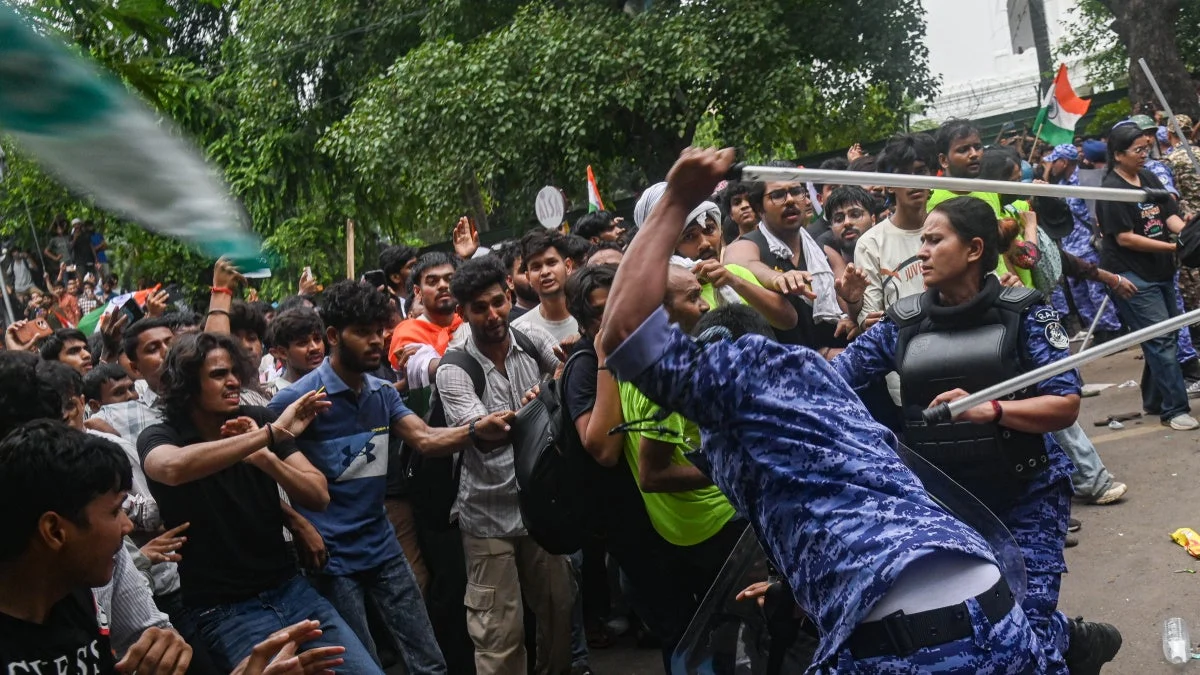
- 3:00 PM: Police launched a coordinated "Lathi" (baton) charge to disperse the crowd. Witnesses described a chaotic scene where protesters were pushed into confined spaces, creating a high risk of a stampede.
- 4:30 PM: Several protesters were detained and transported to local police stations, while the injured were moved to nearby hospitals.
Human Rights Watch verified six videos showing security officers using batons and tear gas against non-resisting protesters. In one verified clip, a tear gas canister exploded in the middle of a group of students sitting on the ground, the force of which knocked a young man off his feet.
Verified Allegations of Excessive Force and Surveillance
The Human Rights Watch investigation involved interviews with nine witnesses, including protest organizers, journalists, and student participants, alongside the verification of 10 social media videos. The findings suggest a pattern of behavior by security forces that deviates from international standards for crowd control.
Witnesses described a "suffocating" environment. A 24-year-old law student recounted how police charged at a crowd that was already hemmed in by barricades. "It was suffocating; there was hardly any space to breathe," she told researchers. "Two of the girls with me fell and people stepped on them." A 24-year-old photojournalist corroborated these accounts, noting that he witnessed male police officers "bashing up" women who were entreating them with folded hands.
A particularly concerning aspect of the report involves the presence of men in civilian clothes participating in the violence. HRW verified a video showing three men in civilian attire wielding plastic batons—identical to those used by the police—beating protesters alongside uniformed officers. Furthermore, many officers from the Delhi Police and the Rapid Action Force (RAF) were observed without name tags, a practice that Human Rights Watch notes "thwarts accountability for their actions."
The report also highlighted the use of advanced technology to monitor the dissent. Digital rights groups reported that protesters were subjected to surveillance using facial recognition systems (FRS). The use of FRS during peaceful protests has been criticized by civil liberties advocates as a tool of intimidation that can lead to the "chilling" of free speech and assembly.
The Digital Blackout: Impact on Safety and Rights
The July 20 crackdown was accompanied by a localized shutdown of mobile internet services. While telecommunication providers confirmed receiving orders to suspend services, the government reportedly failed to abide by Supreme Court directions to make such suspension orders public.
The internet shutdown had immediate consequences for the safety of those on the ground. One protester described losing his friends during a baton charge and being unable to locate them because mobile services were jammed. "No calls were going through," he said. This lack of communication hindered the ability of the injured to seek help and prevented families from confirming the safety of their relatives.
Human Rights Watch emphasized that India has a documented history of using internet shutdowns to restrict information access and conceal abuses by security forces. "Access to the internet is widely recognized as an indispensable enabler of a broad range of human rights," the report stated, citing the 2016 United Nations Human Rights Council resolution that condemned such measures.
Official Responses and Political Repercussions
The official government and police narrative stands in stark contrast to the findings of Human Rights Watch. Delhi police officials claimed that the protesters displayed "unruly, aggressive, and violent behavior," alleging that the crowd attacked officers with stones and vandalized government vehicles. According to police reports, 118 personnel were injured during the skirmish. HRW did verify one video showing a group of protesters beating a police officer who had fallen to the ground, but noted that the majority of the crowd remained non-violent.
The political fallout was immediate. On July 21, opposition leaders, including Rahul Gandhi and Priyanka Gandhi Vadra, held a sit-in near the Prime Minister’s residence to protest the "insensitive" and "authoritarian" crackdown. They were briefly detained by police. However, the legal recourse for the protesters faced a setback when the Supreme Court of India refused to hear an urgent plea regarding police abuses. The court reportedly told the petitioners, "don’t waste our time," a comment that has drawn sharp criticism from legal experts and human rights defenders.
Implications for Democratic Space in India
The events of July 20, 2026, serve as a critical indicator of the shrinking space for dissent in the world’s most populous democracy. The use of "less-lethal" weapons like tear gas and batons against a youth movement highlights a shift toward more aggressive policing of domestic grievances.
International law, including the UN Basic Principles on the Use of Force and Firearms by Law Enforcement Officials, dictates that force should only be used when strictly necessary and must be proportionate to the objective. The 2020 UN guidance specifically states that tear gas should not be used to disperse nonviolent demonstrations. The HRW findings suggest that these international norms were largely ignored during the New Delhi crackdown.
The rise of the "Cockroach Janta Party" signifies a new era of digital-native activism that is difficult for traditional state structures to manage. By utilizing humor, social media, and decentralized organization, the youth movement has managed to maintain momentum despite the crackdown. However, the government’s reliance on surveillance and digital blackouts suggests a move toward a more "techno-authoritarian" approach to governance.
"India’s police have a long history of committing serious human rights violations with impunity," Meenakshi Ganguly concluded. "The authorities need to promptly and impartially investigate security force abuses against the protesters in Delhi and appropriately prosecute those responsible, regardless of rank."
As the young woman injured in the protests remains in critical condition, the call for accountability continues to grow. The international community and domestic civil society will be watching closely to see if the Indian government chooses the path of dialogue and reform or continues to rely on force to manage the aspirations and frustrations of its youth.

Related Posts
Human Rights Watch Calls for Investigation into Death of Detainee Following Removal from Najaf Hospital by Iraqi Drug Police
Human Rights Watch Urges UN Security Council to Extend Lebanon Peacekeeping Mission Amid Escalating Conflict and Humanitarian Crisis