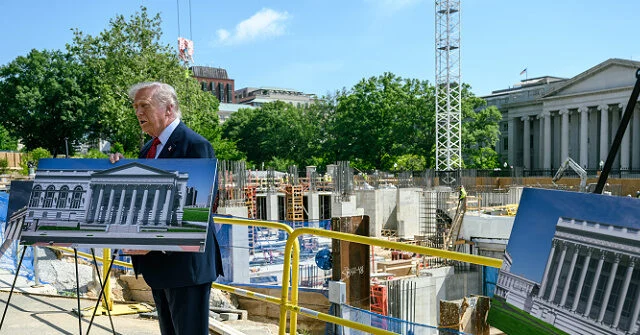
Federal Appeals Court Halts White House Ballroom and Military Complex Construction, Drawing Sharp Rebuke from Former President Trump
A federal appeals court has delivered a significant blow to former President Donald Trump’s plans for a sprawling White House ballroom and military complex, ordering an immediate halt to construction. The decision, rendered by a divided panel of judges, cited a lack of congressional authorization for the ambitious $400 million project, which aimed to replace a substantial portion of the East Wing. Former President Trump swiftly condemned the ruling, attributing it to judges appointed by former Presidents Barack Obama and Joe Biden and asserting that presidents possess inherent authority to renovate and secure the White House without legislative consent.
The court’s ruling, made public on Friday, centered on the principle of congressional control over federal appropriations and property. It found that the Trump administration had overstepped its authority by initiating a project of this scale without explicit funding or approval from Congress, emphasizing that the president does not hold unilateral power to undertake such significant structural changes to the Executive Mansion. This judicial intervention underscores the intricate balance of power between the executive and legislative branches, particularly concerning the use of federal funds and the modification of national landmarks.
The Judicial Decision and Its Constitutional Basis
The federal appeals court’s majority opinion articulated a clear stance on the separation of powers, asserting that major alterations to federal property, especially those involving substantial public expenditure, fall squarely within Congress’s purview. The court’s primary argument rested on the Appropriations Clause of the U.S. Constitution (Article I, Section 9, Clause 7), which states, "No Money shall be drawn from the Treasury, but in Consequence of Appropriations made by Law." This clause grants Congress the exclusive power of the purse, meaning no federal funds can be spent without its explicit authorization.
In the case of the proposed 90,000-square-foot ballroom and military complex, the court determined that the project lacked the necessary congressional appropriation. While presidents traditionally possess some discretion over minor renovations and maintenance of the White House, the scale and scope of the proposed project were deemed to exceed these established bounds. The court rejected the argument that presidential authority to "secure" or "improve" the White House inherently bypasses congressional oversight for a project of this magnitude.
A key phrase highlighted by former President Trump from the court’s reasoning was the characterization of a president as a "temporary tenant" of the White House. This legal framing emphasizes that the presidency is an office, and the individual holding it occupies federal property in trust for the nation, not as a private owner with unfettered discretion over its structural integrity or design. The court’s decision effectively reinforced the notion that the White House, as a national treasure and a symbol of American democracy, is subject to the same constitutional checks and balances that govern other federal assets.
Former President Trump’s Vehement Rebuttal
In a series of posts on his social media platform, Truth Social, former President Trump launched a scathing critique of the court’s decision and the judges involved. He specifically pointed out that one judge was appointed by former President Barack Obama and the other by President Joe Biden, implying a politically motivated ruling.
"Two Judges, one appointed by Barack Hussein Obama, the other by Sleepy Joe Biden, said in a ruling on the desperately needed SECURE Ballroom/Military Complex, including a major DronePort on the roof, that ‘Each President is a temporary tenant … of the White House,’" Trump wrote. He vehemently rejected this characterization, stating, "We are not tenants, who pay rent and do all other things that a tenant must do, we are PRESIDENTS, elected by the people of the United States of America, and have many rights, including the right to fix, renovate, secure, protect, and beautify the White House grounds, which has been built and rebuilt, renovated and rerenovated, repaired and, simply, MADE BETTER, many times since 1792, and never needing the permission of Congress."
Trump’s argument hinges on the idea of inherent presidential authority derived from popular election, suggesting that the mandate from the American people grants the chief executive broad powers over the Executive Mansion. He framed the project as a matter of national security, repeatedly referring to it as a "desperately needed SECURE Ballroom/Military Complex" and asserting that the court’s decision posed a direct threat to national safety by halting a critical initiative. He also claimed that the project was already largely built and funded, raising questions about the financial implications of the construction halt.
Chronology of a Controversial Project
The concept of a significant expansion or modernization of the White House has been a recurring theme throughout various administrations, often driven by evolving security needs and functional requirements. However, specific details regarding former President Trump’s proposed ballroom and military complex began to surface more prominently in the latter part of his presidency and continued into his post-presidency.
While a precise initial announcement date for the specific $400 million project is not widely documented in public records, indications of a desire for enhanced facilities at the White House, particularly for large-scale events and security, have been consistent. The project gained public visibility through satellite imagery and former President Trump’s own social media posts.
- Early Mentions (Unspecified): General discussions or desires for White House facility enhancements.
- Public Visibility of Construction (Post-Presidency): In the period leading up to the court’s ruling, aerial photographs, some shared by former President Trump himself, began to show significant construction activity on the White House grounds, particularly near the East Wing.
- August 4, 2026 (Truth Social Post): Former President Trump shared an aerial photo, confirming construction was underway at the White House’s East Wing. He stated that the project was "on budget and ahead of schedule" and mentioned that the military complex would include a drone port, though the steel structure for it was not yet visible.
- August 7, 2026 (Federal Appeals Court Ruling): The divided federal appeals court issued its ruling, ordering the cessation of construction on the $400 million White House ballroom and military complex due to a lack of congressional authorization.
- August 7, 2026 (Trump’s Initial Reaction): Following the ruling, former President Trump posted on Truth Social, criticizing the judges and their reasoning, and emphasizing his view of presidential authority.
- Subsequent Days (Truth Social Posts): Trump continued to defend the project and criticize the ruling, reiterating the national security aspects and the alleged political motivations behind the judicial decision.
The swift judicial intervention after visible construction had begun indicates that the legal challenge likely emerged as the project’s physical manifestation became undeniable, prompting concerns about adherence to established protocols for federal building projects.
The Proposed White House Ballroom and Military Complex: Scope and Ambition
The proposed White House ballroom and military complex was envisioned as a significant, indeed unprecedented, expansion of the Executive Mansion’s facilities. At the heart of the plan was a 90,000-square-foot ballroom, a scale far exceeding any existing public entertaining space within the White House complex. For context, the State Dining Room, the largest dining facility, is a fraction of this size, and the existing East Room, often used for receptions and ceremonies, is roughly 79 by 36 feet (approximately 2,800 square feet). A 90,000-square-foot ballroom would constitute a massive addition, potentially dwarfing existing structures and significantly altering the historical footprint of the East Wing.
Beyond the ballroom, the project’s designation as a "military complex" with a "major DronePort on the roof" introduced novel and highly advanced security and logistical capabilities. A drone port on the White House roof would represent a significant technological and strategic upgrade, facilitating rapid deployment and retrieval of unmanned aerial vehicles for surveillance, security, or even ceremonial purposes. Such a feature would require extensive structural reinforcement, advanced navigation systems, and integration into the existing security apparatus of the Secret Service and the U.S. military.
The estimated cost of $400 million underscores the project’s ambition and complexity. For comparison, the last major structural addition to the White House was the creation of the East Wing itself during World War II, primarily to conceal the construction of an underground bunker and later to provide additional office space and a visitor’s entrance. Major renovations like the Truman Balcony addition or the extensive interior overhaul during the Truman administration, while costly, were also subject to congressional awareness and, in many cases, explicit authorization or funding through established channels. The sheer scale and modern features of the proposed complex, particularly the drone port, distinguish it from previous White House modifications.
Historical Precedent and Presidential Authority over the White House
The White House, completed in 1800, has undergone numerous renovations, expansions, and structural changes throughout its history. From the rebuilding after the War of 1812 to the extensive modernization during Theodore Roosevelt’s presidency (which saw the construction of the West Wing) and the comprehensive structural overhaul under Harry S. Truman, the Executive Mansion has continuously adapted to the needs of its occupants and the demands of the nation.
However, virtually all significant structural changes and expansions involving substantial federal funding have historically been subject to congressional approval and appropriations. The West Wing, for instance, was conceived to move offices out of the residential quarters, and its construction was authorized and funded by Congress. The East Wing, initially a temporary structure for social events and later expanded, also received congressional assent. Even seemingly minor additions, such as the Truman Balcony, while initiated by the president, typically fall within established maintenance budgets or are publicly debated and approved.
The legal framework governing federal property, particularly historic landmarks like the White House, vests significant authority in Congress. The General Services Administration (GSA) often plays a role in managing federal buildings, and changes to such properties usually require adherence to specific regulations, including environmental impact assessments and historical preservation reviews. The argument that a president, by virtue of popular election, possesses unilateral authority to undertake a $400 million structural overhaul without legislative consent directly challenges this historical and constitutional framework. Legal scholars and constitutional experts generally concur that while presidents have operational control over the White House, major capital improvements and new construction require legislative appropriations. This principle is a cornerstone of the checks and balances designed to prevent executive overreach and ensure democratic accountability in the use of public funds.
Legal and Constitutional Implications
The federal appeals court’s ruling carries substantial legal and constitutional implications, reinforcing the critical role of congressional oversight in federal spending and property management.
- Reinforcing the Appropriations Clause: The decision strongly affirms Congress’s exclusive power of the purse. It establishes a clear precedent that even for projects related to the White House and national security, the executive branch cannot bypass the legislative body’s constitutional authority over federal funds.
- Limits on Executive Power: The ruling places concrete limits on the president’s perceived "unilateral authority" regarding federal property. While presidents have latitude for security measures and routine maintenance, major structural alterations or new construction are not considered within their inherent executive powers without legislative backing.
- Separation of Powers: This case serves as a powerful example of the judiciary acting as a check on the executive branch, upholding the principle of separation of powers. The court effectively intervened to prevent an action deemed to circumvent legislative authority.
- Precedent for Future Projects: The decision sets an important precedent for future administrations contemplating significant changes to the White House or other federal properties. It mandates that such projects must follow established legislative processes for authorization and funding, ensuring transparency and accountability.
- National Security vs. Constitutional Process: The former president’s argument that the project was "desperately needed" for national security highlights a perennial tension between executive claims of urgency and the constitutional requirement for legislative process. The court’s ruling suggests that even in matters of security, the executive branch is not entirely exempt from the constitutional framework governing public expenditure.
Legal experts have noted that the court’s reasoning is consistent with long-standing interpretations of constitutional law, particularly regarding the appropriations power. While a president can initiate ideas or seek funding, the actual allocation and expenditure for a project of this scale must originate from or be explicitly approved by Congress.
Potential Ramifications and Future Steps
The immediate ramification of the court’s decision is the cessation of construction on the White House ballroom and military complex. This halt will likely lead to significant financial implications, including potential costs associated with stopping ongoing work, securing the site, and possibly dismantling any already-completed structures. The claim by former President Trump that the project was "largely built" suggests that substantial investment may have already been made, raising questions about the accountability for these expenditures without prior congressional approval.
For former President Trump, the ruling represents a legal defeat and a frustration of his architectural and security visions for the White House. His strong public reaction indicates his intention to continue challenging the premise of the ruling. While the immediate avenue for appeal would be to the full appeals court (en banc review) or potentially the Supreme Court, the legal arguments would still revolve around the core constitutional principles of appropriations and presidential authority.
For Congress, the ruling reinforces its constitutional prerogatives. It is unlikely that the current Congress would retroactively authorize a project initiated without its consent, particularly one that has drawn such controversy. The decision may prompt greater scrutiny of executive branch spending and construction projects, ensuring adherence to established protocols.
Looking ahead, the future of the proposed White House ballroom and military complex remains uncertain. Without explicit congressional authorization and funding, the project cannot legally proceed. Any future attempt to revive such a plan would necessitate a transparent legislative process, including detailed proposals, budgetary allocations, and potentially public hearings, aligning with the constitutional framework that the federal appeals court has so emphatically upheld. This ruling serves as a stark reminder of the enduring checks and balances inherent in the American system of government, even when applied to the very residence of its chief executive.

Related Posts

Democratic Candidates Must Moderate to Win General Elections, Says Rep. Greg Stanton
Lisa Demuth Secures Republican Gubernatorial Nomination in Minnesota, Defeating Trump-Endorsed Mike Lindell