
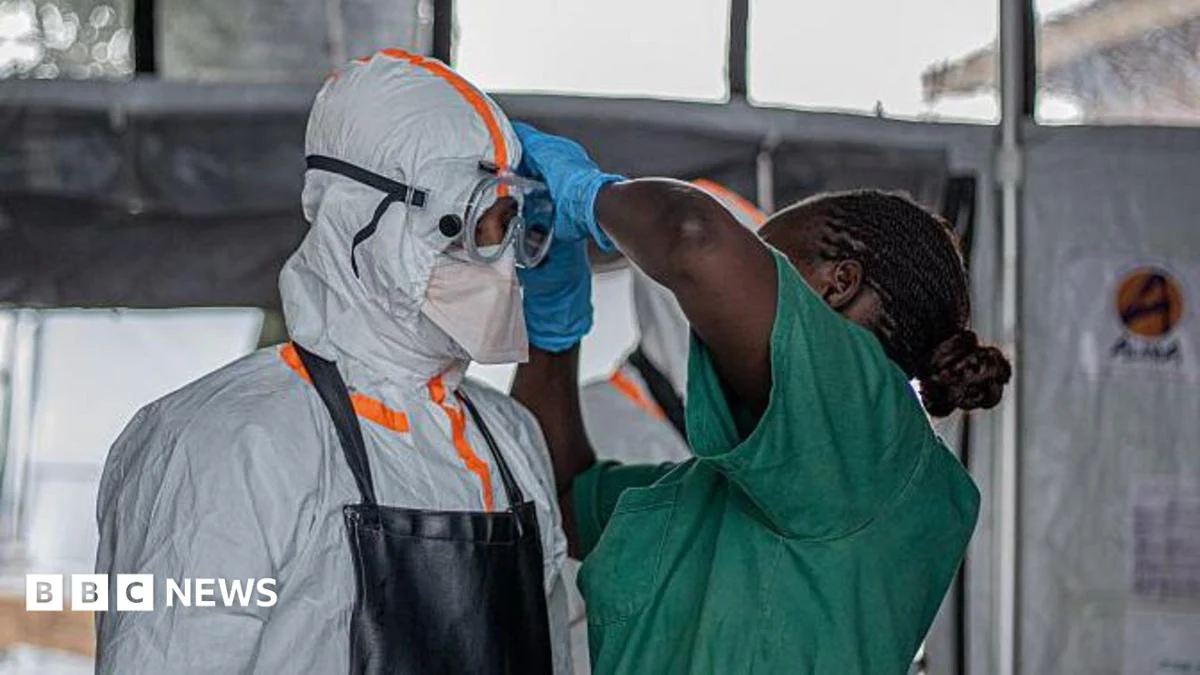
Ebola Outbreak in DR Congo Declared Three Months Late, Hindering Control Efforts Amidst Rising Death Toll and Security Challenges
The World Health Organization (WHO) has issued a stark warning regarding the ongoing Ebola outbreak in the Democratic Republic of Congo (DRC), revealing that the virus began circulating at least three months before its official declaration on May 15, significantly impeding public health authorities’ ability to contain its spread. This critical delay has meant that responders are perpetually playing catch-up, struggling to gain control over what has become the second-worst Ebola outbreak in history. Since the belated declaration, the death toll has tragically surpassed 1,900 individuals, out of more than 4,200 confirmed cases, as reported by the DRC’s Ministry of Health.
Infection rates remain alarmingly high, underscoring the profound challenges faced by health authorities in eastern DR Congo. The epicentre of this particular outbreak, caused by the less common Bundibugyo species of Ebola, is located in the volatile eastern provinces, a region perpetually plagued by insecurity. This complex environment, coupled with the absence of an approved vaccine or specific therapeutic drugs for the Bundibugyo strain, has made the containment efforts exceptionally arduous. Dr. Mohamed Janabi, WHO Africa director, articulated the gravity of the situation during a news conference in Bunia, a city at the heart of the outbreak, stating, "We are chasing the virus, the virus is ahead of us."
A Delayed Discovery and its Grave Consequences
The retrospective analysis conducted by health experts, cited by Dr. Janabi, indicates that the Bundibugyo virus began its insidious spread as early as February. This critical period saw the initial misdiagnosis of Ebola cases as more common ailments such as malaria or typhoid, allowing the highly contagious virus to propagate undetected within communities for weeks. This initial oversight provided the virus with a substantial head start, enabling it to establish numerous chains of transmission before public health surveillance systems could even identify the threat. The consequence of this delayed recognition is a vastly more complex and entrenched outbreak, requiring an intensified response effort in an already challenging operational environment.
The official declaration on May 15 marked the formal commencement of a large-scale international and national response, but by then, the virus had already infiltrated multiple communities across North Kivu and Ituri provinces. The lost three months represent a window of opportunity during which rapid isolation, contact tracing, and community engagement could have been far more effective in curbing the outbreak’s initial momentum. Instead, responders were faced with a widespread epidemic, compounded by deep-seated community mistrust and the constant threat of violence.
The Bundibugyo Strain: An Added Layer of Complexity
Unlike the more frequently encountered Zaire species of Ebola, for which promising vaccines (like rVSV-ZEBOV) and experimental therapeutic drugs (such as mAb114 and REGN-EB3) have shown efficacy in recent outbreaks, the Bundibugyo strain presents a unique set of challenges. There is currently no approved vaccine specifically for Bundibugyo, nor are there any recognized therapeutic drugs tailored to combat this particular variant. This means that medical interventions are largely limited to supportive care, focusing on managing symptoms, rehydration, and addressing co-infections, rather than directly targeting the virus itself. This absence of specific prophylactic or curative tools places a greater burden on fundamental public health measures: rapid case identification, isolation, rigorous contact tracing, and safe burial practices. The inability to offer a definitive treatment or preventive vaccine also makes it harder to build community trust, as health workers cannot provide the same assurances of protection or cure that might be possible with the Zaire strain.
A History of Ebola in the Democratic Republic of Congo
The Democratic Republic of Congo holds a significant, albeit tragic, place in the history of Ebola, as the country where the virus was first identified in 1976 near the Ebola River in what was then Zaire. Since then, the DRC has experienced numerous outbreaks, making its health authorities among the most experienced globally in responding to the disease. However, each outbreak presents its own unique set of challenges, often amplified by the country’s persistent socio-political instability and infrastructural deficits.
Prior to the current crisis, the largest outbreak in DRC occurred in 2014-2016 in West Africa, claiming 11,325 lives. While geographically distinct, that event underscored the potential for Ebola to overwhelm public health systems and highlighted the need for robust international coordination. The current outbreak in eastern DRC is unique in its confluence of factors: a conflict zone, a less understood strain of the virus, and a critical delay in detection. The DRC’s history with Ebola, while providing institutional memory, also means that communities in some areas have developed a complex relationship with response efforts, sometimes marked by suspicion.
The Volatile Eastern Front: Insecurity as a Primary Obstacle
The eastern provinces of North Kivu and Ituri, the epicentre of the current outbreak, are among the most unstable regions in the world. For decades, the area has been plagued by the presence of numerous armed groups, inter-communal violence, and a general state of lawlessness. This pervasive insecurity has emerged as the single most formidable barrier to effective Ebola control. Health workers, often seen as outsiders or associated with government forces, have become targets of violence, with numerous attacks reported on treatment centres, clinics, and personnel. These assaults not only endanger lives but also force the suspension of critical operations, creating gaps in surveillance, vaccination, and treatment efforts.
Dr. Janabi’s revelation that health workers are only able to reach approximately 30% of cases due to insecurity is a stark illustration of this challenge. The remaining 70% of infected individuals are often dying at home, potentially infecting family members and neighbors, further fueling the epidemic’s spread outside the formal health system. Fear of violence also leads to population displacement, making contact tracing virtually impossible as people flee affected areas, inadvertently carrying the virus with them. This constant disruption of essential services and the inability to establish secure operational bases for responders profoundly undermine the entire outbreak response strategy.
Community Mistrust and Traditional Practices
Beyond insecurity, deep-seated community mistrust and deeply ingrained traditional practices have significantly hampered efforts to control the outbreak. Decades of conflict, political manipulation, and a history of external interventions have fostered a pervasive suspicion of government authorities and international aid organizations among local populations. Misinformation and rumors about Ebola and the response efforts are rampant, often leading to outright rejection of medical interventions. Some communities view Ebola as a political ploy, a foreign disease, or even a curse, rather than a viral infection.
This mistrust manifests in various ways: people hiding sick family members at home, refusing to go to treatment centres, or actively resisting safe burial teams. Traditional burial practices, which often involve close physical contact with the deceased’s body, are particularly high-risk given that Ebola victims remain highly contagious after death. While responders have made efforts to engage community leaders and adapt safe burial practices, overcoming decades of cultural norms and ingrained suspicion is a slow and arduous process. The lack of culturally sensitive communication and engagement in the early phases of the outbreak exacerbated these challenges, creating a cycle of fear and resistance that continues to undermine response efforts.
Response Efforts and International Collaboration
Despite the overwhelming challenges, a concerted effort by the DRC government, the WHO, and numerous international partners and non-governmental organizations (NGOs) is underway. Dedicated Ebola treatment centres have been established across the affected regions, striving to provide isolation, supportive care, and dignifying safe burials. These centres, often operated by organizations like Médecins Sans Frontières (MSF), UNICEF, and the International Federation of Red Cross and Red Crescent Societies (IFRC), are critical for breaking chains of transmission and offering hope to the sick.
The WHO plays a crucial coordinating role, providing epidemiological surveillance, technical expertise, and logistical support. The DRC’s Ministry of Health is working to scale up public health campaigns, improve diagnostic capabilities, and strengthen local health systems. Community engagement teams, comprising local leaders, anthropologists, and health promoters, are on the ground, working to build trust, dispel myths, and educate communities about the virus and prevention measures. Efforts are also being made to provide psychosocial support to affected families and survivors, recognizing the immense trauma inflicted by the disease.
While a specific vaccine for Bundibugyo is unavailable, ring vaccination strategies, often using experimental vaccines or those approved for the Zaire strain in a compassionate use context, have been implemented where feasible to protect front-line health workers and close contacts of confirmed cases. Research efforts are also ongoing to better understand the Bundibugyo strain and accelerate the development of specific countermeasures.
Broader Impact and Implications
The prolonged Ebola outbreak in eastern DR Congo carries significant broader implications, extending beyond the immediate health crisis.
- Public Health Strain: The crisis places an immense strain on the DRC’s already fragile health system, diverting resources and personnel from other critical health priorities, such as malaria, measles, and maternal and child health.
- Regional Stability: The potential for cross-border spread to neighboring countries like Uganda, Rwanda, and South Sudan is a constant concern. Previous outbreaks have shown how easily the virus can cross porous borders, threatening regional stability and public health security. Neighboring countries have enhanced their surveillance and preparedness, but the risk remains high given the population movements and trade links.
- Economic Impact: The outbreak disrupts local economies, particularly in agricultural and trade-dependent regions. Travel restrictions, fear, and reduced economic activity further exacerbate poverty and instability.
- Global Health Security: The protracted nature of this outbreak underscores the vulnerabilities in global health security, particularly in conflict zones. It highlights the critical importance of early detection, rapid and secure response capabilities, and sustained international funding and political will to contain infectious disease threats before they escalate into global crises.
- Lessons for Future Outbreaks: The experience with the Bundibugyo strain reinforces the need for diverse research and development portfolios for all known Ebola species. It also emphasizes that in complex humanitarian emergencies, a purely medical response is insufficient; it must be integrated with security, social, and political interventions to be effective.
The road ahead for the Democratic Republic of Congo in controlling this Ebola outbreak remains long and fraught with challenges. The initial delay in detection has created a substantial hurdle, one that health authorities and their partners are working tirelessly to overcome amidst a backdrop of pervasive insecurity and deep-seated community resistance. Sustained international support, innovative approaches to community engagement, and a concerted effort to address the underlying drivers of instability will be paramount in finally bringing this devastating epidemic to an end.

Related Posts
Zambia on Edge: Opposition Leader Arrested Amid Allegations of Insurrection Plot and Election Tensions
Rescuers search for survivors of powerful Indonesia earthquake

