UN Report Highlights Over 900 Obstacles Hampering West Bank Aid Amid Escalating Humanitarian Crisis
More than 900 physical obstacles, including a complex network of Israeli checkpoints, gates, roadblocks, earth mounds, and other restrictions, are significantly delaying and limiting the delivery of essential humanitarian aid across the West Bank, according to a recent assessment by the United Nations. This pervasive system of control fragments Palestinian communities and severely impedes the work of humanitarian organizations, as starkly illustrated by the recent plight of three Palestinian families besieged in the village of Qusra in the Nablus governorate.
The UN Office for the Coordination of Humanitarian Affairs (OCHA) reported that these families have been effectively trapped in their homes since Tuesday, following the establishment of a new settler outpost immediately adjacent to their residences and a subsequent tightening of access restrictions in the surrounding area. Attempts by OCHA and its partners to deliver critical supplies, including food, water, milk formula, medicines, and hygiene items, to the beleaguered residents have been repeatedly thwarted, highlighting the severe operational challenges faced by aid agencies in the occupied Palestinian territory. The incident in Qusra underscores a broader pattern of humanitarian access impediments that contravene international humanitarian law and exacerbate an already precarious situation for Palestinian civilians.
The Pervasive Network of Obstacles: A Daily Reality
The figure of "more than 900 physical obstacles" represents a comprehensive tally of fixed and temporary barriers that fragment the West Bank, impacting every aspect of Palestinian life, from daily commutes to emergency services and economic activity. These obstacles include:
- Permanent Checkpoints: Manned by Israeli soldiers, these control points regulate movement between major Palestinian population centers and areas under Israeli control, often leading to extensive delays and intrusive searches.
- Flying Checkpoints: Erected spontaneously and often unpredictably on West Bank roads, these temporary barriers further disrupt travel, causing uncertainty and making planning difficult for both individuals and aid organizations.
- Earth Mounds and Concrete Blocks: Physical barriers strategically placed to block roads and prevent access to specific areas, often isolating villages or agricultural lands.
- Segregation Barriers and Roads: A complex system of walls, fences, and bypass roads that often separate Palestinian communities from their lands and from each other, while facilitating settler movement.
- Gated Entrances: Many Palestinian villages have main entrances controlled by gates, which can be locked by Israeli forces for extended periods, severing communities from essential services and markets.
- Permit Regimes: A bureaucratic labyrinth of permits required for Palestinians to access areas such as East Jerusalem, the Jordan Valley, or even agricultural lands near settlements, further restricting movement and humanitarian access.
The cumulative effect of these restrictions is profound. Humanitarian organizations report significant delays in reaching vulnerable populations, particularly in times of crisis. Ambulances are often held up at checkpoints, sometimes with tragic consequences for patients. Farmers struggle to access their land, impacting agricultural output and food security. Children face extended commutes to school, and access to healthcare facilities becomes a constant challenge. This system contributes to the de-development of the Palestinian economy, discourages investment, and fosters a dependency on external aid, while simultaneously making the delivery of that aid incredibly difficult.
The Qusra Crisis: A Microcosm of Broader Issues
The unfolding situation in Qusra village, situated in the Nablus governorate, serves as a stark illustration of the direct humanitarian impact of these access restrictions and the ongoing expansion of Israeli settlements. The crisis began on Tuesday with the establishment of a new settler outpost, a structure often initiated without official Israeli government authorization but frequently tolerated and later retroactively legalized. The presence of this outpost immediately triggered a tightening of access restrictions in the surrounding area, effectively isolating the three Palestinian families whose homes are now in close proximity to the new settler presence.
According to OCHA, attempts to reach these families, who are in urgent need of basic provisions, have been repeatedly blocked. Aid workers, including those from the UN and partner organizations, have encountered obstacles that have rendered their efforts unsuccessful so far. The essential items needed – food, water, milk formula for infants, critical medicines, and hygiene products – are basic necessities, and the inability to deliver them underscores a severe violation of humanitarian principles.
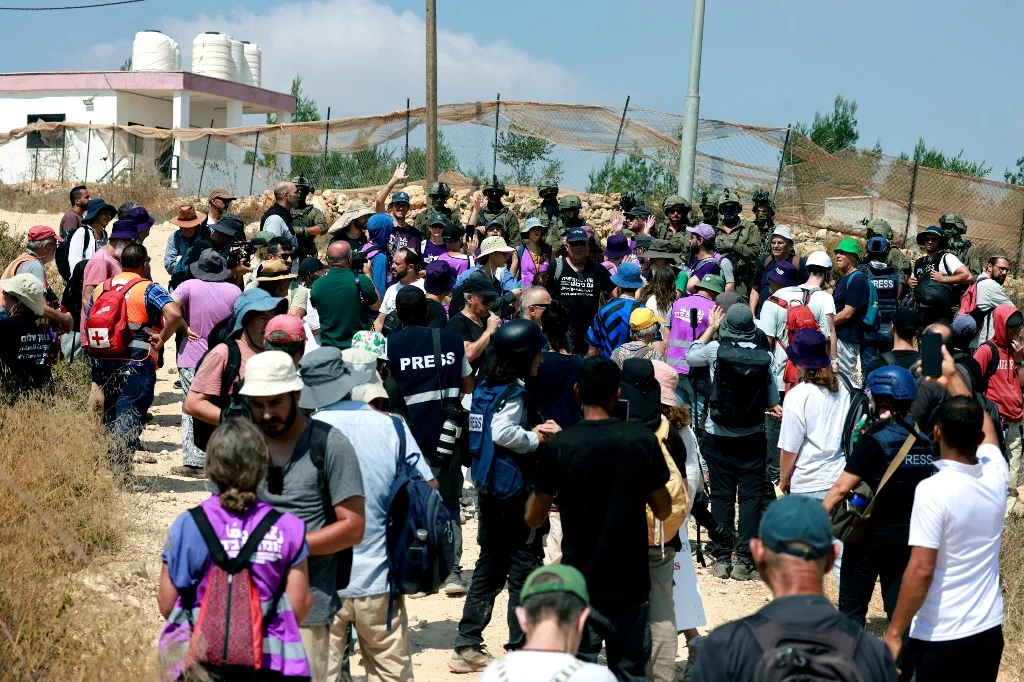
Compounding the crisis, partners on the ground have warned that efforts to protect Palestinian residents have proven ineffective. Settlers reportedly reinstalled a tent that Israeli forces had dismantled just a day prior, signaling a potential lack of enforcement or political will to curb unauthorized settler activity, which often leads to heightened tensions and increased restrictions on Palestinian movement. A protest against the besieging of a Palestinian family home in Qusra was reported on August 14, 2026, where Palestinians and activists gathered to voice their opposition to the escalating situation, as captured in photographic evidence. This incident, while reportedly occurring on a future date, reflects the continuous and deeply concerning nature of such events in the region.
International Law and Humanitarian Obligations

Under international humanitarian law, specifically the Fourth Geneva Convention of 1949, Israel, as the occupying power, has clear obligations towards the civilian population in the occupied Palestinian territory. Article 55 of the Convention states that the occupying power has the duty of ensuring the food and medical supplies of the population; it shall, in particular, bring in the necessary foodstuffs, medical stores and other articles if the resources of the occupied territory are inadequate. Furthermore, Article 59 mandates that if the whole or part of the population of an occupied territory is inadequately supplied, the occupying power shall agree to relief schemes on behalf of the said population, and shall facilitate them by all means at its disposal.
The persistent denial of humanitarian access, as witnessed in Qusra and across the West Bank, directly contravenes these fundamental tenets of international law. OCHA’s mandate includes coordinating humanitarian efforts and advocating for the rights of affected populations, consistently reminding all parties of their obligations. The impediments faced by aid workers not only undermine their ability to fulfill their life-saving mission but also reflect a systemic failure to protect civilians and ensure their basic needs are met. The establishment of outposts and the subsequent tightening of access often lead to forced displacement, creating further humanitarian needs and violating the principle of proportionality and necessity in any security measures.
The Context of Settlement Expansion and Violence
The Qusra incident is not isolated but rather fits within a broader context of accelerating Israeli settlement expansion in the West Bank. All Israeli settlements in the occupied Palestinian territory are considered illegal under international law, a position reaffirmed by numerous UN Security Council resolutions, including Resolution 2334 (2016). Despite this, settlements have continued to expand, often encroaching upon Palestinian lands and resources.
Settler outposts, like the one established near Qusra, are particularly contentious. They are often built without official government permits but frequently receive tacit support or services from Israeli authorities, serving as precursors to larger, officially recognized settlements. Their presence invariably leads to increased friction, land confiscation, and heightened security measures that disproportionately affect Palestinian communities.
Furthermore, settler violence against Palestinians and their property remains a significant concern. OCHA data frequently highlights a trend of increased settler-related incidents, including attacks on individuals, damage to olive trees, destruction of crops, and intimidation. These acts often occur with impunity, further eroding trust and exacerbating an already tense environment. The reinstallation of the tent in Qusra, following its dismantling by Israeli forces, suggests a potential lack of effective enforcement against unauthorized settler activity, empowering further encroachment and exacerbating the vulnerability of Palestinian residents.
Reactions and Calls for Action
The United Nations, through OCHA, has consistently called on Israel to uphold its obligations under international law, ensure unhindered humanitarian access, and protect the civilian population in the occupied Palestinian territory. These calls are often echoed by a wide array of international human rights organizations and diplomatic bodies.
- Palestinian Authority (PA): The PA routinely condemns Israeli settlement expansion and access restrictions as violations of international law and obstacles to a viable two-state solution. They frequently appeal to the international community for intervention and protection for their citizens, highlighting the daily hardships imposed by the occupation.
- Israeli Authorities (IDF/COGAT): Israeli officials, including the Coordinator of Government Activities in the Territories (COGAT), often state that security concerns necessitate checkpoints and restrictions. They typically assert that humanitarian aid is facilitated when security protocols are met, and that actions are taken to maintain law and order. However, humanitarian organizations frequently argue that the scale and nature of restrictions far exceed legitimate security needs and often serve political or settlement-related objectives.
- International Community: Various international bodies and governments have expressed concern over the humanitarian situation and the continuous expansion of settlements. There are ongoing calls for both parties to adhere to international law and engage in meaningful dialogue to de-escalate tensions and work towards a peaceful resolution.
Broader Implications and Future Outlook
The persistent humanitarian access crisis in the West Bank, epitomized by the Qusra incident and the vast network of obstacles, carries profound implications:
- Undermining the Two-State Solution: The fragmentation of the West Bank through settlements and access restrictions makes the concept of a contiguous, viable Palestinian state increasingly challenging, if not impossible.
- Exacerbating Humanitarian Needs: The impediments to aid delivery contribute to chronic food insecurity, inadequate healthcare, and limited access to education, trapping vulnerable populations in a cycle of dependency.
- Erosion of International Law: The continued violations of international humanitarian law without sufficient accountability weaken the global framework designed to protect civilians in armed conflict and occupation.
- Increased Tensions and Instability: The daily humiliations and hardships imposed by the occupation, coupled with the expansion of settlements and settler violence, fuel resentment and contribute to a volatile environment, making peace harder to achieve.
- Straining Aid Efforts: Humanitarian organizations face immense operational difficulties, financial constraints, and security risks in their efforts to provide assistance, sometimes leading to the scaling back of crucial programs.
The situation in Qusra serves as a critical reminder of the urgent need for a renewed international focus on the humanitarian crisis in the West Bank. Without concerted efforts to ensure unhindered humanitarian access, protect civilians, and hold all parties accountable to international law, the cycle of hardship and instability is likely to continue, further diminishing prospects for a just and lasting peace in the region. The international community must move beyond expressions of concern and take decisive action to ensure that humanitarian principles are upheld and that the basic rights and dignity of the Palestinian population are respected.

Related Posts
Over 150 Israeli Settlers Storm Al-Aqsa Compound and Perform Prayers, Violating Status Quo Under Police Protection.
Grandmothers and Grandfathers Under Siege: UK Counter-Terrorism Police Target Elderly Palestine Action Supporters