
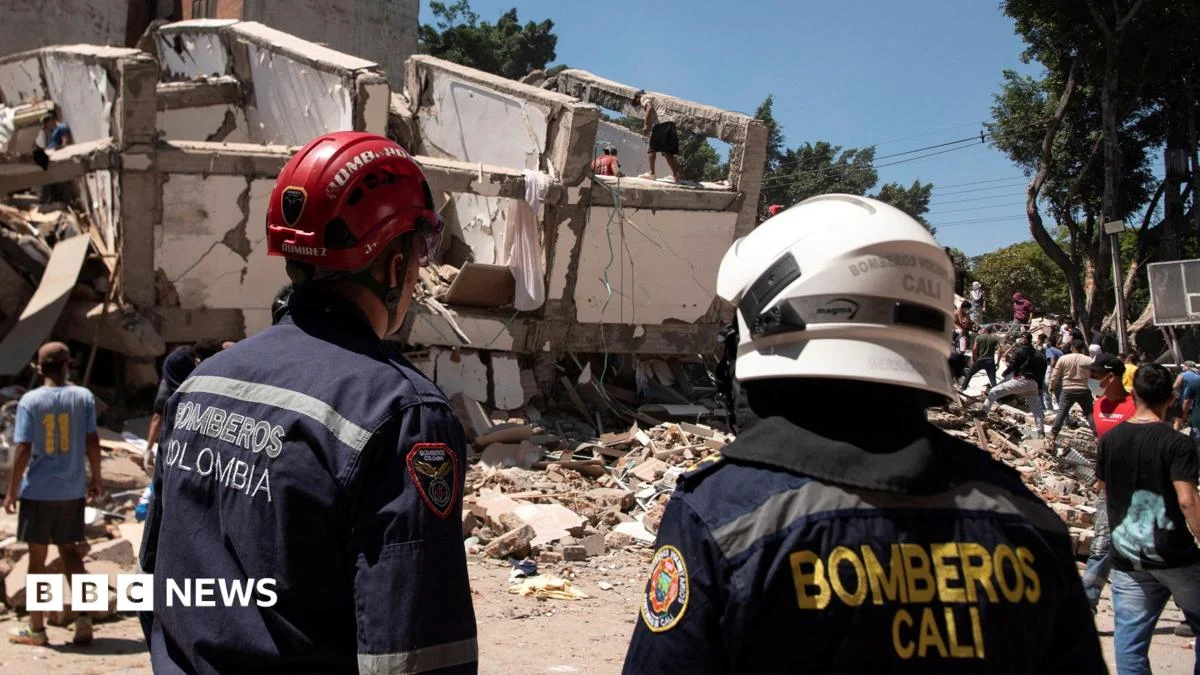
Colombia Grapples with Devastating 7.4 Magnitude Earthquake as Death Toll Climbs and State of Emergency Declared
Colombia has been plunged into a national crisis following one of the most powerful earthquakes to strike the nation in years, a magnitude 7.4 tremor that has claimed at least 132 lives and prompted the declaration of a state of emergency. The grim reality, however, suggests the death toll is tragically poised to escalate further, with search and rescue operations intensifying amid fears that numerous individuals remain trapped beneath the rubble of collapsed structures. This catastrophic event has not only tested the resilience of communities but also presented an immediate, profound challenge to the country’s newly inaugurated leadership.
Chronology and Geological Context of the Catastrophe
The earth-shattering quake struck at 07:34 local time (12:34 GMT) on Monday, sending shockwaves across a vast expanse of western Colombia and beyond. The country’s geological service pinpointed the epicenter near the village of San José del Palmar in Chocó province, at a significant depth of 103 kilometers (64 miles). While deep earthquakes are generally perceived as less destructive on the surface due to the dissipation of energy over distance, this particular event demonstrated the immense power such tremors can unleash, capable of causing widespread structural damage and generating potentially fewer but stronger aftershocks. The sheer magnitude of the quake meant its vibrations were felt across hundreds of miles, reaching as far as neighboring Venezuela, Ecuador, and Panama, underscoring the regional scale of the seismic activity.
Colombia’s geographical location, situated at the complex convergence of the Nazca, Caribbean, and South American tectonic plates, makes it inherently susceptible to seismic events. This geological dynamism, while a constant feature of the region, rarely manifests with such devastating consequences. According to the US Geological Survey (USGS), an estimated 1.5 million people experienced shaking equivalent to magnitude seven or greater, highlighting the widespread nature of the immediate impact. The depth of the quake, while mitigating some surface effects, allowed its energy to propagate widely, affecting multiple cities and regions simultaneously.
Epicenter’s Resilience Contrasts with Widespread Devastation
Ironically, the village of San José del Palmar, closest to the earthquake’s epicenter, reported no immediate deaths or injuries, a fact local mayor León Fabio Marín Moncada described as "miraculous." Despite severe damage to local roads, cutting off access to and from the village, its traditional construction methods and potentially lower population density may have contributed to this fortunate outcome. This starkly contrasts with the scenes of destruction unfolding in major urban centers further afield.
Pereira: A City Gripped by Tragedy
The city of Pereira, a bustling hub in Colombia’s renowned coffee-growing region and approximately 55 kilometers (34 miles) from the epicenter, bore the brunt of the earthquake’s fury. It has emerged as one of the most severely affected areas, accounting for a significant portion of the initial death toll. Local authorities have reported at least 40 fatalities within its metropolitan area, alongside a staggering 65 collapsed buildings. The immediate priority in Pereira remains the perilous task of locating and extracting individuals believed to be trapped within the wreckage of at least 15 of these structures, a race against time for emergency services.
Videos verified by international news outlets, including the BBC, depicted scenes of chaos and terror in Pereira. One particularly harrowing sequence showed a building collapsing dramatically in Plaza Bolívar, the city’s main square, an open space typically bustling with life. The footage captured the immediate aftermath: a cloud of dust engulfing the area, debris scattered widely, and the collective panic of onlookers. In an effort to manage the crisis and facilitate rescue operations, a curfew has been imposed across parts of Pereira, scheduled to remain in effect until 05:00 local time on Tuesday.
Impact Across Western Colombia
Beyond Pereira, the earthquake left a trail of destruction and human suffering across several other key regions and cities:
Cali: Situated approximately 160 kilometers south of Pereira and 200 kilometers from the epicenter, Cali experienced significant structural damage, with 32 buildings reported to have collapsed. The tremors were severe enough to awaken residents and cause widespread alarm. Dan Cutler, a 29-year-old from London on an extended trip with his partner, recounted his terrifying experience to the BBC from Cali. "I’ve never experienced anything like it," he stated, describing how he and his partner "sprinted outside in our pajamas." While their hotel sustained no major structural damage, surface cracks, peeling paint, and plaster bore testament to the intensity of the shaking.
Manizales: This city, roughly 150 kilometers from the epicenter, also reported fatalities, with at least two confirmed deaths. Eyewitness accounts from Manizales painted a vivid picture of the terror. Angélica Ávila, staying in a hotel at the time, described cracks appearing in walls, "everyone screaming," and witnessing "dust coming out of the neighboring buildings, and bricks were falling off the walls." Journalist and meteorologist Luis Felipe Molina, also in Manizales, offered a contrasting perspective on structural integrity. He noted that due to previous seismic events, Manizales has "very strict seismic-resistant building regulations." While his building withstood the impact, the force was still immense: "I have 450 books and only a few were left standing on the shelves. You could hear glass breaking and people screaming," he told BBC Mundo, summarizing it as "a terrible and terrifying experience." This highlights the critical role of robust building codes in mitigating disaster impact.
Other Regions: Reports of deaths and damage also emerged from Quibdó, Medellín, and across the broader Chocó and Valle del Cauca regions, indicating the extensive geographical reach of the earthquake’s destructive power. The cumulative impact on these areas, many of which are rural or less densely populated, is still being fully assessed.
Humanitarian Crisis and Emergency Response
The immediate aftermath of the earthquake has precipitated a significant humanitarian crisis. Colombia’s Association of Capital Cities confirmed that more than 480 people sustained injuries, straining emergency medical services. Hospitals across the affected regions are on high alert, dealing with an influx of trauma patients and requiring urgent supplies and personnel. Search and rescue teams, comprising national police, military units, and civilian volunteers, are working tirelessly around the clock, often using specialized equipment and sniffer dogs, to locate survivors in the debris. The efforts are hampered by damaged infrastructure, including roads, which complicates access to some of the hardest-hit communities.
Beyond the immediate casualties, the earthquake has displaced thousands, with over 1,500 homes confirmed to have been damaged or destroyed. Providing temporary shelter, food, water, and medical aid to these displaced populations is an immediate logistical challenge for the government and aid organizations. Psychosocial support for survivors, many of whom have witnessed horrific scenes or lost loved ones, will also be a critical component of the long-term recovery effort.
National Leadership Responds to Unprecedented Challenge
The gravity of the situation prompted Colombia’s President Abelardo de la Espriella to declare a national disaster situation. This declaration immediately activates special emergency powers, allowing the government to streamline decision-making, reallocate national budgets, and deploy resources more rapidly to the affected areas. For President de la Espriella, who only assumed office on Friday, this earthquake represents an immediate and potentially legacy-defining crisis. His early actions and leadership in coordinating the national response will be closely scrutinized both domestically and internationally. The government’s focus is currently on consolidating rescue efforts, assessing the full extent of the damage, and beginning the arduous process of providing relief to the affected populace. President de la Espriella also confirmed the extensive damage to residential properties, emphasizing the scale of the reconstruction task ahead.
Broader Infrastructure and Regional Impact
The earthquake’s repercussions extended to critical infrastructure. The country’s aviation authority reported damage at several regional airports, including those in Pereira, Manizales, Quibdó, Armenia, Cartago, and Buenaventura. While the extent of this damage varies, it poses significant logistical challenges for bringing in aid, evacuating the injured, and resuming normal transportation, further complicating relief efforts.
Even in the capital city of Bogotá, tremors were strongly felt, causing trees and traffic lights to shake violently. While reports indicated cracks in some buildings, fortunately, there has been no serious damage to the city’s extensive infrastructure, averting an even greater national catastrophe. The widespread nature of the tremors, felt across a significant portion of South America and Central America, underscores the immense power of this particular seismic event.
International Solidarity and Aid Offers
As the full extent of the devastation began to emerge, a wave of international solidarity and offers of support quickly followed. US Secretary of State Marco Rubio affirmed that the United States was "closely monitoring" the situation and stood "ready to support" Colombia in its time of need. Similarly, European Union chief Ursula von der Leyen announced that the EU’s Copernicus satellite system was being deployed to assist in the rescue operations, providing vital geospatial data and imagery to help identify damaged areas and plan relief efforts.
The President of El Salvador, Nayib Bukele, known for his nation’s own experience with seismic activity and disaster response, extended a message of solidarity to the Colombian people and proactively offered personnel and equipment to aid in the ongoing rescue efforts. These early pledges of international assistance highlight the global community’s readiness to rally behind nations facing natural disasters, offering crucial resources, expertise, and moral support during times of immense suffering.
Implications and the Path to Recovery
The earthquake’s impact will be profound and long-lasting, touching upon various facets of Colombian society and economy. The coffee-growing region, a vital economic artery for the country, has been hit hard, potentially affecting agricultural output and livelihoods for months or even years to come. The widespread damage to infrastructure, including roads and airports, will impede economic activity and complicate the supply chain, requiring substantial investment in reconstruction.
The event also brings to the forefront the critical importance of seismic-resistant building standards, as exemplified by the varying degrees of damage in different cities. While Manizales’ stringent codes seemingly offered a measure of protection, the collapse of numerous buildings in Pereira and Cali underscores the need for continuous review, enforcement, and potentially, upgrades to building regulations across all vulnerable regions.
This disaster comes less than two months after twin quakes devastated northern Venezuela, killing more than 6,300 people, serving as a stark reminder of the region’s inherent vulnerability to seismic activity and the ever-present threat of natural disasters. The long-term recovery in Colombia will require sustained national and international efforts, focusing not only on rebuilding physical infrastructure but also on supporting the mental health and economic stability of the affected communities. As rescue operations transition into recovery and reconstruction, the resilience of the Colombian people will be severely tested, but the outpouring of national and international support offers a beacon of hope amidst the current tragedy.

Related Posts
Zambia on Edge: Opposition Leader Arrested Amid Allegations of Insurrection Plot and Election Tensions
Rescuers search for survivors of powerful Indonesia earthquake

