
President Trump’s Executive Order on Childhood Vaccines Sparks Widespread Condemnation from Medical Experts and Public Health Advocates
President Donald Trump has signed an executive order calling for a significant reduction in the number of recommended childhood vaccines, proposing a shift from the current 18 recommended by the American Academy of Pediatrics (AAP) to just 11. The order further suggests splitting the mumps, measles, and rubella (MMR) vaccine into separate shots, a recommendation that directly contradicts established public health guidance and scientific consensus. The announcement immediately drew sharp criticism from leading medical organizations, public health experts, and even members of his own political party, who universally labeled the directive as dangerous and ill-informed.
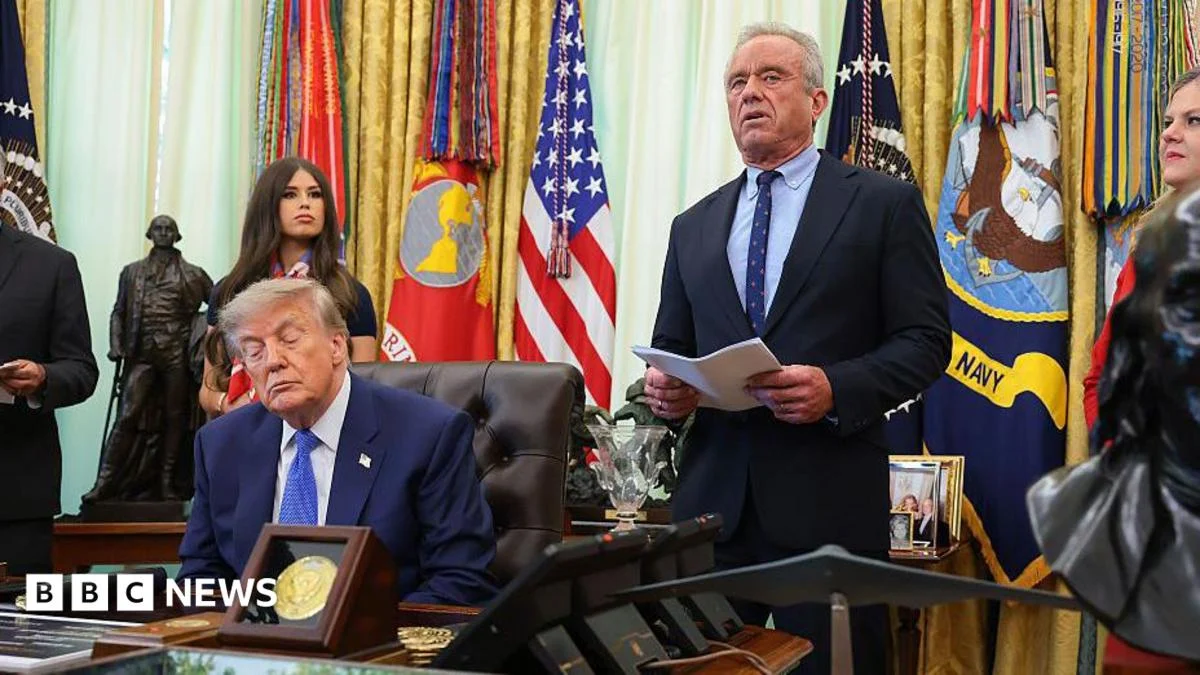
Speaking from the Oval Office on Monday, President Trump articulated his rationale, stating, "Decades ago, children received only a small fraction of the vaccines required today. In those times, people were much healthier and of course the high rates of autism now observed did not exist." This statement reiterated a long-held personal belief of the president, who has frequently cast doubt on the safety of MMR vaccines, despite an overwhelming body of scientific evidence demonstrating no connection between the shots and autism spectrum disorder. The order identifies a revised immunization schedule, advocating for vaccinations against measles, mumps, rubella, diphtheria, tetanus, pertussis, polio, Haemophilus influenzae type B, pneumococcal disease, human papillomavirus, and varicella (chickenpox) as the "gold standard" for children.
The Proposed Changes and Presidential Rationale
The core of the executive order rests on two controversial pillars: a reduced vaccine schedule and the separation of the MMR vaccine. President Trump emphasized the perceived benefits of this approach, stating, "We’re reducing them. It’s not only that you’re doing fewer vaccines, or jabs, as they say, but you’re doing them in a series of visits to the doctor." He likened administering the combined MMR vaccine at once to "pouring a bottle of soda into a child’s body," suggesting it could be "quite lethal." This analogy, however, lacks any scientific basis and contradicts decades of pediatric immunology and public health practice.
Robert F Kennedy Jr., serving as Trump’s Secretary of Health and Human Services (HHS), echoed the administration’s stance, framing the proposed changes as an expansion of "choice" for parents rather than an attempt to prohibit access to childhood vaccines. This emphasis on parental choice, however, comes amid a global resurgence of vaccine-preventable diseases, raising significant concerns about the potential public health implications.
It is crucial to note the limitations of a presidential executive order in this domain. The federal government does not possess the authority to unilaterally implement new vaccine recommendations, as immunization requirements for school attendance are primarily set at the state level. This jurisdictional nuance means that while the order carries significant symbolic weight and can influence public discourse, its direct impact on mandatory vaccination policies is limited. However, its potential to sow doubt and confusion among parents remains a major concern for public health officials.
The Genesis of Vaccine Schedules and the Anti-Vaccine Movement
To understand the gravity of the president’s order, it is essential to delve into the history and scientific basis of existing vaccine recommendations. The current childhood immunization schedule in the United States is developed by the Advisory Committee on Immunization Practices (ACIP), a group of medical and public health experts who advise the Centers for Disease Control and Prevention (CDC). This schedule is then endorsed by organizations like the American Academy of Pediatrics (AAP) and the American Academy of Family Physicians (AAFP). The schedule is meticulously designed based on extensive research, considering when a child’s immune system is most receptive to a vaccine, when they are most vulnerable to specific diseases, and the optimal timing for herd immunity within communities. This process involves rigorous clinical trials, safety monitoring, and continuous review of scientific evidence.
The notion of a link between vaccines and autism gained significant traction following a now-discredited 1998 study published by Andrew Wakefield in The Lancet. Wakefield’s paper, which claimed a connection between the MMR vaccine and autism, was later retracted due to scientific fraud, ethical violations, and undisclosed financial conflicts of interest. Wakefield subsequently lost his medical license. Despite the overwhelming scientific repudiation of this fraudulent study, the myth persisted, fueled by anti-vaccine advocacy groups and prominent individuals. President Trump himself has, over the years, repeatedly expressed skepticism about vaccine safety, often referencing the debunked autism link. For instance, during a 2015 Republican primary debate, he stated, "I am a total believer in vaccines. But I want to have smaller doses over a longer period of time." This sentiment foreshadowed the specific recommendations in his executive order.
Scientific Consensus vs. Executive Order: A Deep Dive
The scientific community’s response to the executive order was swift and unequivocal, highlighting the vast chasm between the administration’s claims and established medical facts.
- The MMR-Autism Myth: Multiple comprehensive studies, involving millions of children across various countries, have definitively found no causal link between the MMR vaccine and autism. A landmark 2019 Danish study, for example, examined 657,461 children born between 1999 and 2010, concluding that the data "did not support the hypothesis that MMR vaccination increases the risk for autism, that it triggers autism in susceptible children, or that it is associated with clustering of autism cases after vaccination." Earlier reports from the Institute of Medicine (now the National Academy of Medicine) also consistently found no evidence supporting such a link. The CDC explicitly states on its website that there is "no published scientific evidence that shows any benefit in separating the combination MMR vaccine into three individual shots."
- The Dangers of Splitting MMR Shots: Experts universally advise against separating the MMR vaccine. The combined vaccine is effective, safe, and significantly reduces the number of doctor visits required for full immunization. Allowing time between individual shots, as suggested by the order, increases the period during which a child is susceptible to measles, mumps, or rubella. It also raises the likelihood of missed appointments, potentially leaving children incompletely vaccinated and vulnerable. From an immunological perspective, the combined vaccine does not overwhelm a child’s immune system, which is constantly exposed to far more antigens from the environment and common illnesses than from vaccines.
- The Risks of a Reduced Schedule: The AAP currently recommends 18 vaccines, designed to protect children against 14 different diseases. Reducing this to 11, as proposed, would leave children vulnerable to several serious, preventable illnesses. While the specific seven vaccines omitted by the order are not explicitly detailed, common components of the AAP’s recommended schedule beyond the 11 listed often include rotavirus, hepatitis A, and additional doses for diseases like diphtheria, tetanus, and pertussis, as well as the full series for HPV and pneumococcal disease. Each vaccine on the current schedule targets a specific pathogen that poses a significant health risk to children, ranging from debilitating neurological damage to life-threatening infections. Delaying or skipping these shots eradicates the protective benefits of herd immunity, making entire communities susceptible to outbreaks.
- Optimal Timing and Immune Response: The timing of current vaccine doses is critical. For instance, the first dose of the combined MMR vaccine is recommended at 12-15 months, when maternal antibodies (which can interfere with vaccine effectiveness) have waned, and the child is entering a period of increased social interaction, elevating exposure risk. A second dose, typically between ages four and six, ensures maximal immunity before school entry. This strategic timing is based on intricate immunological principles, not arbitrary scheduling.
Widespread Condemnation from Medical and Political Spheres
The backlash against President Trump’s order was immediate and severe, highlighting a rare moment of unity among diverse groups in opposition to a presidential directive.
- American Academy of Pediatrics (AAP): Dr. Andrew Racine, president of the AAP, minced no words, calling Trump’s executive order "disheartening" and "dangerous." He emphasized the critical context: the United States was already experiencing measles cases at a 35-year high, mirroring a troubling global trend. "Instead of ensuring every family can access life-saving vaccines for measles, influenza, RSV and more, federal leaders are once again spreading misleading claims," Racine stated. He adamantly rejected the notion that the order was based on "gold-standard science," asserting there was "no new evidence to justify the significant changes." He concluded by warning, "Delaying or skipping shots is risky, especially as measles continues to spread and children go back to school."
- Centers for Disease Control and Prevention (CDC): While not directly commenting on the executive order, the CDC’s publicly available information directly refutes the premises of the order. The agency consistently states that "most people who get MMR vaccine do not have any serious problems with it" and that "getting the vaccine is much safer than getting measles, mumps, or rubella." Their official recommendations for two doses of the combined MMR vaccine, administered at 12-15 months and again between ages four and six, stand in direct opposition to the order’s suggestions.
- Political Opposition and Expert Voices: Republican Senator Bill Cassidy, a physician himself and chair of the Senate health committee, publicly admonished the executive order as "wrong." In a social media post, he declared, "The President does not have the expertise to make these changes. Vaccines are overwhelmingly safe. Vaccines are effective. Vaccines DO NOT cause autism." He urged parents to "listen to their child’s pediatrician about vaccines rather than listening to an inaccurate executive order." This bipartisan condemnation underscored the scientific consensus that transcends political divides on this issue. Leading infectious disease specialists, epidemiologists, and public health advocates across the country echoed these sentiments, expressing deep concern about the potential for increased vaccine hesitancy and the erosion of public trust in established medical science.
Broader Impact and Implications: A Public Health Crisis in Waiting
The implications of President Trump’s executive order extend far beyond mere policy recommendations; they pose a tangible threat to public health.
- Erosion of Herd Immunity: Vaccines work best when a significant portion of the population is immunized, creating "herd immunity" or "community immunity." This collective protection safeguards individuals who cannot be vaccinated (e.g., infants too young, individuals with compromised immune systems) by making it difficult for infectious diseases to spread. If parents, influenced by discredited claims and presidential rhetoric, refrain from vaccinating their children, herd immunity weakens, increasing the risk of outbreaks of diseases like measles, mumps, and rubella, which can have severe, even fatal, consequences.
- Resurgence of Preventable Diseases: The United States had declared measles eliminated in 2000, a testament to successful vaccination campaigns. However, due to pockets of unvaccinated individuals, often fueled by misinformation, measles outbreaks have re-emerged with alarming frequency. In 2019, the U.S. recorded its highest number of measles cases in 27 years (1,282 cases), prompting a renewed focus on vaccination efforts. A presidential order that actively encourages reduced vaccination further jeopardizes these gains and risks a full-scale resurgence of diseases that were once largely eradicated.
- Parental Confusion and Distrust: Conflicting messages from public health agencies and the highest office in the land create immense confusion and anxiety for parents. When political figures contradict established scientific and medical consensus, it undermines trust in institutions like the CDC and AAP, which are critical for maintaining public health. This distrust can lead to vaccine hesitancy, making parents less likely to follow evidence-based medical advice.
- Economic Burden: Outbreaks of vaccine-preventable diseases incur significant economic costs, including healthcare expenditures for treatment, public health resources for contact tracing and containment, and lost productivity due to illness and quarantines. Preventing these diseases through vaccination is one of the most cost-effective public health interventions.
- Global Health Ramifications: Vaccine hesitancy in one country can have global repercussions. International travel facilitates the rapid spread of infectious diseases, meaning that declining vaccination rates in the U.S. could contribute to outbreaks elsewhere, complicating global disease eradication efforts.
In conclusion, President Trump’s executive order on childhood vaccines represents a stark departure from evidence-based public health policy. By advocating for a reduced vaccine schedule and the separation of the MMR shot, based on scientifically disproven claims, the order has drawn near-universal condemnation from the medical and public health communities. Experts emphasize that the current vaccine schedule is rigorously developed, safe, and highly effective in preventing serious diseases. The potential implications of this order—ranging from the erosion of public trust to the resurgence of preventable illnesses—underscore the critical importance of adhering to scientific consensus in matters of public health and listening to the expertise of pediatricians and public health professionals over political rhetoric. The long-term health and safety of children, and the collective immunity of communities, hang in the balance.

Related Posts
Zambia on Edge: Opposition Leader Arrested Amid Allegations of Insurrection Plot and Election Tensions

Rescuers search for survivors of powerful Indonesia earthquake

