Taiwan Launches Unprecedented Han Kuang Exercises with Real-World Stress Tests and Infrastructure Resilience Drills
The Taiwanese military commenced its most rigorous and realistic annual war games on Wednesday, initiating a 10-day series of maneuvers designed to test the island’s ability to repel a full-scale invasion under unpredictable conditions. The 40th iteration of the Han Kuang exercises marks a significant departure from previous years, prioritizing "unscripted" scenarios, decentralized command structures, and, for the first time in the history of the drills, the deliberate disruption of civilian internet services to simulate the chaotic environment of modern electronic warfare. Senior defense officials confirmed that the exercises began early Wednesday morning following a high-priority order from an underground command center in Taipei, triggering a nationwide transition to combat readiness.
A Strategic Shift Toward Decentralized Command
At the heart of this year’s drills is the introduction of the "backbrief" approach, a tactical communication method modeled after United States military doctrine. Under this system, junior officers and field commanders are required to restate mission details and operational intent back to their superiors immediately after receiving orders. This mechanism is designed to eliminate ambiguity in the heat of battle and ensure that subordinates can act autonomously if communication with central command is severed—a scenario Taiwanese planners view as highly likely in the opening hours of a conflict with the People’s Liberation Army (PLA).
One senior official, speaking on the condition of anonymity, emphasized that the goal is to move away from "laboratory-like" conditions where every movement is choreographed for the cameras. Instead, field commanders are being presented with "unexpected scenarios" that force them to reassess, readjust, and issue new orders in real-time. This shift addresses long-standing criticisms from both domestic and international defense analysts who argued that previous Han Kuang drills were overly staged and failed to prepare the military for the fluid nature of contemporary warfare.
Digital Resilience and Internet Throttling
In a move that highlights the growing importance of the "grey zone" and cyber domains, the Taiwanese government has integrated a civilian communication stress test into the military maneuvers. For the first time, authorities are deliberately slowing mobile internet speeds in selected areas to simulate a wartime environment where bandwidth is scarce or restricted due to enemy interference. This component of the drill aims to test how civilians would communicate and receive vital government information if primary data networks were degraded or destroyed.
The digital component reflects a broader concern regarding Taiwan’s vulnerability to isolation. With most of the island’s international data flowing through a handful of undersea cables, defense experts have warned that China could attempt to sever these links to induce panic and paralyze the economy. By testing "bottom-line conditions" for internet access, Taiwan is evaluating the viability of satellite-based backups and emergency broadcasting systems that would serve as a lifeline for the population during a blockade.
Chronology of the Han Kuang Evolution
The Han Kuang exercises have served as the cornerstone of Taiwan’s defense strategy since their inception in 1984. Over the decades, the drills have evolved in response to the changing military balance across the Taiwan Strait:
- 1984–1990s: Early exercises focused on traditional amphibious defense and repelling landing forces at primary beaches.
- 2000s: The drills began incorporating more sophisticated missile defense simulations and air superiority contests as China’s air force modernized.
- 2010s: Following the rise of cyber warfare, the exercises began to include electronic countermeasures and protection of critical infrastructure.
- 2022–Present: Post-Ukraine invasion, the focus has shifted dramatically toward "All-Out Defense," asymmetric warfare, and urban combat.
The 2024 drills represent the culmination of this evolution, focusing on "real-field environments" and the integration of civilian resources into the military’s logistical framework.
Mobilizing the Home Front: Reserves and Civil Defense
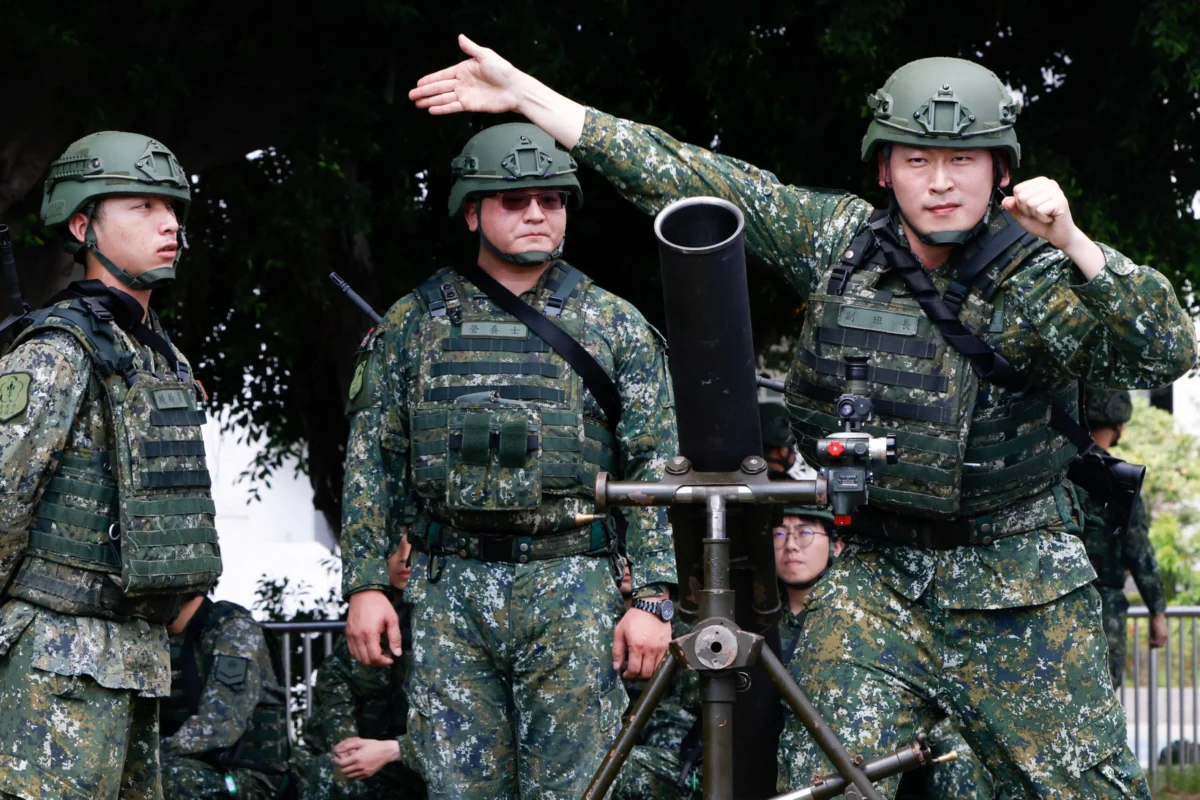
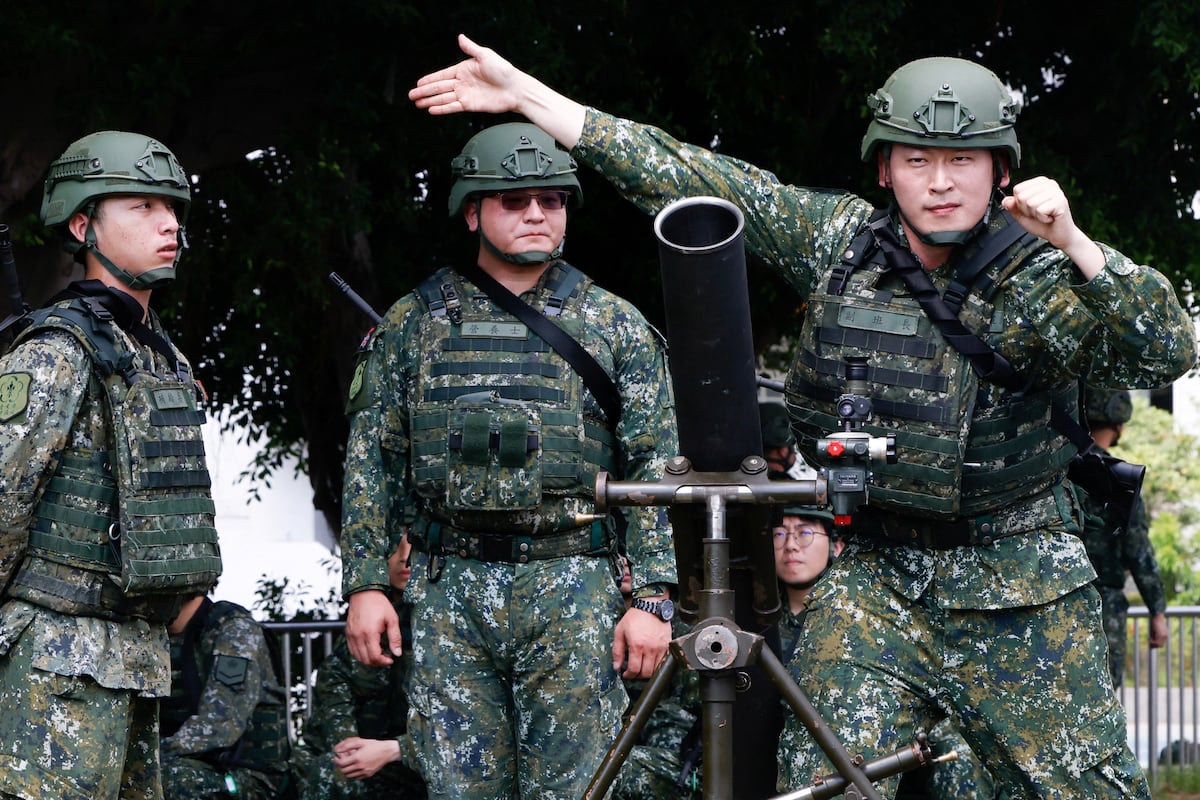
The current exercises involve the mobilization of more than 20,000 reservists, many of whom were seen on Wednesday practicing urban defense tactics in public spaces. On the sports field of a high school in Taipei, reservists in full combat gear practiced setting up mortar positions and taking up defensive rifle stances. This public display of readiness is part of a broader effort to socialize the concept of war among the citizenry.
A key addition to this year’s drill is the "embedded reporter" mechanism. The Ministry of National Defense (MND) has invited media members to join frontline units to simulate the process of wartime news releases. This initiative is designed to counter enemy disinformation and psychological warfare (psyop) campaigns that Beijing is expected to launch alongside any physical assault. By establishing a reliable flow of information from the frontlines, the military hopes to maintain public morale and ensure the international community receives accurate reports of the conflict.
Logistics and the "Pacific Lifeline"
While much of the media attention focuses on the defense of Taipei and the western coastline, a critical component of the 10-day drill is taking place off Taiwan’s Pacific (eastern) coast. The military is simulating the wartime relocation of a major arsenal and running escort drills for supply ships. Planners are increasingly concerned that the PLA may attempt to circle the island and sever supply lines coming from allies like the United States and Japan.
The drills include the mobilization of civilian factories to support the defense industry, testing the island’s industrial capacity to repair hardware and manufacture munitions under fire. This "all-society" approach mirrors strategies seen in Ukraine, where civilian logistics networks have proven essential to the national defense effort.
Supporting Data: The Rising Threat Landscape
The intensity of the 2024 Han Kuang drills is underscored by a significant increase in PLA activity around Taiwan. According to data from the Taiwanese Ministry of National Defense, the number of Chinese military aircraft entering Taiwan’s Air Defense Identification Zone (ADIZ) has risen sharply:
- 2021: Approximately 960 incursions.
- 2022: Approximately 1,730 incursions.
- 2023: Over 2,000 incursions.
Furthermore, China’s "Joint Sword" exercises in recent years have demonstrated an increasing capability to perform multi-domain blockades. In response, Taiwan has increased its defense budget to a record NT$606.8 billion (US$19 billion) for 2024, representing roughly 2.5% of its GDP. The Han Kuang exercises are the primary vehicle for ensuring that this increased spending translates into tangible combat readiness.
Official Responses and Geopolitical Implications
The Chinese government, which views Taiwan as a breakaway province and has never renounced the use of force to achieve "unification," has remained largely silent regarding the specific start of these drills. However, a spokesperson for the People’s Liberation Army typically characterizes such exercises as "futile attempts" by "separatist forces."
Conversely, senior Taiwanese officials have framed the drills as a necessary deterrent. "The emphasis will be on how our entire population, the Republic of China as a whole—especially our citizens—should face war," a defense official stated. This rhetoric reflects the administration’s goal of building "social resilience," ensuring that the population is psychologically and practically prepared for a protracted conflict.
International observers, particularly those in Washington and Tokyo, are watching the drills closely. The shift toward the "backbrief" method and unscripted scenarios is seen as a sign that Taiwan is taking the advice of U.S. military advisors who have long pushed for more flexible, decentralized command structures.
Analysis: The Impact of Realism
The decision to conduct "unscripted" drills carries inherent risks, including the potential for accidents or public inconvenience. However, the benefits of such realism are substantial. By forcing commanders to operate with limited internet and without a pre-set "enemy scenario," the military is identifying gaps in its communication and logistics that would remain hidden in a choreographed exercise.
The success of the 2024 Han Kuang drills will be measured not by the number of targets hit during live-fire demonstrations, but by the ability of the various branches of the military and civilian government to maintain cohesion under duress. As the drills continue through August 14, the focus will remain on the "Pacific lifeline" and the ability to sustain a defense even if the capital’s primary command centers are targeted.
Ultimately, these exercises serve as a stark reminder of the precarious security situation in the Indo-Pacific. By testing "real bottom-line conditions," Taiwan is sending a message to both its citizens and its adversaries: the island is preparing not just for a theoretical battle, but for the messy, unpredictable reality of a modern war of survival.

Related Posts
Pentagon Forges Landmark Seven-Year Agreements with Boeing and RTX to Accelerate Standard Missile-3 Production and Stabilize Defense Supply Chains
Boeing Unveils Ultra Low-Cost Seeker to Enhance Missile Inventory and Combat Cost Challenges in Modern Warfare