
Overnight Russian Ballistic Missile Attacks Kill Three Near Kyiv Amidst Zelensky’s Diplomatic Push for Air Defense Support in Belgrade
In the early hours of Saturday, a series of intense Russian ballistic missile strikes targeted regions surrounding the Ukrainian capital, Kyiv, claiming the lives of at least three individuals, including a child, and injuring three others. The deadly assault occurred just days after a wave of Russian attacks across Ukraine resulted in 21 fatalities, underscoring a grim pattern of escalating violence and the persistent threat posed by Moscow’s military campaign. Concurrently, Ukrainian President Volodymyr Zelensky embarked on a critical diplomatic mission to Belgrade, Serbia, his first visit to the nation, aimed at garnering wider international support for Ukraine, particularly addressing the country’s increasingly dire need for advanced air defense systems and interceptor missiles.
Escalation of Attacks and Civilian Toll in Kyiv
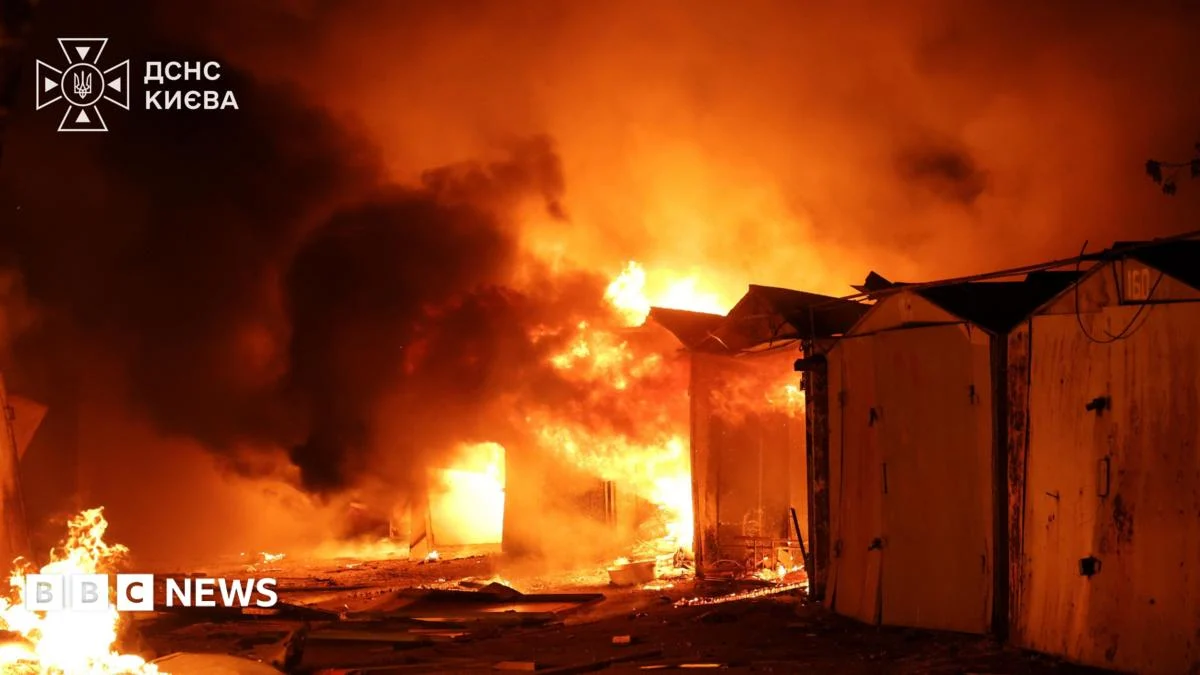
The recent barrage on Kyiv’s periphery inflicted significant damage, with powerful explosions reported by witnesses east of the capital. According to Timur Tkachenko, head of the regional military administration, falling debris from intercepted or impacting missiles damaged multiple apartment buildings and numerous cars. A separate building caught fire, and emergency services were dispatched to extinguish blazes at both a residential structure and a fuel tank within Kyiv itself, as confirmed by Mayor Vitaly Klitschko via Telegram. Ukraine’s State Emergency Service (DSNS) released harrowing photographs depicting burning garages, a business, and other structures in Kyiv, indicating that the full extent of casualties and damage was still being assessed. The use of ballistic missiles, characterized by their high speed and destructive power, presents a formidable challenge to Ukraine’s air defense networks, often leaving minimal time for warning and interception. These weapons, which follow a parabolic trajectory before descending rapidly, are designed to penetrate defenses and inflict widespread damage, often indiscriminately targeting areas with civilian populations and critical infrastructure. The psychological toll on residents, subjected to frequent nocturnal attacks, remains profound, contributing to widespread fear and displacement.
Ukraine’s Strained Air Defense Capabilities: A Critical Plea
The timing of these devastating strikes near Kyiv casts a stark light on President Zelensky’s urgent appeals for enhanced air defense capabilities from Ukraine’s international partners. For weeks, Zelensky has voiced growing concerns about the depletion of Ukraine’s interceptor stockpiles, a critical resource in countering Russia’s relentless aerial assaults. Earlier in the week, he had explicitly stated that delays in receiving anti-ballistic missile systems from allies directly lead to "horrific casualties and destruction." He emphasized that a stronger interceptor capability "could have saved lives" in recent deadly assaults, directly linking the availability of defensive weaponry to civilian protection. The Ukrainian President further elaborated that the supply of interceptors from allies had been "significantly reduced" over the past year, placing immense pressure on Ukraine’s ability to defend its cities and strategic assets.
Ukraine relies heavily on a patchwork of advanced Western air defense systems, including MIM-104 Patriot, NASAMS (National Advanced Surface-to-Air Missile System), IRIS-T, and others, supplemented by older Soviet-era systems. While these systems have demonstrated remarkable effectiveness against various Russian aerial threats, including cruise missiles, drones, and some ballistic missiles, their operational effectiveness is directly tied to a continuous and robust supply of interceptors. Each interception consumes an expensive missile, and the sheer volume of Russian attacks means that stockpiles can dwindle rapidly without consistent replenishment. The logistical challenges of maintaining these complex systems, coupled with the need for trained personnel, further complicate Ukraine’s defensive posture. The strategic implication of weakened air defense is profound: it not only exposes population centers to greater risk but also forces Ukraine to divert resources and personnel, impacting its offensive and defensive ground operations.
Zelensky’s Diplomatic Offensive in Belgrade: A Complex Balancing Act
Amidst the domestic crisis, President Zelensky’s visit to Belgrade represents a pivotal moment in Ukraine’s ongoing diplomatic efforts to broaden its international support base. As his first visit to the Serbian capital, it signifies Ukraine’s strategic intent to engage with nations that have maintained a more nuanced stance on the conflict. The discussions with Serbian President Aleksandar Vučić were set to encompass a range of topics, including economic ties, relations with the European Union, and regional security issues.
Serbia, an aspiring member of the European Union, finds itself navigating a complex geopolitical landscape. While it has publicly condemned Russia’s invasion of Ukraine and provided humanitarian aid to Kyiv, including promising assistance for post-war reconstruction, Belgrade has steadfastly refused to impose sanctions on Russia. This position is largely influenced by historical ties, including a shared Orthodox Christian heritage, strong cultural links, and significant energy dependence on Russia. Furthermore, a considerable segment of the Serbian population harbors pro-Russian sentiments, partly due to historical grievances against Western interventions, notably the 1999 NATO bombing campaign. President Vučić’s administration has consistently sought to balance its ambition for EU integration with maintaining strategic relations with Moscow, a policy that has often drawn criticism from Brussels and Washington.
For Zelensky, securing Serbia’s unequivocal support, or at least a stronger alignment with Western policies concerning Russia, would be a significant diplomatic victory. It would contribute to isolating Russia further on the international stage and demonstrate Ukraine’s ability to win over nations traditionally seen as more sympathetic to Moscow. The discussions in Belgrade were not only about immediate aid but also about shaping the future geopolitical alignment of the Western Balkans in the context of a broader European security architecture. Serbia’s commitment to joining the EU provides a lever for Western partners, who encourage alignment with EU foreign policy, including sanctions against Russia. However, Vučić faces domestic political constraints, making any drastic shift in policy challenging.
Geopolitical Landscape and Serbia’s Ambivalent Position
Serbia’s strategic location in the heart of the Balkans and its unique geopolitical leanings make it a critical player in the broader European security framework. Its aspirations for EU membership are genuine, but the path is fraught with challenges, including the need for extensive reforms, addressing issues of rule of law, and aligning its foreign policy with that of the Union. The refusal to apply sanctions on Russia, a core tenet of EU policy towards the conflict, remains a significant hurdle in its accession process.
Despite its non-sanctions stance, Serbia has demonstrated gestures of support for Ukraine. Beyond humanitarian aid, there have been reports of Serbian ammunition reaching Ukraine through third countries, though Belgrade officially denies direct military supplies. This complex posture reflects a nation attempting to preserve its strategic autonomy while also pursuing integration into the Western bloc. The Serbian government’s stated commitment to helping Ukraine rebuild after the war is another indication of its desire to engage constructively with Kyiv and the wider European community, even as it maintains its traditional ties with Russia. This balancing act underscores the intricate web of historical, economic, and political factors influencing the foreign policy decisions of nations caught between competing geopolitical interests.
Reciprocal Strikes and Stalled Mediation: A Cycle of Escalation
The recent escalation in Russian attacks near Kyiv follows a period marked by intensified reciprocal strikes between both sides and a noticeable faltering in mediation talks aimed at de-escalating the conflict. Earlier in the week, Ukraine had launched drone attacks deep inside Russian territory, successfully hitting two oil refineries. Concurrently, Ukrainian forces targeted Moscow-linked vessels in the Black Sea. President Zelensky explicitly stated that these Ukrainian counter-strikes were intended to limit Russia’s oil revenues, which he argued were being used by Moscow to "finance" its war in Ukraine. These strikes represent a strategic effort by Kyiv to disrupt Russia’s war economy and demonstrate Ukraine’s capability to project power beyond its borders, thereby imposing costs on the aggressor.
The targeting of Russian energy infrastructure carries significant economic and psychological implications. It aims to reduce the Kremlin’s financial resources, which are crucial for sustaining its military operations, and to create domestic pressure within Russia. Similarly, attacks on Black Sea vessels challenge Russia’s naval dominance and its ability to project power in the region, potentially impacting grain exports and other maritime activities.
The backdrop to this renewed intensity of fighting is the apparent collapse of recent mediation talks. While details of these discussions are often kept confidential, reports indicate that both sides have maintained maximalist positions, with Ukraine demanding full territorial integrity and withdrawal of Russian forces, and Russia insisting on its annexed territories and other concessions. A lack of trust, coupled with the desire of both nations to achieve battlefield advantages before entering serious negotiations, has contributed to the impasse. The international community, while advocating for a peaceful resolution, has struggled to find common ground for effective mediation, leading to a prolonged and brutal conflict characterized by cycles of military escalation.
Broader Impact and Implications for the War
The recent events underscore the enduring and multifaceted challenges faced by Ukraine in its defense against Russian aggression. The humanitarian cost of the conflict continues to mount, with civilian casualties, including children, serving as a stark reminder of the war’s brutal reality. The persistent targeting of civilian infrastructure not only causes immediate loss of life and property but also aims to erode the morale of the Ukrainian population and strain the country’s resources.
The critical need for sustained international military and financial aid to Ukraine cannot be overstated. The effective functioning of Ukraine’s air defense, a lifeline for its cities, hinges on the continuous supply of advanced systems and interceptors. Delays or reductions in this support directly translate to increased vulnerability and human suffering. The diplomatic efforts, exemplified by Zelensky’s visit to Belgrade, are equally crucial in maintaining global solidarity, countering Russian propaganda, and securing the long-term support necessary for Ukraine’s survival and eventual reconstruction.
The role of nations like Serbia, navigating complex geopolitical loyalties, highlights the broader challenge of forging a united international front against aggression. While not directly involved in the fighting, their stances and policies can influence the conflict’s trajectory and the effectiveness of international sanctions regimes. The ongoing war of attrition demands immense resources from both sides, pushing their economies and societies to their limits. The implications extend beyond Ukraine’s borders, impacting global energy markets, food security, and the foundational principles of international law and order. The future outlook remains uncertain, but the resolve of Ukraine, coupled with sustained international backing, will be pivotal in determining the ultimate outcome of this devastating conflict and its long-term impact on regional and global security.

Related Posts

Zambia on Edge: Opposition Leader Arrested Amid Allegations of Insurrection Plot and Election Tensions
Rescuers search for survivors of powerful Indonesia earthquake

