US Navy Validates At-Sea Drone Production Using Containerized Microfactories During RIMPAC 2026
In a significant leap toward self-sustaining maritime operations, a defense technology firm has successfully demonstrated the ability to manufacture combat-ready unmanned aerial systems (UAS) aboard a U.S. Navy warship while at sea. Firestorm Labs, an aerospace startup specializing in modular unmanned systems, utilized its proprietary "xCell" containerized microfactory to produce over 1,000 individual components and 12 fully functional "Squall" first-person view (FPV) drones during the USS Essex’s transit to the Rim of the Pacific (RIMPAC) 2026 exercise. This milestone marks a critical turning point for the Navy’s "containerized capability" strategy, proving that the service can generate its own weapons and repair parts in the middle of the ocean, thereby bypassing traditional, vulnerable supply chains.
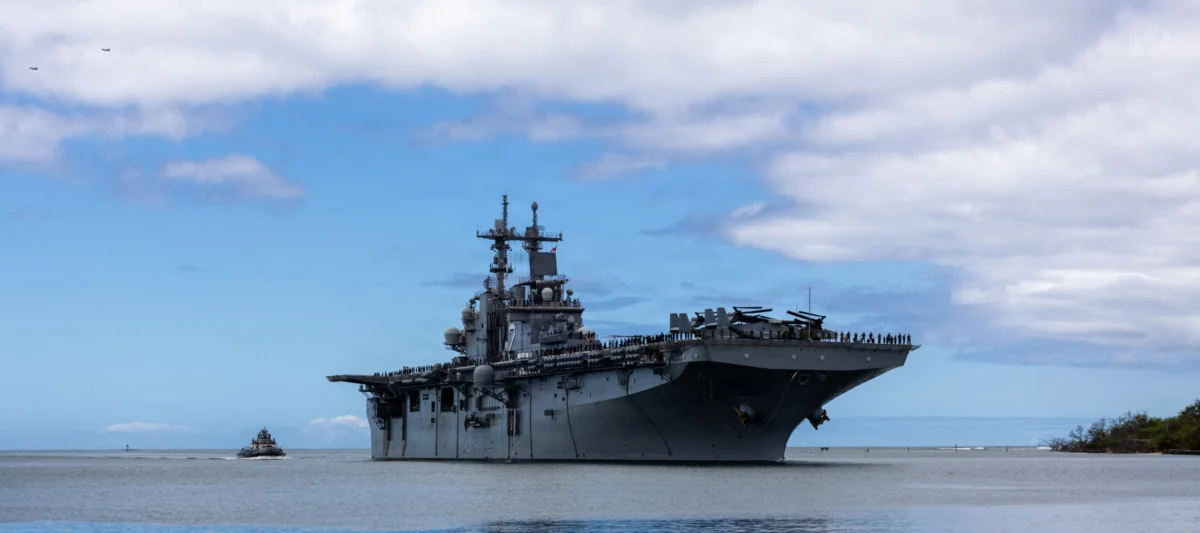
The demonstration occurred aboard the Wasp-class amphibious assault ship USS Essex (LHD-2) as it navigated through challenging conditions in the Pacific. Despite waves reaching heights of 12 feet, the xCell system remained operational, highlighting the ruggedization of modern additive manufacturing (3D printing) technology. The achievement provides a tangible solution to the "contested logistics" problem, where the U.S. military anticipates that future adversaries will target traditional resupply lines, making the ability to manufacture at the "tactical edge" a necessity rather than a luxury.
The xCell System: A Factory in a Box
At the heart of this operational success is Firestorm Labs’ xCell, a "factory-in-a-box" designed specifically for expeditionary environments. The system is housed within a standard shipping container, allowing it to be easily loaded onto various naval platforms, from massive amphibious ships like the Essex to smaller littoral combat ships or even commercial vessels converted for military use.
The xCell utilizes advanced additive manufacturing techniques to print high-strength composite parts. During the transit to Hawaii, the system focused on the Squall drone, a modular FPV platform designed for rapid deployment. By printing the airframes and structural components on deck, the Navy effectively demonstrated a "just-in-time" manufacturing model. This allows commanders to tailor their drone fleet to specific mission requirements on the fly, rather than relying on a fixed inventory of pre-manufactured assets that may not suit the evolving needs of a conflict.
The 12 Squall drones produced during the voyage were not merely prototypes; they were integrated into the broader RIMPAC 2026 exercise. Upon arrival in Hawaii, these 3D-printed aircraft were utilized as "adversary" assets during a series of complex counter-drone drills. This provided U.S. and allied forces with realistic training scenarios against low-cost, high-volume threats—the very types of systems currently dominating modern battlefields in Eastern Europe and the Middle East.
Overcoming Environmental Challenges at Sea
Manufacturing precision electronics and structural components on a moving ship presents a unique set of engineering hurdles. Traditional 3D printers are sensitive to vibration, humidity, and the pitch and roll of a vessel. The USS Essex, while a stable platform compared to smaller destroyers, still experiences significant movement in high sea states.
The Firestorm Labs team and the crew of the Essex reported that the xCell system successfully mitigated these factors. By printing over 1,000 parts in 12-foot seas, the microfactory proved that additive manufacturing has matured enough to handle the rigors of the maritime environment. Beyond drone production, the system was used to fabricate essential mechanical test components. These tests were vital for assessing the structural integrity of the printed materials under the stress of saltwater exposure and constant vibration.
Furthermore, the crew utilized the xCell to print actual military repair parts for the ship’s internal systems. In a standard operational cycle, a broken mechanical component might require a "Priority 1" parts request, necessitating a costly and time-consuming delivery via a C-2 Greyhound or a helicopter. By printing these parts on-site, the Essex crew reduced the repair cycle from days or weeks to a matter of hours.
Strategic Context: The Containerized Capability Campaign Plan
The success aboard the USS Essex is a direct realization of the U.S. Navy’s broader strategic shift toward modularity. In March 2026, Admiral Daryl Caudle, Commander of U.S. Fleet Forces Command, introduced the "containerized capability campaign plan" during the McAleese Defense Programs conference. The vision behind this plan is to decouple a ship’s hull from its specific mission set.
By utilizing standardized shipping containers to house advanced technologies—ranging from 3D printing labs and drone launchers to missile batteries—the Navy can rapidly transform a logistics ship or an older warship into a lethal combatant. This approach allows the service to "plug and play" new technologies as they emerge, rather than waiting for years-long drydock periods to overhaul a ship’s permanent systems.
The xCell demonstration serves as a proof of concept for this modular future. If a single container can provide a continuous supply of FPV drones, it effectively increases a ship’s magazine depth without requiring more space in the traditional armory. This aligns with the Pentagon’s broader "Replicator" initiative, which aims to field thousands of cheap, autonomous systems to counter the mass of near-peer adversaries.
Economic and Tactical Implications of At-Sea Manufacturing
The implications of Firestorm Labs’ success extend into the realm of economics and operational efficiency. Every component printed on the deck of the Essex represents a reduction in the "logistics tail." In a high-intensity conflict in the Pacific, the distance between supply hubs and the front lines can span thousands of miles. Delivering a single drone or a replacement gear via aircraft involves significant fuel costs, maintenance hours for the transport aircraft, and the risk of the delivery being intercepted by enemy forces.
The "Squall" drone itself represents a new class of "attritable" weaponry—systems that are inexpensive enough to be lost in combat without significant financial or strategic consequence. By manufacturing these drones on-site, the Navy can maintain a "pulse" of production that matches the rate of consumption in a combat environment.
Supporting data from recent Navy studies suggests that additive manufacturing at the edge could reduce the volume of stored spare parts by up to 30%, freeing up critical space for fuel and ammunition. Furthermore, the ability to iterate on designs in real-time means that if a specific drone configuration is found to be ineffective against enemy jamming, the onboard microfactory can produce a modified version with different frequencies or airframe shapes within 24 hours.
Integration with the Low-Cost Containerized Munitions Program
The Navy’s focus on containerized drone production is part of a larger ecosystem of modular weaponry. In May 2026, the Pentagon finalized framework agreements with several leading defense firms—including Anduril, CoAspire, Leidos, and Zone 5—under the Low-Cost Containerized Munitions (LCCM) program. This program aims to acquire more than 10,000 containerized missiles over a three-year period beginning in 2027.
The synergy between the LCCM program and Firestorm Labs’ xCell is clear: while LCCM provides the "heavy hitters" in modular boxes, the xCell provides the "eyes and ears" (UAS) and the ability to sustain those systems. Together, these programs represent a move away from the "exquisite" and expensive platforms of the past toward a more resilient, distributed, and mass-producible force.
Chronology of the Demonstration
- June 2026: Firestorm Labs installs the xCell containerized microfactory onto the USS Essex at Joint Base Pearl Harbor-Hickam. Initial calibration is performed in port.
- Early July 2026: The USS Essex departs for open-ocean transit. The xCell begins production of test coupons to verify material strength in the maritime environment.
- Mid-July 2026: Sea states increase to 10–12 feet. Despite the motion, the xCell initiates the "Squall" drone production run. Over 1,000 individual parts, including motor mounts, frames, and wing structures, are printed.
- Late July 2026: Essex crew members assist in the assembly of 12 Squall drones. Sailors are trained on the assembly process, demonstrating the system’s ease of use for non-specialized personnel.
- July 29, 2026: The USS Essex returns to Pearl Harbor to begin the formal RIMPAC 2026 exercises. The 12 drones are transferred to the exercise control group.
- August 2026: The 3D-printed drones are successfully flown as adversary targets in counter-UAS exercises, validating their flight performance and structural integrity.
Looking Ahead: The Future of Distributed Lethality
The success of the USS Essex mission provides a blueprint for the future of the "Golden Fleet" era—a term used by naval leadership to describe a force that is more autonomous, more modular, and more capable of sustaining itself in contested waters. As the Navy looks toward 2027 and beyond, the integration of containerized factories is expected to become a standard feature of Expeditionary Strike Groups.
Industry analysts suggest that the next phase of this technology will involve multi-material printing, allowing for the creation of even more complex systems, including integrated electronics and sensors, directly from the printer bed. For Firestorm Labs, the RIMPAC 2026 demonstration is a validation of their "software-defined manufacturing" approach, which treats the factory itself as a deployable weapon system.
By proving that a warship can serve as both a launch platform and a factory, the U.S. Navy has signaled to its adversaries that its "magazine" is no longer limited by what it carries out of port, but by the raw materials and ingenuity it carries within its containers. In the evolving landscape of 21st-century warfare, the ability to out-produce the enemy at the point of contact may prove to be the ultimate strategic advantage.

Related Posts
Pentagon Forges Landmark Seven-Year Agreements with Boeing and RTX to Accelerate Standard Missile-3 Production and Stabilize Defense Supply Chains
Boeing Unveils Ultra Low-Cost Seeker to Enhance Missile Inventory and Combat Cost Challenges in Modern Warfare