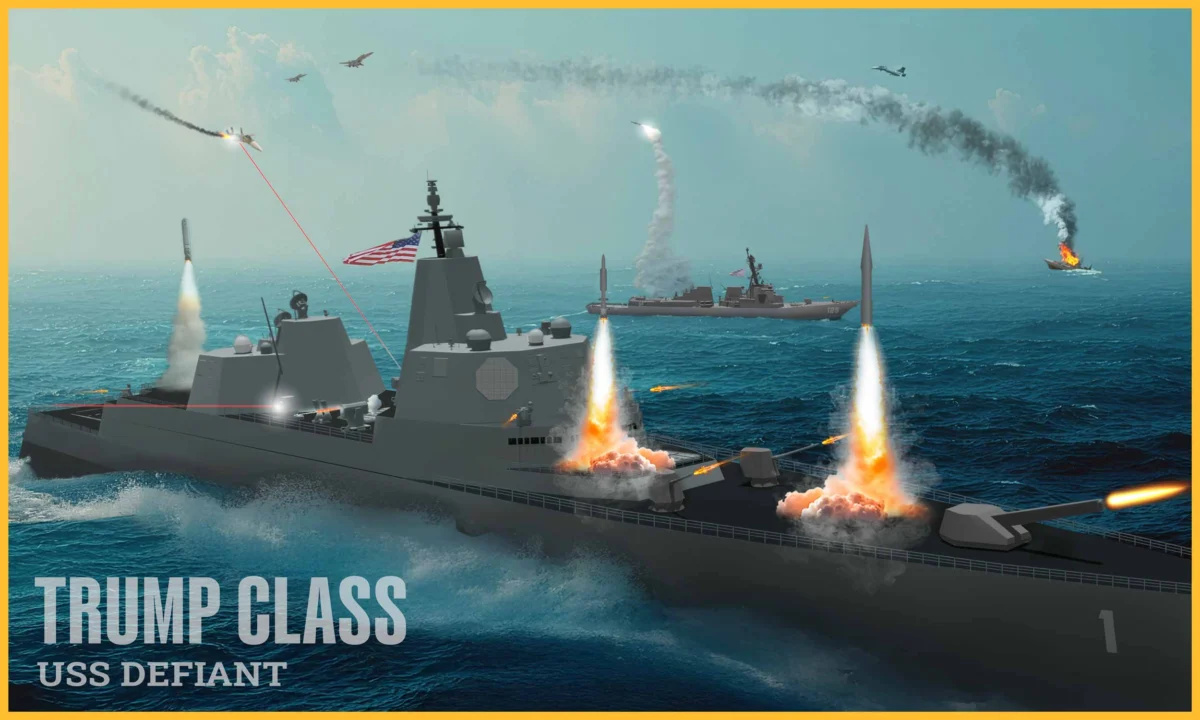
Congressional Budget Office Projects 275 Billion Dollar Total Cost for Proposed Navy Trump-Class Nuclear-Powered Battleship Procurement
The Congressional Budget Office (CBO) released a comprehensive report on Wednesday detailing the staggering financial requirements for the United States Navy’s proposed fleet of next-generation surface combatants. According to the federal agency, the procurement program for the newly designated Trump-class nuclear-powered guided-missile battleship, or BBG(X), is estimated to reach a total cost of $275 billion. The first vessel in this ambitious class is projected to cost $23.4 billion, a figure that significantly exceeds the cost of the nation’s most advanced aircraft carriers. This report comes at a time of heightened scrutiny regarding the U.S. shipbuilding industrial base and the strategic shift toward heavy, nuclear-powered surface vessels capable of high-energy warfare.
Technical Specifications and Unprecedented Scale
The Trump-class battleship represents a radical departure from the Navy’s recent focus on smaller, more agile littoral combat ships and multi-mission destroyers. At a projected displacement of 35,000 tons, the BBG(X) would be the largest surface combatant constructed for the U.S. Navy since the end of World War II. To provide a sense of scale, the CBO report notes that this vessel would be more than three and a half times the size of the current Arleigh Burke-class guided-missile destroyers and more than double the displacement of the Zumwalt-class stealth destroyers.
The decision to utilize nuclear propulsion is driven by the ship’s immense power requirements. Unlike conventional gas turbine engines, the onboard nuclear reactors are designed to provide the sustained electrical output necessary to operate a suite of advanced "Star Wars" style weaponry. According to the specifications outlined in the report, the Trump-class will be the most heavily armed surface vessel in naval history. Its planned arsenal includes:
- Hypersonic Missiles: Designed to penetrate sophisticated enemy air defenses at speeds exceeding Mach 5.
- Nuclear-Capable Cruise Missiles: Providing a sea-based leg of the nuclear triad on a surface platform.
- Directed Energy Weapons: Large-scale lasers capable of intercepting incoming drones and missiles at the speed of light.
- Electromagnetic Rail Guns: Using kinetic energy to strike targets at extreme ranges without the use of traditional explosives.
- Multi-Domain Missile Batteries: A massive array of vertical launch system (VLS) cells for anti-air, land-attack, and anti-ship operations.
Chronology of the BBG(X) Program
The path toward the Trump-class battleship began in December 2024, when the administration formally announced its intention to revive the battleship concept for the 21st century. The move was framed as a response to the growing naval capabilities of peer competitors and the need for a "capital ship" that could survive and dominate in highly contested "Blue Water" environments.
The timeline for the program is expansive, stretching over three decades:
- December 2024: Initial announcement of the Trump-class (BBG(X)) designation.
- March 2025: The Government Accountability Office (GAO) issues a warning regarding the "perpetual state of triage" within U.S. shipyards.
- Late 2026: The Navy updates its cost projections, though they remain $6 billion lower than the CBO’s eventual $23.4 billion estimate for the lead ship.
- 2028: Projected start of construction for the first-in-class BBG(X).
- 2028–2056: The Navy aims to procure 15 battleships, averaging one vessel every two years.
- 2058: The target date for the full integration of these vessels into the fleet, by which time total large surface combatant tonnage must increase by 60%.
Comparative Financial Analysis
The CBO’s $275 billion estimate highlights a significant disparity between the Navy’s internal projections and independent budgetary assessments. While the Navy initially projected the lead ship to cost roughly $17.4 billion, the CBO’s updated figure of $23.4 billion reflects the historical tendency for first-in-class vessels to encounter significant cost overruns due to unforeseen technical challenges and design changes.
The subsequent 14 ships in the class are expected to cost approximately $18 billion each, benefiting from the "learning curve" of production. However, even these reduced costs dwarf other major naval assets. For comparison, the USS Gerald R. Ford (CVN-78), the lead ship of the Navy’s newest class of nuclear-powered aircraft carriers, cost approximately $13.3 billion. The fact that a single Trump-class battleship is projected to cost $10 billion more than a supercarrier underscores the complexity and density of the technologies being integrated into the BBG(X) hull.
Industrial Base and Shipbuilding Challenges
One of the most critical sections of the CBO report addresses the feasibility of the production schedule. To meet the service’s goals, U.S. shipyards would need to maintain a relentless pace, delivering a 35,000-ton battleship every other year while simultaneously producing two Arleigh Burke-class (DDG-51) destroyers annually.
The report estimates that by 2035, shipyards would need to handle 12% more tonnage than previously planned. By 2058, the total tonnage of large surface combatants under construction would need to rise by 60%. This requirement arrives at a time when the American shipbuilding industry is already struggling with labor shortages, aging infrastructure, and supply chain bottlenecks.
Shelby S. Oakley, a director at the Government Accountability Office (GAO), recently testified before the Senate Armed Services Committee regarding these systemic issues. Oakley noted that for nearly two decades, shipbuilding has been plagued by "unrealistic expectations of costs and timing." The GAO’s findings suggest that adding a massive, technologically complex battleship program to the current workload could exacerbate the "state of triage," where resources are constantly shifted to fix failing programs at the expense of others.
Operational Advantages and Nuclear Efficiency
Despite the daunting upfront costs, the CBO and GAO reports highlight potential long-term operational benefits. By utilizing nuclear power, the Trump-class battleships would eliminate the need for a constant supply of marine diesel or fuel oil. This "infinite" range—limited only by food supplies and mechanical maintenance—allows for persistent presence in remote theaters like the Indo-Pacific without the vulnerability of a logistics "tail" of vulnerable oilers.
While the GAO did not provide a specific dollar amount for these savings, proponents of the program argue that the reduction in life-cycle fuel costs and the increased "time on station" justify the initial investment. Furthermore, the nuclear reactors provide the massive electrical "surge" capacity required for the ship’s rail guns and laser systems, which would be impossible to power efficiently with conventional turbines on a smaller frame.
Strategic Implications and Global Power Projection
The shift toward the BBG(X) signals a fundamental change in American naval doctrine. For decades, the aircraft carrier has been the undisputed centerpiece of the fleet. However, the emergence of "carrier killer" anti-ship ballistic missiles has led some strategists to call for more heavily armored and better-defended surface ships.
The Trump-class battleship is designed to be a "high-end" combatant capable of operating within the reach of enemy shore-based defenses. Its mix of defensive lasers and offensive hypersonic missiles is intended to create a "bubble" of American sea control. Additionally, the inclusion of nuclear cruise missiles suggests the vessel will play a role in strategic deterrence, providing a mobile, survivable platform for theater nuclear options.
Critics, however, worry that the program could become a "financial black hole," drawing funds away from the submarine force or smaller, more numerous unmanned vessels. The $275 billion price tag represents a significant portion of the projected defense budget over the next thirty years, sparking a debate over whether the Navy is over-investing in a single, massive platform.
Future Outlook
As the Navy moves toward the 2028 construction start date, the BBG(X) program remains a focal point of legislative debate. The CBO report serves as a cautionary document, reminding policymakers of the immense scale of the undertaking. Whether the U.S. shipbuilding industry can rise to the challenge of a 60% tonnage increase, or if the "perpetual state of triage" will lead to delays and further cost escalations, remains the primary concern for the Pentagon and Congress alike.
For now, the Trump-class battleship stands as a symbol of a new era of naval ambition—one defined by nuclear power, directed energy, and a return to the heavy armor of the past, albeit at a price point that will test the limits of the American defense budget for decades to come.

Related Posts
Pentagon Forges Landmark Seven-Year Agreements with Boeing and RTX to Accelerate Standard Missile-3 Production and Stabilize Defense Supply Chains
Boeing Unveils Ultra Low-Cost Seeker to Enhance Missile Inventory and Combat Cost Challenges in Modern Warfare