
Ukraine Denounces "Human Safari" Drone Attack on Civilian in Kherson, Citing Systemic Russian Strategy and War Crimes
President Volodymyr Zelensky of Ukraine has publicly condemned a drone attack in the southern Kherson region, sharing a disturbing video that depicts a remotely operated drone actively pursuing and striking a civilian street vendor. Zelensky labeled the incident a "safari" attack, a term used to describe the deliberate targeting of non-combatants by Russian forces, designed to instill terror and psychological distress among residents in frontline areas. The incident, which has garnered widespread international attention, underscores the escalating brutality of the conflict and raises urgent questions about adherence to international humanitarian law.
The Anatomy of an Attack: A Civilian’s Ordeal
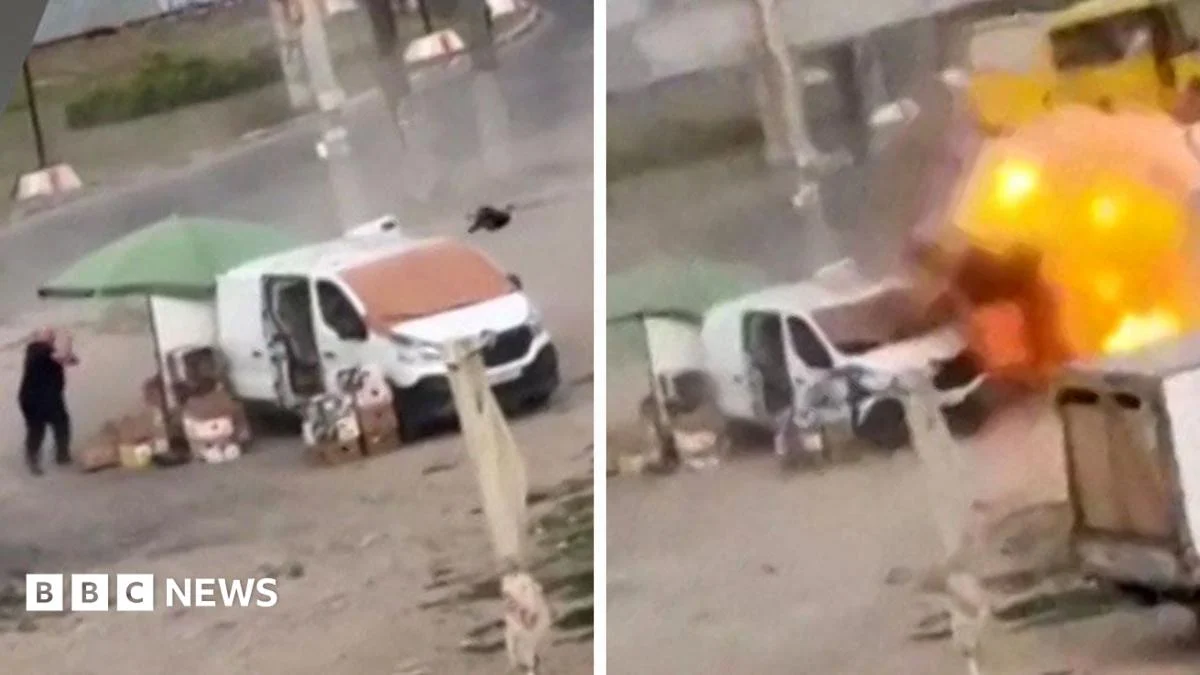
The harrowing video, which was widely circulated on social media platforms after being shared by President Zelensky, captures a chilling sequence of events. It shows a drone hovering menacingly above a city street in the Kherson region, its presence immediately recognized by a street vendor. The man, later identified as 52-year-old Yuriy, a vegetable vendor, attempts to evade the aerial predator. The drone, however, demonstrates an unnerving persistence, chasing Yuriy as he desperately maneuvers around a white van, seeking cover. The pursuit culminates in the drone swooping down with deadly precision, exploding upon impact with the unsuspecting civilian.
Medics later confirmed that Yuriy survived the assault but sustained significant injuries, including multiple shrapnel wounds, a concussion, and severe trauma. Speaking from his hospital bed, Yuriy recounted the terrifying ordeal. He explained that he and his wife were in the process of setting out crates of fresh vegetables next to their van when a distinct buzzing sound pierced the air. As his wife fled, the drone fixated on him. In a desperate and almost surreal attempt to signal his civilian status, Yuriy held up heads of garlic towards the drone’s camera, hoping to convey that he was merely a vendor, not a threat. "It could see that I had tomatoes out, some cucumbers and eggplants laid out on the floor," Yuriy stated, emphasizing the drone operator’s clear awareness of his non-combatant status. He further detailed the drone’s calculated movements, noting how it "even ducked under the umbrella when I was running away round the other side," indicating a deliberate and precise targeting by the operator.
BBC Verify, an independent fact-checking unit, successfully geolocated the video to a market space adjacent to a roundabout in the Tavriiskyi district of northern Kherson. While the precise origin of the footage remains unconfirmed, the earliest public copy discovered by BBC Verify appeared on a pro-Ukrainian Instagram account on Tuesday morning, suggesting its rapid dissemination following the attack.
"Human Safari": A Deliberate Strategy of Terror
The term "human safari" or "drone safari" has tragically become synonymous with a particularly heinous tactic employed by Russian forces in Ukraine, especially prevalent in regions like Kherson, which lies mere miles from the active front line. This strategy involves the deployment of remotely operated drones, often kamikaze or FPV (First Person View) drones, specifically to target and terrorize civilians. The intent extends beyond mere collateral damage; it aims to inflict psychological warfare, sow fear, and disrupt the daily lives of residents who choose to remain in their homes despite the proximity to combat zones.
Ukraine’s Foreign Minister Andrii Sybiha vehemently condemned the incident, describing it as a "barbaric war crime." He asserted that these "safaris" represent a "deliberate and systemic Russian strategy," underscoring the premeditated nature of such attacks. Sybiha’s remarks highlighted the chilling aspect that "the sadist operating this drone knows full well that he is targeting a civilian," dismissing any notion of mistaken identity or accidental targeting. He further elaborated that such attacks are part of a calculated Russian campaign to intimidate civilian populations and called for robust international condemnation and accountability.
This is not an isolated incident. A United Nations report, anticipated for release in 2025, has already documented instances where Russian armed forces have "recurrently killed and injured civilians" in the area through the deliberate use of drones. The report further notes the disturbing practice of these drone operators posting videos of their attacks online, allowing thousands to witness the final, terrifying moments of their victims. The UN has unequivocally stated that "posting videos of civilians being killed and injured amounts to the war crime of outrages upon personal dignity," a grave violation of international humanitarian law. This act, which seeks to humiliate and dehumanize victims, adds another layer of depravity to the already egregious targeting of civilians.
Kherson’s Enduring Ordeal: A Frontline Reality
The Kherson region holds significant strategic and symbolic importance in the ongoing conflict. Following Russia’s full-scale invasion in February 2022, Kherson city was one of the first major urban centers to fall under Russian occupation. After months of brutal control, Ukrainian forces achieved a significant victory in November 2022, liberating the city and the western bank of the Dnipro River. However, this liberation did not bring peace. The Dnipro River now serves as a de facto front line, separating Ukrainian-controlled territory from Russian-occupied areas on the eastern bank.
Consequently, Kherson and its surrounding settlements remain under constant, indiscriminate shelling and drone attacks from Russian forces positioned across the river. Daily life for residents is a harrowing gauntlet of air raid alerts, artillery barrages, and the ever-present threat of drone incursions. Essential services are frequently disrupted, infrastructure is damaged, and the psychological toll on the population is immense. The "human safari" attacks represent an intensified and technologically advanced form of this ongoing terror campaign, specifically designed to prey on the vulnerability of those attempting to maintain some semblance of normalcy in a war zone.
The Evolving Landscape of Drone Warfare and International Law
The incident involving Yuriy underscores the rapidly evolving nature of modern warfare, where advanced drone technology is increasingly employed not only for reconnaissance and conventional military targeting but also for psychological warfare and direct attacks on non-combatants. The proliferation of relatively inexpensive yet highly effective FPV drones, often adapted from commercial models, has democratized air power, putting sophisticated surveillance and strike capabilities into the hands of operators. While both sides in the conflict utilize drones, the deliberate targeting of clearly identifiable civilians, as depicted in the Kherson video, constitutes a clear violation of the laws of armed conflict.
International humanitarian law, enshrined in the Geneva Conventions and their Additional Protocols, unequivocally prohibits attacks on civilians and civilian objects. The principle of distinction mandates that parties to a conflict must at all times distinguish between civilians and combatants and between civilian objects and military objectives, directing attacks only against military objectives. Targeting Yuriy, a street vendor displaying his wares, in a market area, represents a blatant disregard for this fundamental principle. Such acts also fall under the jurisdiction of the International Criminal Court (ICC) as potential war crimes, specifically targeting civilians, causing unnecessary suffering, and outrages upon personal dignity.
Calls for Accountability and the Global Response
President Zelensky’s decision to share the graphic video on social media was a deliberate attempt to galvanize international attention and outrage. "The world must see this," Zelensky wrote on Telegram. "It must see every piece of evidence that Russia has gone mad, and every fact that Russian soldiers are enjoying killings and tormenting people." His words reflect a broader Ukrainian strategy to continuously document and expose alleged Russian war crimes, hoping to build an irrefutable case for justice and to maintain international pressure on Moscow.
The international community, including human rights organizations and various state actors, has repeatedly condemned Russia’s actions in Ukraine. However, the scale of alleged war crimes, coupled with Russia’s consistent denial of targeting civilians, presents significant challenges for accountability. Russia launched its full-scale invasion in February 2022, maintaining that its "special military operation" is aimed at "demilitarizing" and "denazifying" Ukraine, and it routinely dismisses reports of civilian casualties as Ukrainian propaganda or accidental collateral damage.
Yet, the mounting evidence, meticulously collected by organizations like the UN, the ICC, and numerous non-governmental organizations, paints a starkly different picture. The sheer volume and consistency of reports detailing indiscriminate attacks, deliberate targeting of civilian infrastructure, and tactics like the "human safari" suggest a pattern of behavior that contravenes established international norms and laws.
The implications of such attacks extend beyond immediate casualties. They erode trust in international legal frameworks, contribute to a climate of impunity, and inflict deep, lasting trauma on affected populations. For the international community, the incident in Kherson serves as a potent reminder of the urgent need to bolster mechanisms for documenting war crimes, supporting international investigations, and ensuring that perpetrators are held to account, regardless of their position or nationality. The struggle for justice in Ukraine is not merely a regional concern but a global imperative to uphold the foundational principles of humanity and international law in the face of escalating barbarity.
Additional reporting by Richard Irvine-Brown, BBC Verify

Related Posts
Zambia on Edge: Opposition Leader Arrested Amid Allegations of Insurrection Plot and Election Tensions
Rescuers search for survivors of powerful Indonesia earthquake

