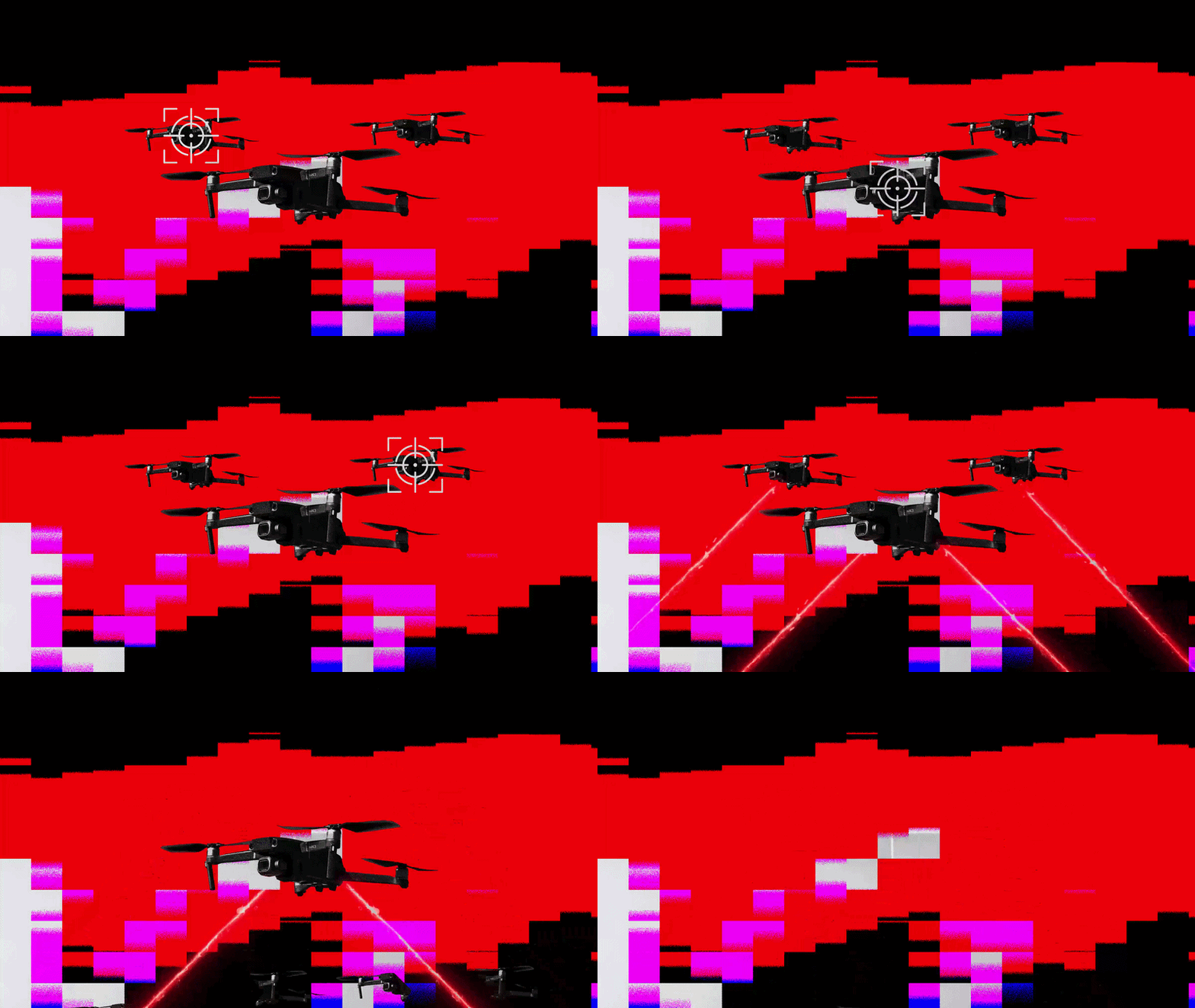
The United States Military Is Finally Deploying Laser Weapons to Combat the Drone Threat
For more than half a century, the promise of directed-energy weaponry has lived primarily in the realm of science fiction and experimental defense budgets. From mounting high-energy lasers on modified 747 aircraft to test their potential against ballistic missiles, to equipping Humvees with prototype zappers designed to neutralize improvised explosive devices, the United States military has spent decades attempting to bridge the gap between theoretical physics and battlefield utility. Until now, these programs were largely relegated to the "research and development" graveyard.
That cycle of perpetual experimentation is nearing an end. According to defense officials and sources familiar with internal Pentagon procurement, the U.S. Army is finalizing a landmark contract to acquire and rapidly deploy the Enduring High Energy Laser (E-HEL). This initiative marks the first time the U.S. military has formally committed to integrating laser-based air defense systems into its active arsenal on a significant scale. An official announcement regarding the contract is expected to surface as early as this week, signaling a definitive shift in American military doctrine regarding the defense of fixed bases against emerging aerial threats.
The Drone Proliferation Crisis
The decision to pivot toward directed energy is not a product of theoretical ambition, but of necessity born on the front lines. The recent conflicts in Ukraine and the Middle East have fundamentally altered the calculus of modern air defense. Cheap, mass-produced, and highly effective unmanned aerial systems (UAS) have rendered traditional defensive measures economically and logistically unsustainable.
The stark reality of this disparity was highlighted during the height of recent tensions in the Middle East. The U.S. military frequently found itself in the position of utilizing Patriot interceptor missiles—each costing approximately $4 million—to destroy Iranian-designed drones valued at roughly $35,000. Beyond the extreme cost-per-kill ratio, this practice rapidly depleted the American stockpile of interceptor missiles, creating a strategic vulnerability.
"For years, lasers were going to be the future, and they never really came into their own," explains Mark J. Lewis, former chief scientist of the U.S. Air Force. "Now, they are actually coming into their own. The fundamental advantage is the magazine depth. You can keep firing them as long as you have a stable power supply."
A Timeline of Technical Evolution
The journey to the E-HEL has been marked by a series of technical hurdles and notable public failures. In the mid-2000s, the defense industry attempted to harness chemical lasers, which utilized toxic mixtures of chlorine and hydrogen peroxide. While powerful, they were logistically nightmarish to maintain in a combat zone. Subsequent efforts shifted toward solid-state systems using synthetic garnet crystals, which proved safer but lacked the necessary power output to reliably disable incoming threats.
The current technological breakthrough centers on "fiber lasers"—bundles of glass wires infused with rare-earth ions. These systems provide superior heat management and beam focusing, allowing multiple lower-power lasers to be bundled into a weapon-grade coherent beam.
The recent path toward deployment has been accelerated by an urgent series of field tests and unfortunate accidents. In February, an AeroVironment laser deployed along the U.S.-Mexico border gained infamy when it accidentally engaged a party balloon, triggering a temporary shutdown of airspace around El Paso. Shortly thereafter, the same system erroneously intercepted a U.S. Border Patrol drone. While these incidents were embarrassing, they paradoxically provided the Pentagon with proof of concept: the systems were indeed capable of tracking and destroying small, fast-moving aerial targets.
Operational Integration and the "Program of Record"
The most significant development is not the weapon itself, but its designation as a "program of record." In Pentagon nomenclature, this denotes a formally approved, long-term procurement project inscribed within the five-year budget cycle. This status guarantees funding, mandates maintenance infrastructure, and signals to defense contractors that the technology is ready for mass production.
"Program of record indicates a wider cultural acceptance of the new technology as a military capability," says Craig Robin, who oversaw the directed energy portfolio for the Army’s Rapid Capabilities and Critical Technologies Office.
The Army is currently negotiating a contract with AeroVironment for up to 20 E-HEL units. These systems are designed to be compact enough for deployment in a four-by-seven-foot container or mounted atop all-terrain vehicles. During a recent demonstration at White Sands, New Mexico, Defense Secretary Pete Hegseth observed the capabilities of various directed-energy projects, reinforcing the administration’s public support for the technology.
In late March, President Donald Trump underscored this shift, noting that the new laser technology would perform the same defensive duties as the Patriot system at a fraction of the cost.
Technical Limitations and Tactical Realities
Despite the optimism surrounding the E-HEL, experts caution that directed-energy weapons are not a panacea. The physics of laser operation impose hard constraints on their utility. Environmental factors remain a primary obstacle; high humidity, heavy fog, and rain scatter the photons, significantly reducing the beam’s range and effectiveness.
Furthermore, laser systems are inherently serial, not parallel. Unlike a missile battery that can launch multiple interceptors simultaneously, a laser must "dwell" on a target for several seconds to burn through its chassis or disable its flight controls. In a massive drone swarm attack, a single laser unit would be unable to neutralize every incoming projectile.
"The whole idea of swapping traditional munitions for lasers is really dumb," says Lewis. "The gun works fine. Why would you replace it with the laser? Use the laser in ways that you can’t use the gun."
The industry is responding to these limitations with specialized hardware. Companies such as nLight have secured massive contracts—up to $627 million—to develop laser systems capable of targeting more robust threats, including cruise missiles. However, the power levels required for these missions introduce new risks, including the potential for accidental damage to orbiting satellites.
The Strategic Implication
The deployment of the E-HEL marks a transition from a speculative era of defense research to a pragmatic era of engineering. The Pentagon’s strategy is no longer about finding a singular replacement for traditional air defense, but rather building a "layered" defense architecture. In this model, lasers serve as the first line of defense against low-cost, expendable threats, while traditional missiles are reserved for high-value targets like manned aircraft and cruise missiles.
This shift is critical given the recent, tragic losses in the field. On March 1, an Iranian-manufactured drone strike killed six U.S. service members and injured 30 others, a failure of force protection that added immense political pressure on the Pentagon to expedite the fielding of counter-UAS technology.
As the U.S. Army begins the process of equipping its bases with the E-HEL, the military is betting that the engineering refinements in semiconductor diodes, adaptive optics, and machine vision are sufficient to overcome the atmospheric and tactical limitations that have haunted the technology for decades. While the era of "Star Wars" style warfare remains distant, the era of the practical, cost-effective, and operational ray gun has officially arrived. The success of this program will likely determine the future of base defense for the next quarter-century, proving whether the promise of the laser can finally survive the harsh conditions of the modern battlefield.

Related Posts

The Las Vegas Cybersecurity Summit and the Escalating Threat of Autonomous Digital Exploitation

New York City Council members and privacy advocates launch legislative campaign to ban biometric facial recognition at public entertainment venues