Saudi Arabia Hails Trump’s "Historic Agreement" on Gaza Demilitarization, Calls for Full Implementation and Path to Palestinian Statehood
Riyadh, Kingdom of Saudi Arabia – In a significant diplomatic development, Saudi Arabia has officially lauded US President Donald Trump’s recent announcement of a "historic agreement on the demilitarisation" of the Gaza Strip. The Kingdom’s foreign ministry issued a statement praising President Trump’s leadership and unwavering commitment, which they asserted were instrumental in securing this pivotal deal. This endorsement underscores a notable alignment between Riyadh and Washington on a crucial aspect of the Israeli-Palestinian conflict, signaling a potential new chapter in regional peace efforts.
Saudi Arabia’s Endorsement and Vision for Comprehensive Peace
The statement from the Saudi foreign ministry went beyond mere acknowledgment, expressing profound gratitude to a host of international and regional partners. Egypt, Qatar, Turkey, the United States, the newly established "Peace Council," and other unnamed entities were specifically thanked for their collective endeavors in reaching this agreement. This broad recognition highlights the multilateral nature of the negotiations and the perceived collaborative spirit that led to the breakthrough.
Crucially, the Kingdom reaffirmed its unwavering commitment to the comprehensive peace plan enshrined in UN Security Council Resolution 2803. While details of this resolution remain subject to ongoing diplomatic discussions, Saudi Arabia emphasized the imperative for all agreed phases outlined within the resolution to be meticulously carried out within a clearly defined and agreed-upon timeframe. This insistence on a structured, time-bound implementation schedule reflects a desire to avoid past pitfalls of stalled negotiations and ensure tangible progress.
The Saudi statement meticulously outlined several critical preconditions and objectives for the successful implementation of the agreement. These included: a complete and unconditional Israeli withdrawal from the Gaza Strip, a move seen as essential for restoring Palestinian sovereignty and dignity; the swift deployment of an international stabilisation force, intended to ensure security, maintain order, and prevent a vacuum that could lead to renewed conflict; the guarantee of uninterrupted humanitarian aid and robust reconstruction efforts, vital for addressing the severe socio-economic challenges faced by Gaza’s population; and the full return of the Palestinian Authority (PA) to the territory, a step crucial for establishing legitimate governance and reunifying Palestinian political institutions.
Beyond these immediate logistical and security imperatives, Saudi Arabia articulated a broader vision for the agreement’s long-term impact. The Kingdom asserted that this demilitarisation deal should serve as the foundational impetus for launching a far-reaching political process. This process, they stressed, must unequivocally guarantee the Palestinian people’s right to self-determination and culminate in the establishment of an independent, sovereign Palestinian state. The ultimate goal, as envisioned by Riyadh, is the achievement of lasting peace rooted in mutual recognition between the states of Palestine and Israel, a cornerstone of the two-state solution framework.
The "Historic Agreement" and Its Genesis
President Trump’s announcement, hailed by Riyadh as "historic," reportedly came after an intensive period of shuttle diplomacy and multilateral engagements. The agreement on the demilitarisation of the Gaza Strip is understood to be a cornerstone of a broader US-led peace initiative, which seeks to resolve one of the world’s most intractable conflicts. The precise terms of the demilitarisation remain largely under wraps, but the core concept involves the dismantling of all non-state armed groups and their military infrastructure within Gaza, paving the way for a civilian administration under the Palestinian Authority, supported by an international security presence.
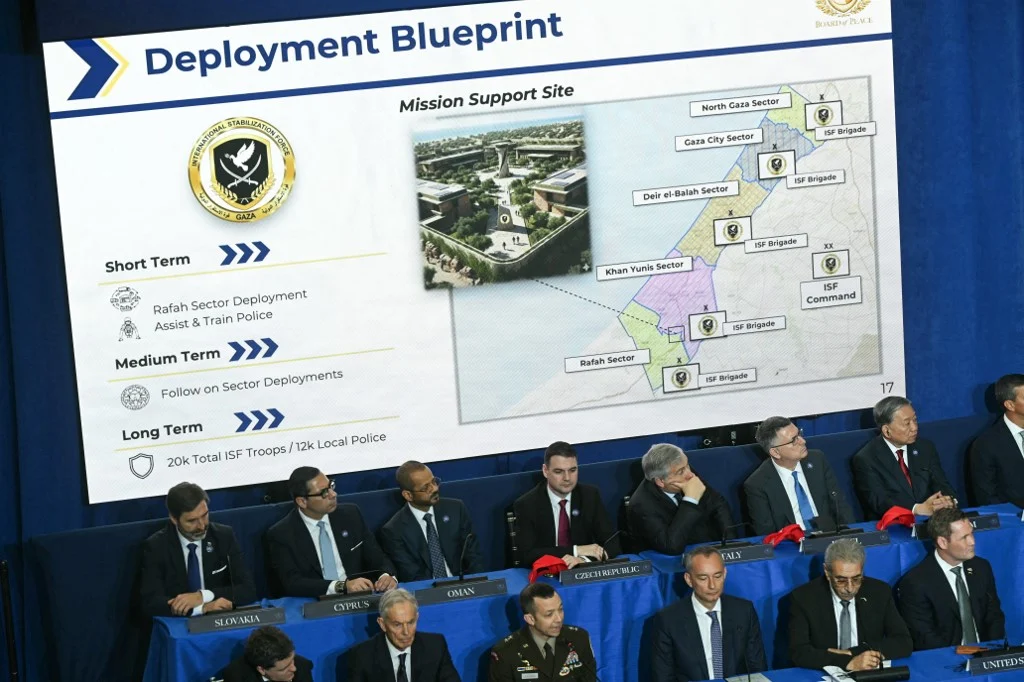
A pivotal moment in the lead-up to this announcement was the inaugural meeting of the "Board of Peace," hosted by President Trump in Washington D.C. on February 19, 2026. The image released alongside the Saudi statement, depicting a map of Gaza displayed at this high-level gathering, underscored the central focus of these discussions. While the full list of attendees at this "Board of Peace" meeting has not been publicly disclosed, it is understood to have brought together senior representatives from key regional and international powers, including those nations thanked by Saudi Arabia: Egypt, Qatar, Turkey, and potentially others whose influence was deemed critical to brokering the deal. This newly formed "Board of Peace" appears designed to serve as a high-level oversight body, tasked with monitoring the implementation of the agreement and steering the broader peace process.
UN Security Council Resolution 2803: The Blueprint for a New Era
The Saudi foreign ministry’s explicit reference to UN Security Council Resolution 2803 is central to understanding the proposed framework for peace. While the resolution’s full text has not yet been disseminated publicly, the Saudi statement provides crucial insights into its likely provisions. It is understood that Resolution 2803 represents a comprehensive peace plan, building upon decades of international efforts and outlining a phased approach to conflict resolution.

Key elements of Resolution 2803, as inferred from the Saudi endorsement, are expected to include:
- Phased Implementation and Timeline: The resolution is anticipated to stipulate a detailed, time-bound roadmap for the agreement’s execution, establishing clear benchmarks and deadlines for each stage of the process. This structured approach aims to foster accountability and prevent indefinite delays.
- Complete Israeli Withdrawal: A central tenet is the requirement for a full withdrawal of Israeli forces from the Gaza Strip, including any remaining military presence or control points, thereby ending the long-standing occupation and blockade.
- Deployment of an International Stabilisation Force (ISF): The resolution likely mandates the establishment and deployment of a robust, multi-national ISF. This force would be tasked with maintaining security, preventing the resurgence of armed groups, ensuring the demilitarisation of Gaza, protecting humanitarian corridors, and supporting the Palestinian Authority’s return. Its mandate would be clear, and its composition would likely draw from a range of UN member states, possibly including contributions from Arab and European nations, under a UN-approved framework.
- Uninterrupted Humanitarian Aid and Reconstruction: Recognizing the dire humanitarian situation in Gaza, the resolution would prioritize mechanisms to ensure the free flow of humanitarian aid, essential goods, and reconstruction materials. It would likely establish international oversight bodies to manage and coordinate large-scale reconstruction projects, focusing on rebuilding homes, infrastructure, and vital services destroyed by years of conflict.
- Return of the Palestinian Authority (PA): A critical political component is the facilitation of the PA’s full return to legitimate administrative and security control over the Gaza Strip. This would involve a transition of authority from existing de facto rulers and the establishment of a unified Palestinian governance structure across both the West Bank and Gaza.
- Launch of a Broader Political Process: Resolution 2803 is expected to serve as a launchpad for final status negotiations, addressing core issues such as borders, settlements, Jerusalem, refugees, and security arrangements. The ultimate objective is to achieve a just and lasting peace based on the internationally recognized parameters of a two-state solution, guaranteeing Palestinian self-determination and an independent state living securely alongside Israel.
Gaza’s Complex Landscape: A History of Conflict and Humanitarian Crisis
The Gaza Strip, a narrow coastal enclave home to over two million Palestinians, has been at the epicenter of the Israeli-Palestinian conflict for decades. Since 2007, following the victory of Hamas in Palestinian legislative elections and the subsequent factional violence with Fatah, Gaza has been under the de facto control of Hamas. This period has been characterized by recurrent conflicts with Israel, a stringent blockade imposed by Israel and Egypt, and a severe humanitarian crisis.
The economic and social fabric of Gaza has been decimated by successive conflicts and the blockade. Unemployment rates consistently hover around 50%, with youth unemployment significantly higher. Access to clean water, electricity, and healthcare is severely limited, and over 80% of the population relies on humanitarian assistance. Past reconstruction efforts have been hampered by political constraints, funding shortages, and restrictions on the entry of materials. The demilitarisation agreement, if successfully implemented, holds the potential to fundamentally alter this reality, opening Gaza to the world and enabling comprehensive rebuilding and economic development.
Key Regional and International Facilitators
The success of such a complex agreement hinges on the sustained engagement of key regional and international actors, as acknowledged by Saudi Arabia.
- United States: Under President Trump, the US has sought to redefine its approach to the Israeli-Palestinian conflict, emphasizing a comprehensive regional solution. Its role as a primary broker and guarantor of the agreement is indispensable, providing diplomatic leverage and financial incentives.
- Egypt: Sharing a border with Gaza, Egypt is a crucial player in any peace process involving the enclave. Its security concerns regarding border control and the flow of goods and people are paramount. Egypt has historically played a significant mediating role between Israel and Palestinian factions and is expected to contribute to the international stabilization force.
- Qatar: A key financial donor to Gaza and an important diplomatic channel for various Palestinian factions, Qatar’s involvement is vital for both humanitarian support and political buy-in. Its extensive diplomatic network and financial resources make it an indispensable partner in any reconstruction effort.
- Turkey: While often critical of Israeli policies, Turkey has maintained a complex relationship with both Israel and Palestinian groups. Its inclusion among the thanked partners suggests a role in ensuring broader regional acceptance and potentially engaging with diverse Palestinian stakeholders.
- The "Peace Council": This newly referenced entity appears to be a multi-stakeholder body, likely comprising senior diplomats, security experts, and development specialists from the nations actively involved in brokering the deal. Its function would be to provide continuous oversight, mediate disputes, and coordinate the complex implementation phases of the agreement and Resolution 2803.
Inferred Reactions from Other Stakeholders
While Saudi Arabia’s statement focused on its own position and gratitude, the implications of such an agreement necessitate considering the likely reactions and challenges from other key parties:
- Palestinian Authority (PA): For the PA, the agreement presents a monumental opportunity to regain control over Gaza and reunify the Palestinian territories. Their reaction would likely be one of cautious optimism, tempered by the immense logistical and political challenges of re-establishing governance and security in Gaza after years of separation. The PA would likely emphasize that the demilitarization is a step towards, not a substitute for, full statehood and sovereignty over all Palestinian territories, including East Jerusalem. Internal Palestinian reconciliation between Fatah and other factions would be critical for the PA’s successful return.
- Israel: The agreement’s promise of Gaza’s demilitarization addresses a core Israeli security concern. However, any withdrawal would be subject to strict verification mechanisms and robust security guarantees provided by the international force. The Israeli government would likely frame the deal as a significant step towards long-term security and regional stability, while navigating internal political pressures from those wary of concessions or withdrawal. The explicit mention of "mutual recognition between Palestine and Israel" would represent a significant shift for certain political factions within Israel, even as it aligns with the two-state solution framework.
- United Nations: As the custodian of Resolution 2803, the UN would play a crucial role in legitimizing and coordinating the international efforts. Its various agencies would be central to humanitarian aid, reconstruction, and potentially leading the international stabilization force. The UN Secretary-General would likely issue statements welcoming the agreement and emphasizing the need for full compliance and sustained international support.
- Militant Factions in Gaza (e.g., Hamas): The demilitarization of Gaza directly challenges the existing military infrastructure of groups like Hamas and Palestinian Islamic Jihad. Their reaction would be the most critical and potentially contentious hurdle. While the agreement’s premise implies their eventual disarmament or integration into a PA-controlled security framework, outright rejection could destabilize the entire process. It is plausible that through indirect channels or intense international pressure, a conditional acceptance or a pathway for their political reintegration (without their military wing) might be sought, or the agreement may proceed under the assumption that the international force and PA would enforce demilitarization. The successful implementation of demilitarization would require either their cooperation or their effective neutralization by the international force and PA. The path to achieving this without significant resistance remains a major challenge.
Implications for Regional Stability and the Future of the Israeli-Palestinian Conflict
The "historic agreement" on Gaza demilitarization, as welcomed by Saudi Arabia, carries profound implications for the region and the enduring conflict:
- Enhanced Security and Stability: A truly demilitarized Gaza, secured by an international force and under legitimate PA control, could significantly reduce the threat of rockets and cross-border violence, thereby enhancing security for both Israelis and Palestinians in the region. This could pave the way for a more stable and predictable environment.
- Renewed Path to Palestinian Statehood: By addressing the immediate crisis in Gaza and reunifying the Palestinian territories under the PA, the agreement could inject new momentum into the broader political process towards an independent Palestinian state. Saudi Arabia’s emphasis on self-determination and an independent state living alongside Israel underscores this aspiration.
- Economic Revival for Gaza: With the blockade lifted, demilitarization enforced, and international reconstruction aid flowing, Gaza could experience an unprecedented period of economic revival. This would include rebuilding critical infrastructure, fostering industries, creating jobs, and improving the quality of life for its long-suffering population.
- Shifting Geopolitical Landscape: Saudi Arabia’s prominent endorsement of a US-brokered deal signals its evolving role in regional diplomacy. It suggests a potential alignment with the US on critical regional issues and a willingness to leverage its influence to advance peace, possibly paving the way for broader normalization efforts between Arab states and Israel, once a credible path to Palestinian statehood is established.
- Challenges to Implementation: Despite the initial optimism, the implementation of such a comprehensive plan will face immense challenges. These include securing sustained international funding, overcoming potential resistance from spoilers, navigating complex political dynamics within Palestine and Israel, and maintaining a unified international front. The definition and enforcement of "demilitarization" will be a particularly sensitive and complex task.
Challenges and the Road Ahead
The road ahead for this "historic agreement" is undoubtedly fraught with challenges. The intricacies of withdrawing Israeli forces, deploying an effective international stabilization force, reintegrating the Palestinian Authority, and managing the political and security transition in Gaza will demand sustained diplomatic effort, significant financial investment, and unwavering political will from all parties. The success of this initial phase will be crucial in building confidence and momentum for the subsequent, even more complex, final status negotiations. As the world watches, the implementation of UN Security Council Resolution 2803 will serve as a critical test of whether this agreement truly heralds a new, more peaceful era for the Israeli-Palestinian conflict.

Related Posts
Over 150 Israeli Settlers Storm Al-Aqsa Compound and Perform Prayers, Violating Status Quo Under Police Protection.
UN Report Highlights Over 900 Obstacles Hampering West Bank Aid Amid Escalating Humanitarian Crisis