
Michigan Primary Becomes National Bellwether for Democratic Party’s Ideological Divide
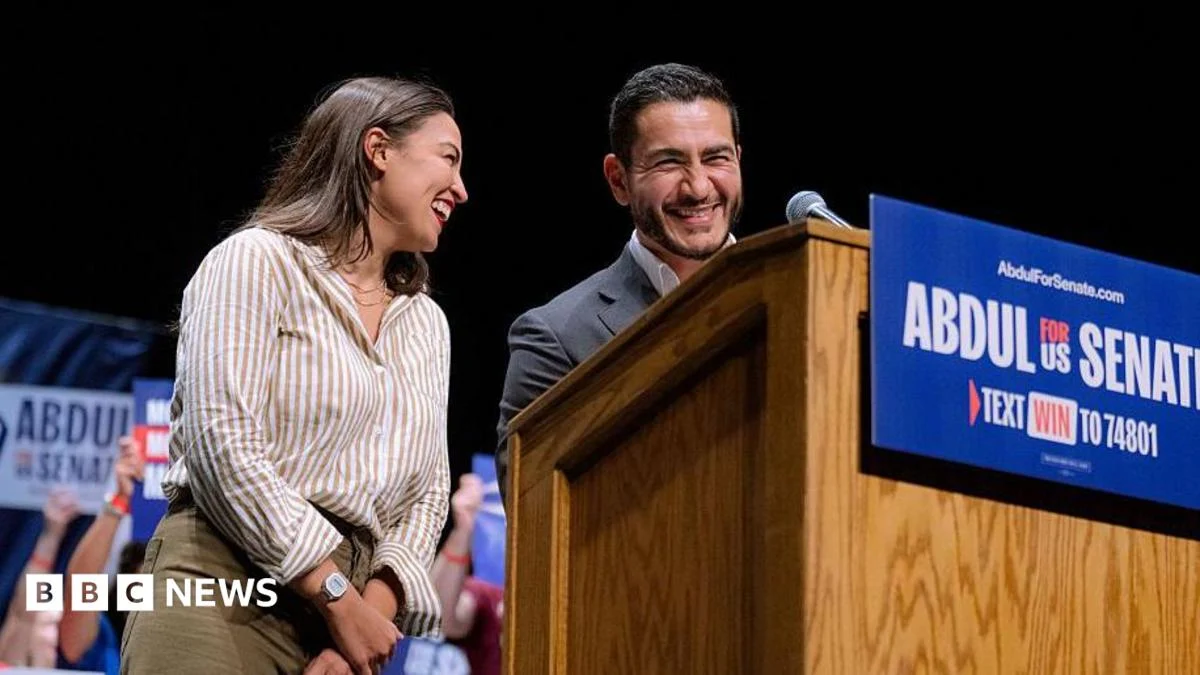
On a Saturday evening in Michigan, with the skies still hazy from drifting Canadian wildfire smoke, hundreds of voters packed into Detroit’s opulent 104-year-old Opera House, rising from their seats to cheer loudly as Senator Bernie Sanders and Democratic Representative Alexandria Ocasio-Cortez took the stage. The event was a powerful display of progressive might, aiming to galvanize support for Senate hopeful Abdul El-Sayed, a physician and public health advocate running on a platform deeply rooted in the American left’s core tenets. This high-profile rally, featuring two of the Democratic Party’s most prominent progressive voices, underscored the intensifying ideological battle within the party, a struggle whose outcome in Michigan could ripple across the national political landscape.
The Battle for Michigan’s Open Senate Seat
El-Sayed, a former Wayne County health director and son of Egyptian immigrants, is challenging Congresswoman Haley Stevens for the Democratic nomination for an open Senate seat. The August 4th primary is not merely a local contest; it has become a microcosm of the broader ideological schism defining the Democratic Party as it navigates a challenging political environment. El-Sayed’s campaign is built around ambitious policy proposals, including universal healthcare (famously dubbed "Medicare for All"), an annual wealth tax on billionaires, and a staunch re-evaluation of US foreign policy, particularly regarding aid to Israel and immigration enforcement. His supporters, visible at the rally with signs bearing his slogan and shirts advocating for an end to immigration enforcement and unconditional US aid to Israel, represent a fervent base eager for transformative change.
His opponent, Congresswoman Haley Stevens, presents a stark contrast. An experienced politician with a track record in Congress, Stevens embodies the more centrist, establishment wing of the Democratic Party. Her campaign is well-funded, benefiting significantly from corporate campaign donations and robust endorsements from powerful figures within the state, including Michigan’s popular Governor Gretchen Whitmer and outgoing Senator Gary Peters, whose seat is now up for grabs. Stevens has positioned herself as a pragmatic leader focused on tangible results, emphasizing her experience and ability to work across the aisle, appealing to a broader, more moderate electorate.
Michigan: A Crucial Swing State in the National Chessboard
The stakes in Michigan are exceptionally high. The state has long been a pivotal battleground, famously voting for Democrat Joe Biden in 2020 after having sided with Donald Trump in 2024. This electoral volatility makes every race in Michigan, especially an open Senate seat, a critical barometer for national political trends. For Democrats, retaining this seat is paramount if they hope to expand their slim majority in the Senate and effectively counter a potential resurgence of Donald Trump’s agenda. The winner of the Democratic primary on August 4th will face off against Trump ally Mike Rogers in the November 3rd general election, setting up a contest that could determine the balance of power in Washington.
The importance of Michigan is not lost on national political observers, who are closely monitoring whether the progressive wave seen in recent primary victories across the country—including in New York and Colorado—can translate into success in a politically diverse, historically working-class Midwestern state. Political strategist Adrian Hemond, based in Michigan, pointed out the challenge: "They got a big win electing Mamdani mayor of New York City, but also, it’s New York City. They have been much less able to win in some more traditionally purple areas." This sentiment highlights the ongoing debate within the party about the electability of openly progressive candidates in swing districts and states, particularly those that have shown a willingness to support populist figures like Trump.
The Progressive Momentum and its Midwestern Test
The rally in Detroit was a testament to the enthusiasm surrounding the progressive movement. Ocasio-Cortez, in her address, framed El-Sayed as representing the "politics of the future," a sentiment echoed by many in the crowd who are disillusioned with the political status quo. This energy is not isolated; self-described Democratic socialist Francesca Hong is attempting to secure a win in the governor’s race in neighboring Wisconsin just a week after Michigan’s primary, further illustrating the regional test for the progressive agenda.
However, miles outside the Detroit Opera House, a different perspective emerged. Voters like Colleen Houlihan, a 74-year-old from Ferndale, Michigan, expressed skepticism about El-Sayed’s ability to defeat Stevens or secure a general election victory for Democrats with his ambitious, left-leaning policies. "This may not be the moment for progressives," Houlihan stated, indicating her likely vote for Stevens. "I want radical change in the country, but we’ve got to start with this administration and it’s got to be an electable candidate to get power back in sane hands." This perspective underscores the pragmatic concerns of some Democratic voters who prioritize electability and a perceived ability to govern over ideological purity, especially in a closely divided nation.
Economic Anxieties and Healthcare as a Defining Issue
El-Sayed’s campaign is acutely aware of the economic anxieties gripping many Americans. His focus on "money out of politics, money in pockets, Medicare for all" resonates deeply with voters struggling with rising costs. Les Lukacs of Monroe, Michigan, a long-standing Democrat without health insurance, articulated this urgency, stating he would not vote for Stevens in November if El-Sayed lost the primary. "We can barely afford groceries and gas," he lamented. "I have to make sacrifices – and healthcare is one of them."
Polling data from the past year consistently shows healthcare costs as one of the top issues for voters heading into the November midterms, alongside the soaring prices of gas, groceries, and housing. This economic backdrop provides fertile ground for El-Sayed’s message, which directly addresses these kitchen-table concerns. He contends that if the Democratic Party truly prioritized everyday people, "they’d be fighting on the same policies I’m fighting for," suggesting a disconnect between the party establishment and the needs of its base.
The broader challenge for the Democratic Party is evident in recent favorability ratings. A Gallup poll, corroborated by Pew Research, indicated a significant decline in positive views of the Democratic Party among its own members, falling by 12% to 67% in 2025. This erosion of internal support highlights the urgency for the party to address voter concerns effectively and project a unified, compelling vision. While El-Sayed has strategically avoided the "Democratic socialist" label embraced by some peers, he has drawn lessons from their successes, particularly Zohran Mamdani’s victory in New York City, attributing it to strong social media engagement and a laser focus on affordability – themes El-Sayed has integrated into his own campaign.
Foreign Policy Divides: Israel and the Arab-American Vote
Beyond domestic policy, the Michigan primary has brought into sharp focus the deepening divisions within the Democratic Party over foreign policy, particularly concerning US involvement in the Middle East and aid to Israel. El-Sayed has been an outspoken critic of unconditional US aid to Israel, aligning with a growing segment of voters who, in the wake of recent conflicts, believe the US is too supportive of its longtime ally.
This issue carries particular weight in Michigan, which is home to the second-largest Arab-American population in the US. El-Sayed, himself the son of Egyptian immigrants, has unequivocally labeled Israel’s actions in Gaza as a genocide, a powerful statement that resonates deeply within the community. He has also highlighted his opponent’s financial ties to the American Israel Public Affairs Committee (AIPAC), noting that the influential pro-Israel lobbying group has spent almost $30 million to support Stevens’ campaign. This direct confrontation on foreign policy provides a clear differentiator between the candidates.
In contrast, Congresswoman Stevens, like many moderate Democrats, has publicly supported upholding US aid to Israel without conditions. Her campaign did not respond to requests for comment on her specific stance from the BBC, reflecting a cautious approach to an increasingly contentious issue within the party. Rex Nazarko, the leader of the American Muslim Engagement and Empowerment Network, believes El-Sayed’s position will attract a significant number of Democrats in Michigan who withheld support from Kamala Harris and Joe Biden in the 2024 presidential election due to their administration’s stance on Israel, potentially consolidating a crucial protest vote within the progressive camp.
The Road Ahead: Unity or Further Fragmentation?
As the primary approaches, the central question for Democrats remains whether the progressive wing can not only win internal contests but also successfully unite the broader party to secure victories in swing states against Republican challengers. Sally, a 45-year-old Michigan resident and elected official who declined to share her last name, expressed excitement about the progressive movement’s enthusiasm but questioned its long-term sustainability. "There’s a lot of that momentum, but keeping that momentum going is really hard," she observed. She also acknowledged the practical reality of modern politics, noting that while Stevens faces criticism for corporate campaign funding, "big money helps in politics" and "it’s those connections that are going to support changes in law and make things move faster."
Even some of El-Sayed’s most ardent supporters harbor anxieties about the outcome. Claire McHugh, a 70-year-old who attended the rally, admitted, "I’m a little scared. I’m a little nervous. I just hope that enough people are fed up with the status quo." These sentiments underscore the profound uncertainty surrounding the direction of the Democratic Party and its ability to mobilize a diverse coalition of voters.
When asked whether left-wing candidates could bridge the gap with more moderate Democrats to defeat Republicans, El-Sayed stated he was not primarily concerned with the future of the Democratic Party as an institution. Instead, he presented his campaign as a potential blueprint: "If Democrats want to find their future, I think we’re showing it to them right here." This defiant stance suggests a belief that the party’s future lies in embracing a more progressive platform, even if it means challenging established norms.
Political analysts, like Larry Sabato, a prominent political scientist, emphasize the urgent need for unity. Regardless of which faction prevails in the primaries, Democrats must find a way to "sew these two very large groups back together" if they hope to reverse recent electoral losses and build a sustainable path to power. "It’s already frayed," Sabato warned. "If they don’t do the repair job they need to do and quickly, certainly through 2028, then they’re going to have to get used to losing." The Michigan primary, therefore, is not just about a Senate seat; it is a critical inflection point for the Democratic Party, testing the viability of its progressive wing and the enduring challenge of forging unity amidst deep ideological divides. The outcome will undoubtedly offer significant insights into the party’s trajectory for years to come.

Related Posts
Zambia on Edge: Opposition Leader Arrested Amid Allegations of Insurrection Plot and Election Tensions

Rescuers search for survivors of powerful Indonesia earthquake

