The Surveillance Paradox: Madison Square Garden Disables Its Own Biometric Security for Elite Wedding Celebration
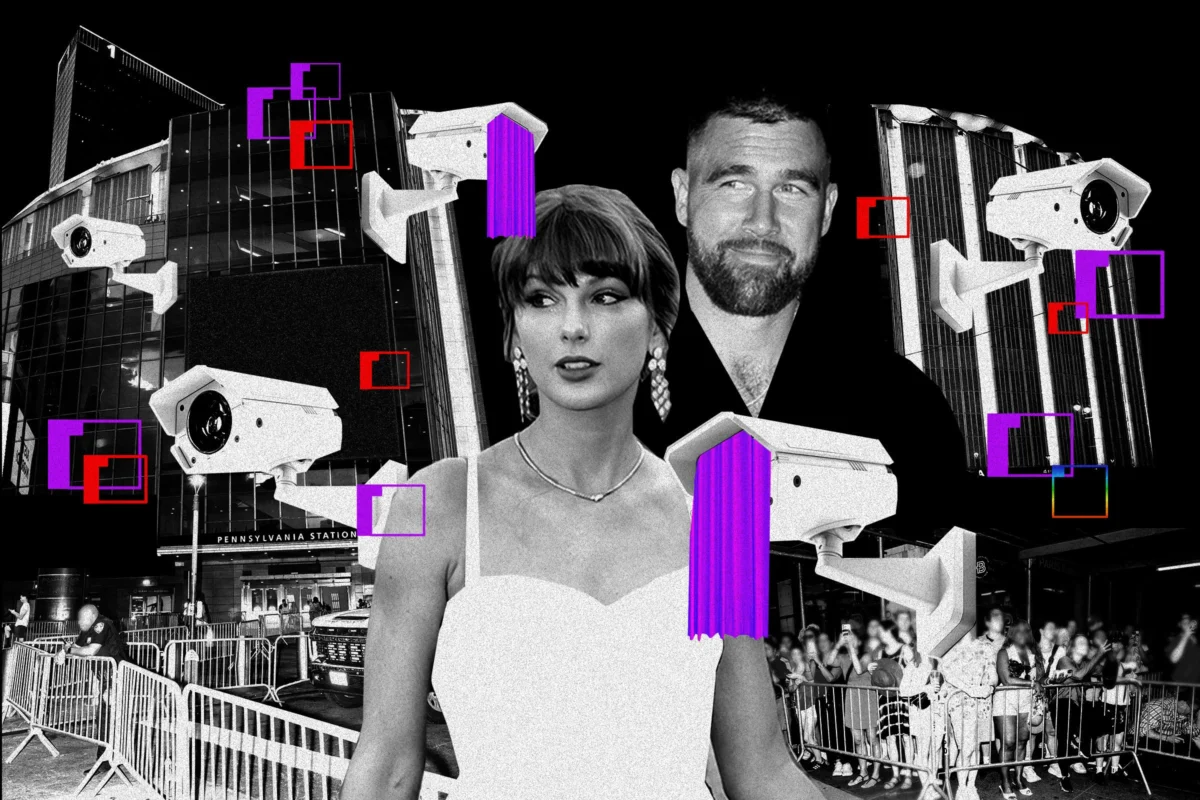
Madison Square Garden, often branded by owner James Dolan as the most secure venue in the United States, recently faced a significant internal security policy shift during one of the most high-profile events in its history. On the nights of July 2 and July 3, 2026, the arena’s extensive network of surveillance cameras and controversial facial-recognition software was effectively deactivated for the wedding celebration of global pop icon Taylor Swift and NFL star Travis Kelce. Internal documentation obtained by investigative reports indicates that an executive directive forced a seven-hour lockdown of the venue’s video management system, a move that stands in stark contrast to the venue’s standard operating procedures for high-profile gatherings.
The decision to disable the security apparatus—which typically relies on Genetec software and eConnect biometric scanning to monitor, track, and log every individual entering the premises—raises fundamental questions about the intersection of wealth, privacy, and corporate surveillance. While the venue maintained a "heightened threat environment" status due to national holiday celebrations and geopolitical tensions, the specific privacy demands of the celebrity couple necessitated a suspension of the very technology that MSG leadership has long championed as a vital public safety tool.
A Timeline of Restricted Access
The operational pivot began on the afternoon of July 2, as the city prepared for the Independence Day holiday weekend. According to an internal memo circulated among security personnel, a "client privacy request" prompted an immediate shutdown of the video management system. The directive was explicit: staff members who normally rely on live camera feeds and facial-recognition alerts were barred from their stations.
The chronology of the event reveals the lengths to which the couple’s security detail went to ensure discretion:
- July 2, 3:00 PM: The seven-hour lockdown of the Genetec video management system commences. Security staff are informed that if they remain logged into the network, they will be forcibly disconnected.
- July 2, Evening: Approximately 130 police officers are deployed in the surrounding blocks, not for the event itself, but for the broader citywide security measures, creating a surreal environment where the perimeter was highly guarded while the interior remained a digital "blind spot."
- July 3: The protocol is repeated for the main wedding festivities, with roughly 1,000 elite guests in attendance.
During these hours, the system was restricted to a tiny cadre of senior leadership and engineers, effectively cutting off the standard surveillance loop that, under normal circumstances, identifies and monitors every attendee. This stands in direct contradiction to the venue’s usual policy, where even the New York Police Department, when hosting graduation ceremonies at the arena, operates within a facility where cameras remain active and facial recognition remains a constant, silent observer.

The Technology of Control
For years, Madison Square Garden has operated at the forefront of biometric data collection in private entertainment spaces. The system, which captures facial geometry and compares it against a proprietary database, has been used not only to identify "genuine security risks" but also to enforce bans on individuals deemed antagonistic to ownership.
The mechanism relies on a two-pronged approach: Genetec acts as the central hub, aggregating video data, while eConnect provides the biometric analysis. When a person walks through an entrance, their image is captured and instantly cross-referenced. If a match occurs, security personnel are alerted, and the individual can be tracked in real-time across the vast arena floor.
Critics have long argued that this system creates a chilling effect on public participation. Reports have surfaced of lawyers being denied entry because their firms are currently engaged in litigation against MSG, and even a minor attending a Girl Scout event was once flagged due to her mother’s professional affiliation. By deactivating this system for the Swift-Kelce wedding, the venue inadvertently conceded that the technology is not an immutable requirement for security, but rather a tool that can be toggled on or off at the discretion of the owner or the client.
Disparity in Privacy Expectations
The Swift-Kelce event highlights a growing divide regarding the "privatization of privacy." While the general public is routinely subject to biometric scanning as a condition of entry, the ultra-wealthy are increasingly able to purchase an exemption from these pervasive systems.
Digital rights advocates point to this as a dangerous precedent. Evan Greer, director of Fight for the Future, has characterized this as a glimpse into a future where "privacy is a luxury for the elite few, and the rest of us are subjected to pervasive surveillance everywhere we go." The implication is that if the technology is unnecessary for a 1,000-person celebrity gathering in a city with "heightened threat" warnings, its necessity for the average concert-goer or sports fan becomes increasingly difficult to justify from a security standpoint.
The Database Controversy
The scrutiny surrounding MSG’s surveillance practices has been compounded by recent cybersecurity breaches. The hacker group ShinyHunters recently compromised an internal database containing over 39,000 records of VIPs, including sensitive data points such as race, gender, and sexual orientation.

MSG’s subsequent litigation against media outlets regarding the disclosure of this database has forced the company to provide public justifications for its data collection. The venue maintains that the "Threat Management" field is used to log prior incidents and verify identities, while the demographic information is utilized for "inclusion-oriented outreach." However, the data revealed that many high-profile individuals, including celebrities such as Elliot Page and Zac Posen, were tagged with "risk" labels, reinforcing concerns that the surveillance system is used to monitor social and professional reputations rather than strictly physical threats.
Implications and Regulatory Future
As New York City lawmakers consider new legislation to restrict the use of biometric surveillance in private venues, the Madison Square Garden case has become a focal point of the debate. A recent, relatively minor fine issued by the state liquor authority regarding the venue’s usage of the technology suggests that regulators are struggling to keep pace with the rapid adoption of private facial recognition.
Furthermore, the logistical reality of the Swift-Kelce wedding demonstrates that even in "the world’s most famous arena," true privacy is an artifact of negotiation and financial influence. When the cameras are off, the environment becomes a private sanctuary; when they are on, the venue functions as an information-gathering engine.
For the average citizen, the takeaway is clear: the technology is not a universal standard of safety, but a variable in the business model of modern entertainment. As the legal battles between MSG and its critics continue, the events of early July serve as a stark reminder that in the modern digital age, the right to move through a public or semi-public space without being logged, analyzed, and tagged is increasingly dependent on one’s status, wealth, and power.
The silence from the Swift-Kelce camp regarding the surveillance lockdown is perhaps the most telling aspect of the entire affair. While their security team successfully negotiated a private space, they left the public to contemplate the reality of a venue that, for the rest of the year, continues to treat every face as a data point to be captured, stored, and potentially used as leverage in the opaque world of corporate litigation and threat management.

Related Posts
The Las Vegas Cybersecurity Summit and the Escalating Threat of Autonomous Digital Exploitation
New York City Council members and privacy advocates launch legislative campaign to ban biometric facial recognition at public entertainment venues