
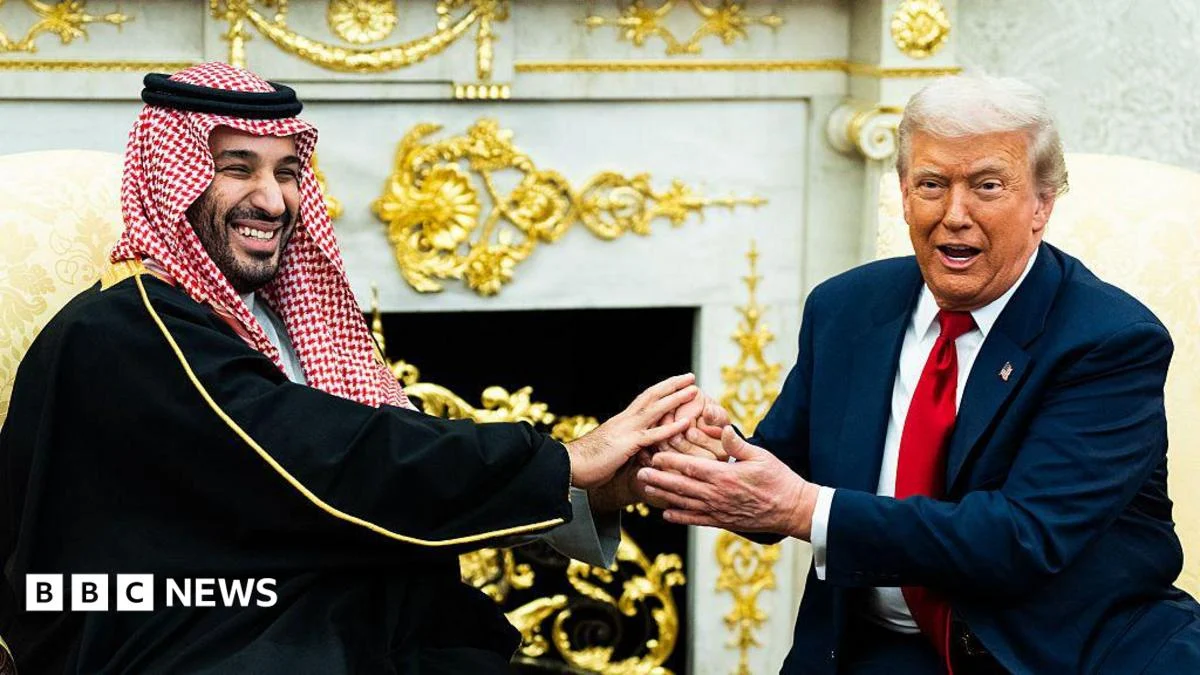
US signs landmark nuclear deal with Saudi Arabia
The agreement, officially termed a "peaceful nuclear co-operation agreement," aims to grant "great access for American companies in the Saudi nuclear energy program," as outlined by the US Energy Department. While the full text of the deal has not been publicly disclosed, US media outlets indicate that a pivotal component of the arrangement could permit Saudi Arabia to enrich uranium on its own soil in the future. Uranium enrichment is a dual-use technology, essential for producing fuel for nuclear power plants but also a critical step in manufacturing nuclear weapons. This potential provision has ignited significant debate among experts, who suggest it would mark an unprecedented shift in US non-proliferation policy and could elevate the risk of nuclear proliferation in the already volatile Middle East.
The Agreement’s Contours and Unprecedented Provisions
The US Energy Department confirmed that alongside the co-operation deal, a "bilateral safeguards agreement" was also signed. According to official statements, these two agreements collectively "lay the legal foundation for a decades-long, multi-billion-dollar partnership that advances several priority economic and strategic objectives, including nuclear nonproliferation." This suggests a comprehensive framework designed to govern the development and operation of Saudi Arabia’s nuclear facilities with a stated emphasis on safety and non-proliferation.
The Saudi government, in its own statement, characterized the deal as "an extension of existing co-operation between the two countries in the energy sector." It also highlighted that the agreement follows a visit by the Saudi leader to Washington last November, underscoring the high-level diplomatic engagement preceding its conclusion. The timing of the announcement is particularly noteworthy, coinciding with escalating tensions between the US and Iran. Saudi Arabia, a long-standing strategic ally of the US, hosts several American military bases that have recently been targeted by Iranian-backed forces. Moreover, the deal was revealed just two days after Iran’s allies in Yemen, the Houthi movement, declared a "maritime blockade" against the kingdom, further emphasizing the complex regional dynamics at play.
Crucially, earlier media reports, which appear to be corroborated by expert concerns, indicated that the agreement might allow Saudi Arabia to enrich uranium domestically to produce fuel for a US-built enrichment facility. This deviates significantly from previous US nuclear cooperation models, where recipient nations typically rely on imported fuel or external enrichment services to mitigate proliferation risks. The economic implications for the US are substantial, potentially generating billions of dollars for American companies involved in the construction and operation of such facilities.
US Secretary of Energy Chris Wright emphasized the rigorous standards embedded within the agreement. "Rest assured, these agreements uphold the highest standards of nuclear safety and nonproliferation, while relying on the world’s best nuclear technology and scientists, designed right here in the United States," Secretary Wright stated. The energy department further asserted that the deal advances both "US and regional security" and will reinforce "high standards of nuclear safety, security, and nonproliferation and strengthening the United States’ competitive edge in civil nuclear technology."
Proliferation Concerns and Expert Dissent
Despite official assurances, the prospect of Saudi Arabia developing indigenous uranium enrichment capabilities has triggered considerable apprehension. Nuclear experts and former officials in Israel, a paramount US ally in the Middle East, have openly voiced concerns that such a provision could ultimately enable Saudi Arabia to develop a nuclear weapon. While many analysts contend that achieving nuclear weaponization would likely span decades and invite severe international condemnation and pushback, the fundamental concern revolves around the precedent and the inherent dual-use nature of enrichment technology.
Rosemary Kelanic, director of the Middle East program at the US-based Defense Priorities think tank, described the inclusion of a Saudi enrichment facility as "quite shocking." She underscored the historical context, stating, "The US has never done that before, we have never helped another country enrich on their own soil." Kelanic elaborated that the primary reason for this long-standing policy is that "if you can produce your own nuclear fuel, you become a much bigger risk" for building nuclear weapons, as it grants a nation greater autonomy over a critical step in the nuclear fuel cycle that can be diverted for military purposes.
This potential provision distinguishes the Saudi deal from the "123 Agreement" struck by the US with Saudi Arabia’s neighbor, the United Arab Emirates, in 2009. Under the UAE agreement, Abu Dhabi explicitly committed not to produce its own nuclear fuel and accepted a suite of other stringent restrictions, a model often referred to as the "gold standard" for non-proliferation. The departure from this precedent in the Saudi deal is expected to galvanize significant opposition from nuclear non-proliferation campaigners globally, whose overarching objective is to prevent an increase in the number of nuclear weapons worldwide.
Geopolitical Underpinnings and Strategic Calculus
Saudi Arabia has persistently lobbied for such a nuclear cooperation agreement for years, spanning multiple US presidential administrations. Historically, Washington had reportedly made Saudi recognition of Israel and the normalization of diplomatic and economic relations a key precondition for advanced nuclear cooperation. However, according to US media reports, this demand appears to have been dropped as a prerequisite for the current deal, signifying a significant concession by the Trump administration.
President Trump has actively cultivated a closer relationship with Saudi Arabia throughout his tenure, prioritizing strategic and economic alignment. Beyond the direct commercial and strategic benefits anticipated from this deal, an additional impetus for its timing appears to be the reported discussions between Russia and China and Saudi Arabia regarding similar nuclear cooperation ventures. The US likely sought to preempt its geopolitical rivals and secure its position as the preferred partner in the kingdom’s ambitious nuclear energy program.
The deal represents a significant diplomatic and strategic victory for Saudi Arabia, potentially reshaping power dynamics in the Middle East, albeit over a protracted timeline. Energy sector expert Bob McNally, a former member of President George W. Bush’s National Security Council, lauded the deal as a "win." He emphasized the accomplishment of a "major country" like Saudi Arabia choosing to partner with the US to develop its nuclear sector. McNally further argued for the necessity of "reliable, always on, ideally emissions-free" energy, particularly in the burgeoning "AI era," and expressed limited concern regarding the proliferation risks associated with assisting Saudi Arabia’s nuclear capabilities.
Congressional Scrutiny and Political Opposition
The agreement is now slated for review by the US Congress, where it is anticipated to face considerable scrutiny and potential opposition from lawmakers across the political spectrum. Despite President Trump’s Republican Party currently holding majorities in both the House and Senate, the deal’s implications are expected to transcend partisan lines.
US Secretary of State Marco Rubio, while traveling in the Philippines, preemptively pushed back against critics concerned about Saudi Arabia’s potential to develop nuclear weapons. "The US is not going to reach any agreement with any country in the world that leads to the risk of proliferation," Rubio asserted. However, several Democratic lawmakers who have voiced opposition to the deal swiftly pointed out Rubio’s past stance. During his time as a senator, Rubio had notably endorsed the "No Nuclear Weapons for Saudi Arabia Act," legislation that explicitly required congressional approval for any nuclear deal with the Saudis.
Massachusetts Democratic Senator Edward Markey issued a scathing statement condemning both Rubio and Trump, accusing their "hypocrisy" of being "matched only by their recklessness." Markey contended, "They are allowing Saudi Arabia, a belligerent and authoritarian nation, to develop nuclear weapons technologies while starting a war with Iran under the guise of preventing an Iranian nuclear bomb." He concluded, "This deal would make us all less safe. We must stop the proliferation of nuclear weapons." These sharp rebukes underscore the intense political battle likely to unfold on Capitol Hill as Congress grapples with the agreement’s approval.
Broader Regional and International Implications
The nuclear issue has been a central point of contention in the prolonged US-Israeli conflict with Iran. Both nations have cited the prevention of an Iranian nuclear weapon as a primary justification for their actions against Tehran, a claim that Iran vehemently denies. The potential for Saudi Arabia to develop its own enrichment capabilities could significantly alter the regional strategic balance, potentially triggering a nuclear arms race. Saudi Arabia’s de facto ruler, Crown Prince Mohammed bin Salman, famously stated in a 2018 interview with CBS News that while his nation was not planning to acquire nuclear weapons, "without a doubt if Iran developed a nuclear bomb, we will follow suit as soon as possible." This declaration highlights the deeply entrenched security dilemma in the region and the potential for a cascading effect should Iran pursue nuclear weapons.
The US-Saudi nuclear deal, therefore, carries profound implications not only for the bilateral relationship but also for regional stability and the global non-proliferation regime. While the agreement aims to bolster US economic interests and strategic influence in a critical region, particularly in the face of rising Chinese and Russian engagement, it simultaneously introduces a new layer of complexity to nuclear safeguards and international security. The upcoming congressional review will be a pivotal moment, determining whether the perceived strategic advantages outweigh the potential risks of proliferation in an already volatile Middle East. The world will watch closely to see if the "highest standards of nuclear safety and nonproliferation" can indeed be upheld in practice, or if this landmark deal will inadvertently set a dangerous precedent for future nuclear development.

Related Posts
Zambia on Edge: Opposition Leader Arrested Amid Allegations of Insurrection Plot and Election Tensions

Rescuers search for survivors of powerful Indonesia earthquake

