
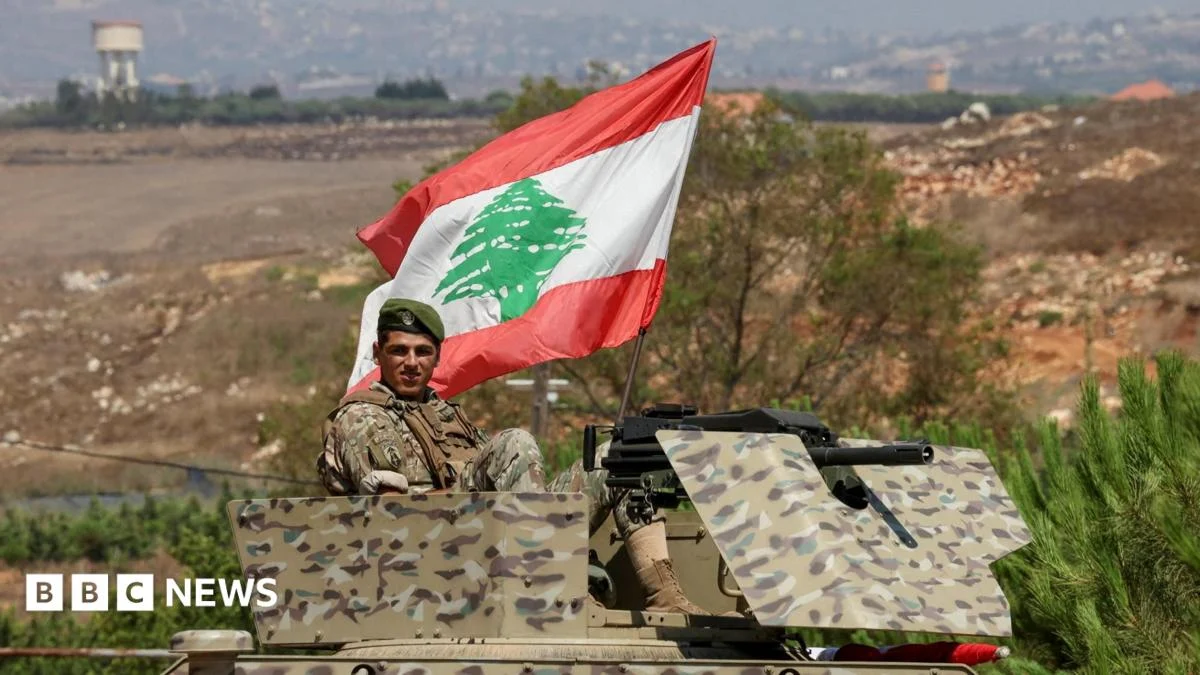
Lebanese army says troops deploying in ‘pilot zone’ after Israeli withdrawal
Lebanon’s armed forces have initiated a significant deployment into a "pilot zone" in the country’s south, a move following a partial withdrawal of Israeli forces and undertaken as part of a sensitive US-brokered agreement finalized last month. This critical development, aimed at stabilizing a volatile border region and potentially paving the way for broader de-escalation, was immediately met with a tense incident involving Israeli warning shots, underscoring the profound challenges inherent in the peace process.
On Tuesday morning, engineering units of the Lebanese Army commenced their entry into Zawtar al-Gharbiyeh, a village situated in the Nabatieh district. This initial deployment, announced by the army command, marks a tangible step in the implementation of the Trilateral Framework, an accord reached at the end of June between Israel, Lebanon, and the United States. The framework’s ambitious objectives include a phased Israeli withdrawal from territories occupied during their recent conflict with Hezbollah, coupled with the eventual disarmament of the Iran-backed Lebanese group.
However, the fragility of the nascent agreement was quickly highlighted. Later on Tuesday, the Lebanese army reported that Israeli forces had opened fire in the vicinity of their deployed troops. The Israeli military subsequently confirmed the firing of warning shots, stating that the Lebanese troops had "crossed approximately 150m (490ft) into the security zone and breached the barriers" in the adjacent area of Zawtar al-Sharqiyeh, an area Israel considers critical for its defense. No injuries were reported, and the Lebanese units reportedly withdrew from the immediate flashpoint, but the incident served as a stark reminder of the deeply entrenched mistrust and the potential for rapid escalation along the shared border.
The Trilateral Framework: A Diplomatic Overture Amidst Conflict
The Trilateral Framework, formally agreed upon in late June, emerged from intense diplomatic efforts spearheaded by the United States. Its primary aim is to de-escalate the recent conflict that erupted on March 2nd, when Hezbollah launched rockets into Israel following a strike that killed Iran’s supreme leader. Israel responded with a comprehensive bombing campaign across Lebanon and an invasion of a significant portion of the country’s south, leading to widespread destruction and a severe humanitarian crisis.
The framework, a complex and multifaceted agreement, envisions a phased approach to peace. Key provisions include the withdrawal of Israeli troops from specific "pilot zones" in southern Lebanon, which would then be secured by the Lebanese Armed Forces (LAF). Crucially, the agreement also links this withdrawal to the disarmament of Hezbollah, a condition that has proven to be a major point of contention and a formidable obstacle to lasting peace.
Discussions leading to Tuesday’s deployment were a direct result of meetings held in Rome the previous week between Israeli and Lebanese representatives. The US State Department had announced on Monday afternoon that "pilot zone operations" had officially begun in Zawtar al-Gharbiyeh, as well as two other Lebanese villages, Froun and Srifa, signaling the practical activation of the framework. This announcement underscored the significant diplomatic groundwork laid to reach this "milestone," as described by US officials.
An Israeli military official, speaking on Monday, had confirmed that the Israel Defense Forces (IDF) would "adjust its force posture in one of the pilot areas" to facilitate the Lebanese army’s mission. However, the official also reiterated Israel’s commitment to "safeguarding the security of IDF soldiers and preserving its right to self-defence and to remove threats." Emphasizing the core Israeli objective, the official stated, "The objective of the pilot and the agreement is the disarmament of the Hezbollah terrorist organisation and the removal of its illegal weapons." This statement highlighted the fundamental divergence in priorities and interpretations that continue to plague the implementation of the agreement.
Deployment and Immediate Tensions: A Chronology of Events
The chronology of events leading up to and during the deployment reveals the meticulous, yet precarious, nature of the agreement’s implementation:
- Late June: The Trilateral Framework is formally agreed upon by Israel, Lebanon, and the United States.
- Last Week (prior to deployment): Israeli and Lebanese representatives hold discussions in Rome, laying the groundwork for the pilot zone operations.
- Monday Afternoon: The US State Department announces the commencement of "pilot zone operations" in Zawtar al-Gharbiyeh, Froun, and Srifa.
- Monday Evening: An Israeli military official confirms the IDF’s intention to adjust its posture in one of the pilot areas, while stressing the objective of Hezbollah’s disarmament and the IDF’s right to self-defense. They also reiterated the IDF’s commitment to remaining in the "security zone" for as long as deemed necessary.
- Tuesday Morning: Lebanese Army engineering units begin deploying to Zawtar al-Gharbiyeh. The Lebanese army command issues a statement calling on citizens to avoid the village until the security situation stabilizes and to comply with military instructions.
- Tuesday (concurrently): Lebanese President Joseph Aoun travels to Washington for a crucial meeting with US President Donald Trump.
- Tuesday (later in the day): The Lebanese army command reports that Israeli forces "opened fire in the vicinity of these units," warning that such an "attack hinders the implementation of deployment steps in the pilot zones."
- Tuesday (shortly after): The IDF confirms firing "warning shots into the air" after Lebanese troops and an engineering vehicle allegedly crossed into the Israeli-declared "security zone" near Zawtar al-Sharqiyeh. The IDF notes the Lebanese troops subsequently withdrew, with no injuries.
- Tuesday (further reports): Lebanon’s state-run National News Agency (NNA) reports two large explosions near Beit Yahoun and Kounine (Bint Jbeil district), attributing them to Israeli forces. It also reports blasts from Israeli controlled demolitions in Majdal Zoun (Tyre district).
The Lebanese army also confirmed its troops were already carrying out missions in Froun and Srifa following Monday’s US announcement, with an Israeli source reportedly telling Haaretz newspaper that no Israeli troops were present in those specific villages, indicating a staggered withdrawal process.
Diplomatic Efforts and US Commitment to Lebanon
The deployment unfolded concurrently with a high-stakes meeting in Washington between US President Donald Trump and his Lebanese counterpart, Joseph Aoun. President Aoun’s agenda was clear: to urge President Trump to exert pressure on Israel for a full withdrawal from the remainder of southern Lebanon and to secure robust US support for the Lebanese army in taking complete control of areas where Hezbollah currently holds significant sway.
"I told him [Trump] I need two things from you: political support and supporting the LAF [Lebanese Armed Forces]," Aoun informed reporters in the Oval Office. This direct appeal underscored Lebanon’s desperate need for international backing to assert its sovereignty and rebuild its security infrastructure in the face of formidable internal and external challenges.
Speaking alongside Aoun, President Trump vowed substantial US assistance to Lebanon, acknowledging the nation had been "hit hard" for decades. "It’s been a very badly treated place and country, and we’re going to have it properly treated," he declared, adding, "And treated with the respect it deserves." This pledge of support, while general, signals a continued US commitment to Lebanon’s stability and its efforts to recover from prolonged conflict. Trump also mentioned "concrete plans" to help Lebanon build the capacity to disarm Hezbollah, though he did not elaborate on the specifics of these plans. He further noted the increasing self-sufficiency of the Lebanese army, a key factor in empowering it to challenge Hezbollah’s dominance. Intriguingly, Trump also stated he would speak directly to representatives of Hezbollah if requested by President Aoun, a potential diplomatic channel that could prove controversial but perhaps necessary for broader engagement.
Hezbollah’s Stance: A Major Hurdle to Disarmament
A central and perhaps the most intractable challenge to the Trilateral Framework is the position of Hezbollah. The Iran-backed group has unequivocally rejected the agreement, particularly the provisions linking Israel’s withdrawal to its disarmament. Hezbollah views such conditions as crossing "all red lines," asserting its right to maintain its arsenal as a deterrent against perceived Israeli aggression and as a defender of Lebanese territory.
Hezbollah, an organization that emerged in the early 1980s in response to Israel’s invasion of Lebanon, has evolved into a formidable military and political force. It commands a significant armed wing, often described as more potent than the official Lebanese army, and holds considerable political influence, including seats in the Lebanese parliament and cabinet. Its deep entrenchment in Lebanese society, particularly in the south and parts of Beirut, makes any attempt at forceful disarmament fraught with the risk of internal conflict and further destabilization. Israel, for its part, has repeatedly stated that it will not fully withdraw from Lebanon until Hezbollah is completely disarmed, setting up a fundamental impasse. The group’s rejection, therefore, casts a long shadow over the long-term viability of the US-brokered agreement.
Humanitarian Crisis and Civilian Impact of the Conflict
The recent conflict, which began on March 2nd, has exacted a devastating toll on Lebanon. According to the Lebanese health ministry, more than 4,300 people have been killed in Lebanon, a figure that includes almost 800 children, women, and medics. This immense human cost underscores the urgent need for a lasting peace and the cessation of hostilities.
The material destruction has also been catastrophic. In areas still occupied by Israeli forces, numerous villages have been completely ravaged by Israeli strikes or controlled demolitions. Lebanon’s NNA reports of explosions and demolitions in towns like Majdal Zoun in Tyre district on Tuesday are a grim testament to the ongoing destruction. While the Israeli military asserts it has been targeting and destroying Hezbollah infrastructure, human rights groups have raised serious concerns. They argue that some of the actions constitute the deliberate destruction of civilian infrastructure, potentially amounting to war crimes. This includes residential buildings, agricultural land, and vital public services, further compounding the humanitarian crisis and the monumental task of reconstruction facing Lebanon.
On the Israeli side, authorities report that 37 Israeli soldiers and four civilians have been killed on both sides of the border during the conflict, highlighting the mutual suffering and the cyclical nature of violence in the region.
Historical Context of Southern Lebanon’s Volatility
The current situation in southern Lebanon is deeply rooted in decades of conflict and occupation. Israel’s presence in southern Lebanon dates back to its 1978 Litani Operation and significantly expanded with the 1982 invasion, which aimed to dislodge the Palestine Liberation Organization (PLO). Following its withdrawal from much of Lebanon in 1985, Israel maintained a "security zone" along the border, which it occupied for 15 years, until its unilateral withdrawal in May 2000. This occupation fueled the rise of Hezbollah, which positioned itself as the primary resistance movement against Israel.
The 2006 Lebanon War further cemented Hezbollah’s image among many Lebanese as a defender against Israeli aggression, even as it caused immense destruction. The recent conflict, ignited by Hezbollah’s rocket attacks in retaliation for the killing of Iran’s supreme leader, is the latest chapter in this protracted struggle. The continuous presence of Israeli forces in a "security zone" – the 10km (six-mile) deep strip of occupied Lebanese territory along the border – remains a persistent point of contention and a reminder of Lebanon’s fractured sovereignty. The IDF official’s reiteration that Israel would remain in this zone "for as long as necessary" to defend northern Israeli communities underscores the enduring nature of this dispute.
Implications and the Path Forward
The deployment of the Lebanese army to the pilot zones represents a tentative but critical step towards implementing a fragile peace agreement. Its immediate implications are multi-layered:
- Fragile Stability: The incident involving warning shots highlights the extreme sensitivity of the situation and the ever-present risk of miscalculation or escalation. The success of the pilot zones will depend heavily on robust communication and de-escalation mechanisms through the trilateral Military Co-ordination Group for Lebanon.
- Assertion of Lebanese Sovereignty: The deployment marks a symbolic and practical effort by the Lebanese government to reassert its authority over its southern territories, historically dominated by non-state actors or foreign forces. This is crucial for the long-term legitimacy and stability of the Lebanese state.
- Strengthening the LAF: The US commitment to supporting the Lebanese Armed Forces is vital. A stronger, better-equipped, and adequately trained LAF is indispensable for effectively challenging Hezbollah’s military dominance and eventually achieving the disarmament objective.
- Regional Dynamics: The agreement is a direct outcome of broader regional tensions involving the US, Israel, and Iran. Its success or failure will inevitably impact the delicate balance of power and the trajectory of proxy conflicts across the Middle East.
- Humanitarian Recovery: For the thousands displaced and affected by the recent conflict, the agreement offers a glimmer of hope for a return to normalcy and the beginning of reconstruction. However, the scale of destruction and the lingering security threats make this a daunting task.
The road ahead for the Trilateral Framework is fraught with challenges. Hezbollah’s steadfast rejection of disarmament remains a formidable hurdle, suggesting that full implementation of the agreement, particularly its core objective, will be a protracted and complex process. The continued existence of the Israeli "security zone" further complicates the narrative of a full Israeli withdrawal. While the diplomatic efforts and the initial deployment signify a positive shift from open conflict, the incident on Tuesday serves as a potent reminder that lasting peace in southern Lebanon will require sustained political will, robust security mechanisms, and a delicate balancing act to navigate the deep-seated grievances and strategic imperatives of all parties involved. The world watches closely as this critical experiment in de-escalation unfolds.

Related Posts
Zambia on Edge: Opposition Leader Arrested Amid Allegations of Insurrection Plot and Election Tensions
Rescuers search for survivors of powerful Indonesia earthquake

