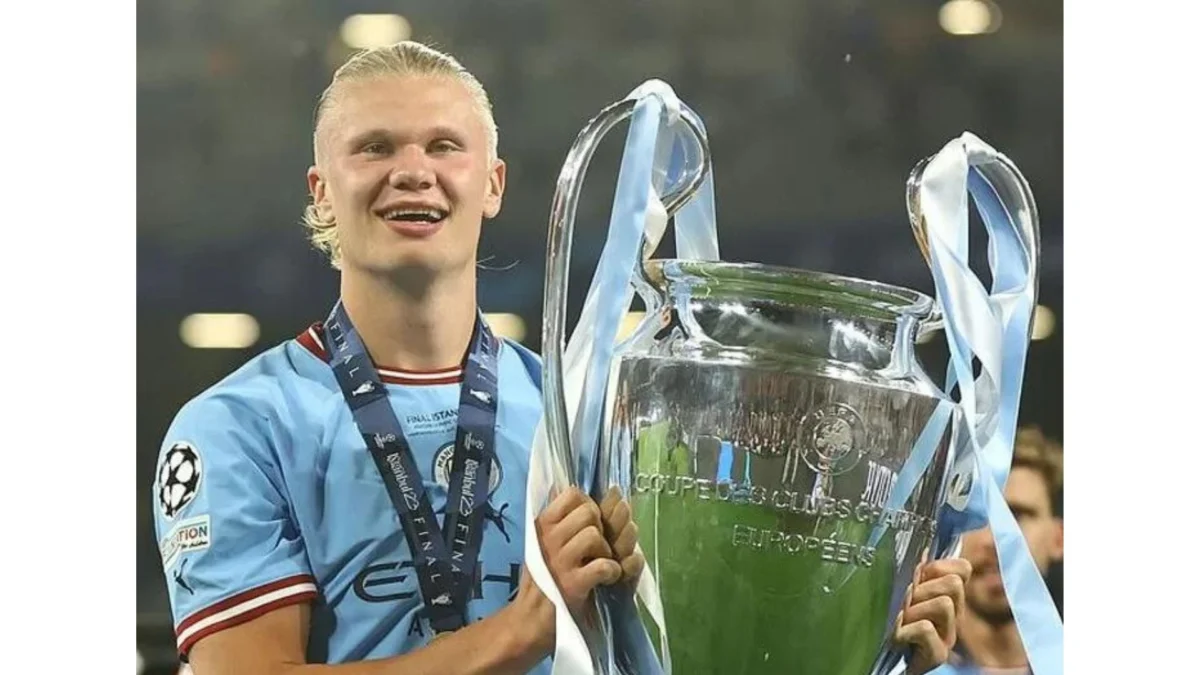
Harry Kane Enters Elite Champions League Half-Century Club as Haaland Dominates Speed Records
The landscape of European football’s most prestigious competition, the UEFA Champions League, has shifted once again as Harry Kane officially joined the pantheon of players to reach 50 goals in the tournament. His brace against Atalanta BC not only secured a comfortable progression for Bayern Munich but also etched his name into the record books, marking him as one of the most efficient strikers in the history of the competition. This milestone arrives during a period of transition in elite football, where modern goal-scorers are shattering efficiency metrics that once seemed untouchable.
A Landmark Night in Munich
Bayern Munich entered their second-leg fixture against Atalanta BC with a comfortable 6-1 aggregate lead, yet manager Vincent Kompany opted for a full-strength starting lineup. The decision underscored the club’s commitment to maintaining momentum in the 2024/25 campaign. Kane, who has been in scintillating form since his high-profile move from Tottenham Hotspur, seized the opportunity to solidify his legacy. By netting his 49th and 50th goals in the competition, he reached the half-century mark in just 66 appearances.
The achievement serves as a testament to Kane’s tactical evolution. Since arriving in Bavaria, the England captain has transitioned from a dual-threat playmaker and finisher into a lethal focal point within Kompany’s high-pressing system. With 11 goals in 13 Champions League matches this season, Kane’s output has provided Bayern with the clinical edge required to navigate the complexities of modern European knockout football.
The Evolution of Scoring Efficiency
The race to 50 Champions League goals has historically been a metric used to distinguish the sport’s greatest marksmen. However, the modern era has seen a drastic acceleration in scoring rates. The statistical landscape is currently led by Erling Haaland, whose meteoric rise has redefined the expectations of a center-forward.
Haaland reached the 50-goal plateau in a staggering 49 matches. This record is not merely a result of volume but of profound efficiency; the Manchester City striker averages a goal every 80.82 minutes. His ability to find space and execute with clinical precision has forced analysts to reconsider the ceiling for career goal tallies. Should Haaland maintain his current trajectory, he is widely viewed as the most significant threat to Cristiano Ronaldo’s all-time record of 140 goals.
Following Haaland, the historical hierarchy of the "fastest to 50" list reveals a clear divide between the traditional strikers of the early 2000s and the hyper-efficient modern era. Ruud van Nistelrooy, who held the record for nearly two decades, reached the milestone in 62 games. While Van Nistelrooy’s record stood as the gold standard for efficiency for years, it has now been eclipsed by the current generation.

Statistical Breakdown: The Fastest to 50 Goals
The top 10 list of players who reached 50 Champions League goals in the fewest matches illustrates a fascinating chronological progression of the sport:
- Erling Haaland (49 games): The Norwegian’s record is statistically anomalous. His blend of physicality and positioning has allowed him to outpace even the most prolific scorers in history.
- Ruud van Nistelrooy (62 games): A quintessential penalty-box striker, Van Nistelrooy’s achievement remains a benchmark for the pre-social media era of football.
- Lionel Messi (66 games): Often cited as the greatest player in the history of the competition, Messi’s consistency over five different campaigns of 10+ goals cemented his status before his eventual departure from Europe.
- Harry Kane (66 games): By tying Messi’s record, Kane has solidified his standing among the greatest English players to grace the continent. His ability to perform at the highest level across two different clubs speaks to his adaptability.
- Robert Lewandowski (77 games): A model of longevity and sustained excellence, Lewandowski’s presence in the top five highlights his role as the premier number nine of the last decade.
- Kylian Mbappé (79 games): As one of the youngest players to reach the milestone, Mbappé’s speed and technical prowess have made him a mainstay in the top 10 despite having yet to lift the trophy.
- Karim Benzema (88 games): Benzema’s journey to 50 was characterized by a late-career surge. His pivotal role in Real Madrid’s recent successes, particularly his 15-goal campaign in 2021/22, showcases a different path to the milestone.
- Cristiano Ronaldo (91 games): While his place on this specific list is eighth, his status as the all-time leading scorer (140 goals) remains the ultimate objective for every player on this list. His early-career development shows how his game evolved from a winger to the most effective poacher in history.
- Raúl (97 games): The Real Madrid icon held the record for total goals for years. His 97-game journey to 50 reflects a different era of the competition, where the volume of matches was lower and the tactical structures were more rigid.
- Mohamed Salah (97 games): The first African player to join this exclusive club, Salah’s journey is a reflection of his consistency for Liverpool, where he became the focal point of a team that reached multiple finals.
Tactical Implications and Managerial Perspectives
The reliance on these elite scorers highlights a broader tactical shift in the Champions League. Modern managers are increasingly building their squads around "pure" finishers who can convert low-probability chances into goals. Vincent Kompany’s tactical approach at Bayern Munich—utilizing Kane not just as a creator but as the primary recipient of high-volume service—has been vindicated by the striker’s rapid accumulation of goals.
Analysts have noted that the "Kane-Bayern" partnership has optimized the English forward’s movement. By playing in a team that consistently dominates possession, Kane has seen an uptick in his "Expected Goals" (xG) metrics. This is a common theme among the top 10; players like Lewandowski and Benzema similarly benefited from playing in sides that consistently progressed to the latter stages of the tournament, thereby increasing their opportunities to score.
Historical Context and Future Trajectories
The achievement of 50 goals is often viewed as a "career-defining" threshold. For players like Harry Kane, it serves as the ultimate validation of his move to the Bundesliga. For others, such as Kylian Mbappé, the milestone is merely a checkpoint on the way to greater individual and team honors.
The inclusion of players like Mohamed Salah and Robert Lewandowski on this list underscores the globalization of elite scoring. Historically, the list was dominated by players from the traditional powerhouses of Spain and Italy. Today, the inclusion of Norwegian, English, Polish, and Egyptian stars reflects the broader reach of the Champions League.
Conclusion
As the 2024/25 Champions League campaign progresses, the conversation will inevitably shift from who reached 50 goals the fastest to who will remain the most influential in the knockout stages. Erling Haaland remains the frontrunner in terms of pure goal-scoring speed, but Harry Kane’s milestone serves as a reminder that consistency and adaptability are equally vital.
With these players continuing to push the boundaries of what is mathematically possible in a tournament of this intensity, the record books are likely to undergo further revisions in the coming years. For now, Harry Kane sits comfortably among the legends of the game, having reached a peak that only a select few have ever attained. Whether this surge in goal-scoring efficiency will lead to further silverware for Bayern Munich or Manchester City remains the defining narrative of this season.