The Mathematical Calculation That Appears Simple at First Glance, But Few Can Solve It
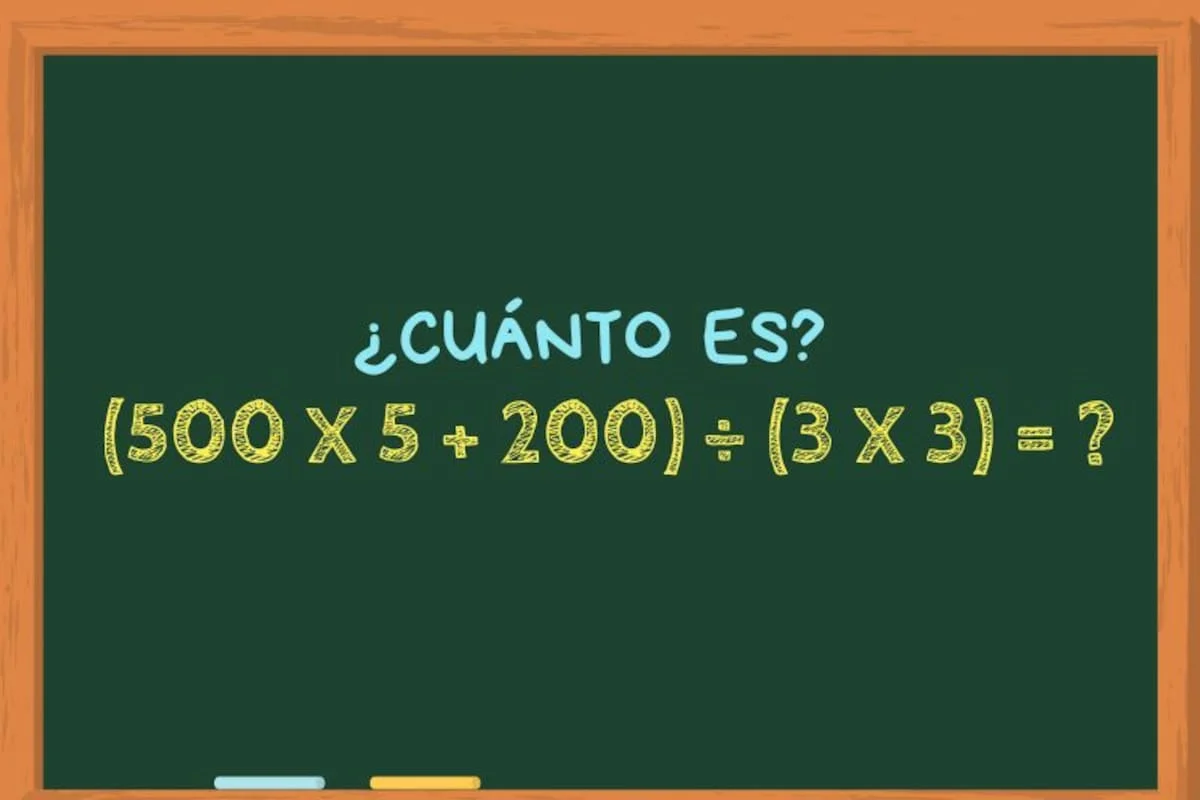
Mathematical puzzles and visual challenges have become a prominent feature of online content, frequently shared across social media platforms. While many of these problems present themselves as straightforward exercises, the interplay of various mathematical operations often sparks debate and confusion among individuals attempting to arrive at a solution within a limited timeframe. The latest iteration of this popular online phenomenon presents a specific expression that demands resolution in under 30 seconds: (500 x 5 + 200) ÷ (3 x 3) = ? This seemingly elementary equation has the potential to divide opinions and highlight common misconceptions in arithmetic.
The foundational principle for navigating such mixed operations is the universally recognized order of operations, often remembered by the acronym PEMDAS (Parentheses, Exponents, Multiplication and Division from left to right, Addition and Subtraction from left to right) or BODMAS (Brackets, Orders, Division and Multiplication from left to right, Addition and Subtraction from left to right). Adherence to this hierarchy is crucial, as deviations can lead to erroneous outcomes, transforming what appears to be a simple task into a significant mental hurdle. The prevalence of these challenges underscores a broader trend in digital media consumption, where bite-sized, interactive content captures user attention and encourages engagement through shared problem-solving.
Deconstructing the Mathematical Challenge: A Step-by-Step Solution
For those who found themselves stumped or uncertain about their answer to the presented mathematical expression, a clear, sequential approach can illuminate the correct path to the solution. The exercise is designed to test not only basic arithmetic skills but also the ability to apply the established order of operations systematically.
The initial step involves addressing the operations within the first set of parentheses: (500 x 5 + 200). According to the order of operations, multiplication takes precedence over addition. Therefore, the first calculation within this bracket is:
500 multiplied by 5 equals 2500.
Following the multiplication, the addition within the same parenthesis is performed:
2500 plus 200 equals 2700.
Thus, the entire first parenthetical expression resolves to 2700.
Next, attention turns to the second set of parentheses: (3 x 3). This part of the expression is a straightforward multiplication:
3 multiplied by 3 equals 9.
With both parenthetical expressions evaluated, the original equation is significantly simplified. The problem now becomes:
2700 divided by 9.
Performing this final division yields the definitive answer:
2700 ÷ 9 = 300.
Therefore, the correct result of the mathematical challenge is 300. The structure of this problem, with its nested operations and the requirement for precise sequencing, is a common design element in mathematical puzzles intended to expose common errors in calculation.
The Cognitive Benefits of Engaging with Mental Arithmetic Challenges
Beyond their immediate function as engaging online diversions, regularly tackling mental arithmetic problems offers a wealth of cognitive advantages. Research consistently points to the profound impact of mathematical exercises on brain function. A notable study published in the Journal of Neuroscience by researchers at Princeton University indicated that the practice of mathematical calculations directly influences an individual’s decision-making capabilities. Each operation performed actively engages critical areas of the brain associated with logic, reasoning, and memory retention. This cognitive stimulation can lead to enhanced problem-solving skills in various aspects of daily life, not just within the realm of numbers.
The benefits extend to several key areas of cognitive function:
- Enhanced Logical Reasoning: The systematic application of rules and procedures in mathematics directly translates to improved ability to analyze situations, identify patterns, and draw logical conclusions in non-mathematical contexts.
- Improved Memory and Concentration: Solving mathematical problems requires holding information in working memory and maintaining focus on the task at hand. Regular practice strengthens these faculties, leading to better concentration and recall in everyday activities.
- Boosted Problem-Solving Skills: Mathematical challenges often involve breaking down complex problems into smaller, manageable parts. This analytical approach is a transferable skill that aids in tackling a wide range of personal and professional issues.
- Increased Numerical Fluency: Familiarity and comfort with numbers, gained through practice, can reduce anxiety associated with numerical tasks and improve efficiency in financial management, data interpretation, and other number-reliant activities.
- Delayed Cognitive Decline: Studies suggest that mentally stimulating activities, including complex calculations, can contribute to building cognitive reserve, potentially delaying the onset or slowing the progression of age-related cognitive decline and neurodegenerative diseases.
These advantages highlight that engaging with puzzles like the one presented is not merely a pastime but a form of cognitive training that yields tangible benefits for long-term brain health and daily functioning.
The Rise of Online Brain Teasers: A Digital Phenomenon
The popularity of mathematical puzzles like the one featured is part of a broader digital trend. Platforms and social media feeds are replete with visual riddles, logic problems, and mathematical challenges designed to capture attention and encourage user interaction. This surge in popularity can be attributed to several factors:
- Accessibility: These challenges are readily available on smartphones, tablets, and computers, requiring no special equipment or software.
- Shareability: The inherent nature of these puzzles, often involving a clear question and a definitive answer, makes them ideal for sharing on social media. Users often tag friends, inviting them to participate and compare results, fostering a sense of community and friendly competition.
- Sense of Accomplishment: Successfully solving a difficult puzzle provides a dopamine hit, a feeling of accomplishment and intellectual satisfaction that encourages users to seek out more such challenges.
- Low Barrier to Entry: While some puzzles are complex, many are designed to be approachable, allowing individuals with varying levels of mathematical proficiency to engage. This inclusivity broadens their appeal.
- Distraction and Entertainment: In an increasingly fast-paced world, these puzzles offer a brief but engaging escape, a mental break from routine tasks and daily stressors.
This phenomenon reflects a shift in how individuals consume information and entertainment online, with interactive and engaging content taking center stage. Websites and publishers are increasingly recognizing the value of such content in driving traffic and user retention.
LN Juegos: A Hub for Cognitive Engagement
For enthusiasts of riddles and mental challenges, LA NACION has developed LN Juegos, a dedicated platform offering a diverse array of interactive content designed to stimulate users and provide a welcome respite from daily routines. This initiative underscores the growing recognition of online gaming and puzzle-solving as valuable forms of cognitive exercise and entertainment.
LN Juegos features a wide selection of popular pastimes, catering to various interests and skill sets. Among the most sought-after word games are the classic Crucigrama (Crossword), Palabra oculta (Hidden Word), and Sopa de letras (Word Search). These games not only test vocabulary and spelling but also enhance pattern recognition and memory.
Beyond wordplay, the platform also hosts highly engaging logic and number-based challenges. Trivias (Quizzes) test general knowledge across a broad spectrum of topics, encouraging learning and recall. The perennial favorite, Sudoku, demands logical deduction and numerical sequencing without repetition. Palabras cruzadas (Word Squares), another popular offering, combines elements of word association and grid completion.
This comprehensive suite of games is part of an innovative proposal that is continuously updated and expanded each month, ensuring a fresh and engaging experience for its user base. The platform’s commitment to variety and regular content updates positions it as a significant player in the online puzzle and gaming landscape, catering to a demographic that values both entertainment and mental stimulation. The success of such platforms highlights a clear demand for accessible, engaging, and cognitively beneficial digital content.
Broader Implications: The Role of Digital Puzzles in Education and Well-being
The widespread appeal and educational benefits of online mathematical challenges and puzzles extend beyond mere entertainment. They represent a valuable tool that can be integrated into various aspects of learning and personal development. In an educational context, these puzzles can serve as engaging supplements to traditional curriculum, making abstract mathematical concepts more tangible and enjoyable for students. By presenting problems in a gamified format, educators can foster a more positive attitude towards subjects often perceived as difficult or intimidating.
Furthermore, the social aspect of sharing and solving these puzzles online can create collaborative learning environments. Students and individuals can work together, discuss strategies, and learn from each other’s approaches, reinforcing the idea that learning is often a social endeavor. This peer-to-peer learning can be particularly effective in demystifying complex topics and building confidence.
From a well-being perspective, the cognitive stimulation provided by these challenges contributes to overall mental fitness. In an era where screen time is often associated with passive consumption, interactive puzzles offer an active and rewarding way to engage with digital devices. The sense of accomplishment derived from solving a difficult problem can boost self-esteem and reduce stress. This mindful engagement can serve as a healthy alternative to more sedentary or passive forms of digital entertainment.
The trend of mathematical and visual puzzles gaining traction online is not merely a fleeting digital fad. It reflects a deeper human inclination towards problem-solving and intellectual engagement. As technology continues to evolve, we can anticipate the development of even more sophisticated and personalized cognitive challenges, further blurring the lines between entertainment, education, and mental well-being. The simple act of solving an equation, when framed correctly, can indeed be a powerful catalyst for cognitive growth and personal enrichment.

Related Posts

The Electric Vehicle Battery Health Debate Emerges as Argentina’s EV Market Accelerates

President Donald Trump Confirms Secret Departure from Turkey Amidst Assassination Threat