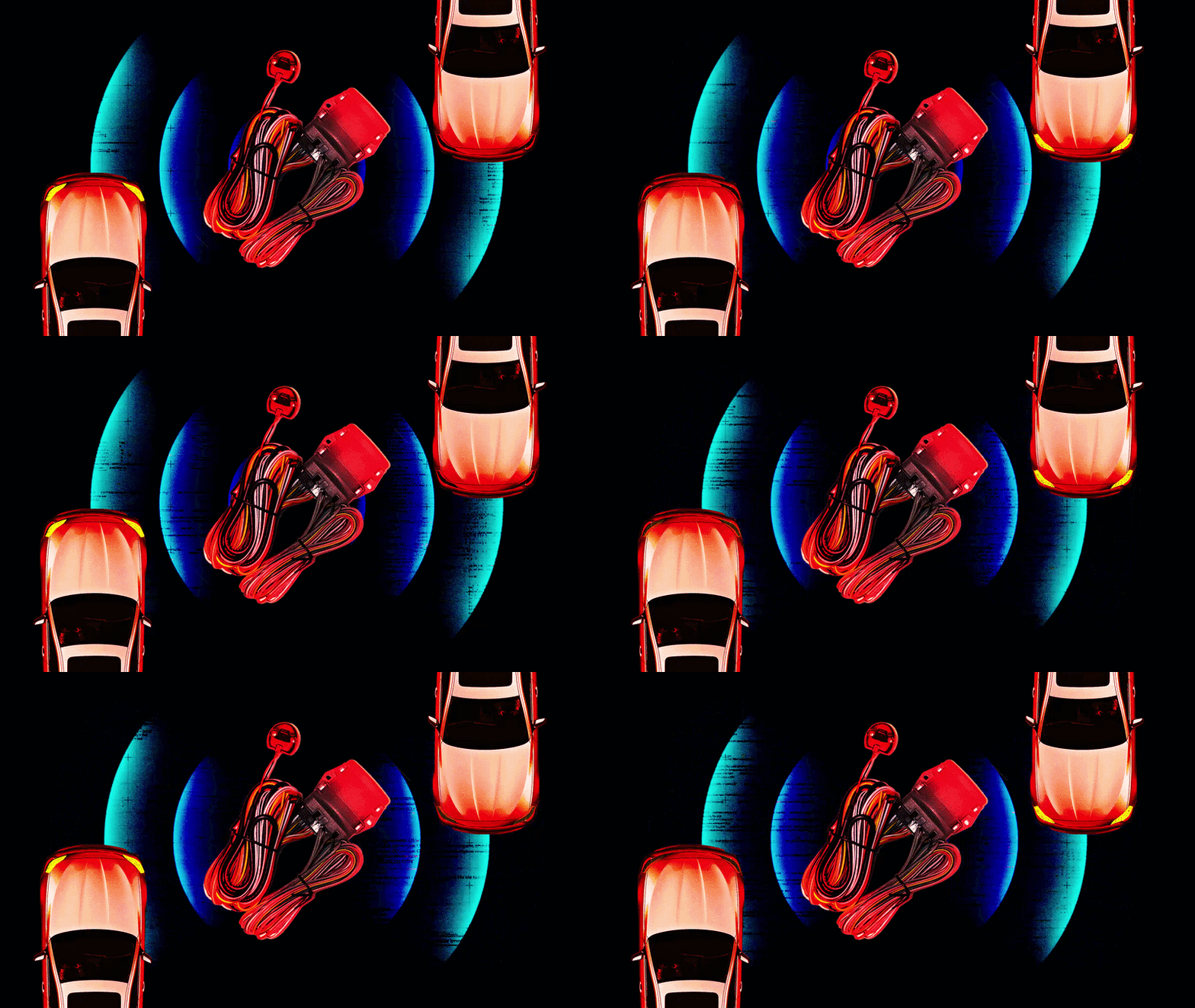
The Hidden Digital Time Bomb Lurking in Millions of American Vehicles
As modern automobiles increasingly resemble multi-ton computers on wheels, the cybersecurity landscape for personal transportation has shifted from mechanical maintenance to digital hygiene. Drivers have become accustomed to the concept of over-the-air (OTA) updates for infotainment systems and engine control modules, mirroring the software management common in smartphones and laptops. However, a recent investigation by a team of computer science researchers at the University of California San Diego (UCSD) has exposed a massive, invisible vulnerability: millions of vehicles are harboring insecure third-party hardware that the owners never requested, never authorized, and—in many cases—do not even know exists.
The device at the center of this security crisis is the KARR Security System, an aftermarket alarm and anti-theft product installed by automobile dealerships across the United States. Researchers estimate that more than 2 million vehicles are currently equipped with this technology. Because the system is wired into the sensitive electrical and control systems of these cars, it creates a significant attack surface that allows unauthorized actors within Bluetooth range to bypass security measures. A successful exploit can enable a range of malicious actions, including silently unlocking the vehicle, disabling the alarm, activating lights and horns, or even cutting the ignition to leave a driver stranded on the roadside.
The Anatomy of the Vulnerability
The core of the security failure lies in the authentication protocol used by the KARR Security System. By reverse-engineering the accompanying smartphone application, the UCSD research team discovered that the system relies on a universal authentication key. This static key is shared across all KARR-enabled devices. Because the hardware remains active—or can be remotely activated—even in vehicles where the owner declined to purchase the alarm as an optional add-on, the vulnerability is widespread and indiscriminate.

When a dealer installs the KARR unit, it becomes a permanent fixture of the vehicle’s electrical architecture. Even if a consumer chooses not to pay for the "active" subscription services, the device continues to broadcast Bluetooth signals while the car is in operation and for a brief window after the ignition is turned off. The UCSD researchers demonstrated that by crafting a custom application using the extracted authentication key, they could send spoofed commands to these devices. This process, they found, could "wake up" the alarm system in a vehicle where it was purportedly inactive, effectively turning a dormant component into a fully functional remote-control gateway for hackers.
A Timeline of Discovery and Delayed Response
The journey toward this disclosure began in 2018, when Nishant Bhaskar, a researcher at UCSD, began analyzing radio-enabled skimmers used in point-of-sale terminal fraud. During his field research, he began detecting unusual Bluetooth signals while monitoring traffic on public highways. By cross-referencing these signals with the Federal Communications Commission (FCC) equipment authorization database, Bhaskar traced the mysterious signals back to the KARR Security System.
It was not until 2024 that the project gained momentum, when graduate researcher Jerry Yu began a deep-dive investigation into the security architecture of the devices. The research team’s timeline of discovery proceeded as follows:
- 2018: Initial detection of unusual Bluetooth signals originating from vehicles on public roads; subsequent identification of KARR as the source.
- January 2025: UCSD researchers formally notify the Acrisure Protection Group, the parent company of the KARR Security System, regarding the severe authentication flaws discovered in their product.
- Mid-2025: Following a period of non-resolution, researchers prepare for public disclosure at major security conferences, including Defcon and Usenix.
- July 2026: Acrisure Protection Group releases a firmware update for the vulnerable Bluetooth models, shortly before the scheduled academic presentations.
The 18-month delay between the initial report and the rollout of the patch has drawn criticism from cybersecurity experts, who argue that such a broad-reaching vulnerability should have been prioritized for immediate remediation.

Implications for Automotive Supply Chains
The KARR situation highlights a systemic issue in the automotive supply chain: the "dealer-add-on" model. Unlike components integrated by original equipment manufacturers (OEMs) during the factory build, aftermarket systems installed by dealerships exist in a regulatory gray area. Because these systems are often installed by third-party contractors or dealership service departments, they are frequently omitted from the manufacturer’s primary security update channels.
Stefan Savage, a professor of computer science at UCSD and a pioneer in the field of automotive security, notes that this creates a unique defensive challenge. "It affects a large number of vehicles, the manufacturer of your car can’t fix it, and you don’t even know you have the problem," Savage explains. "It provides all the elements a car thief would want, but you have none of the advantages we normally have in terms of defending it, because you’re disconnected from the supply chain that put it there."
The economic and safety implications are profound. If a malicious actor uses the KARR exploit to unlock a vehicle, they gain physical access to the cabin. While the KARR system itself does not grant control over the vehicle’s engine or steering, it serves as a "key" that can be combined with common locksmith tools. Once inside, a thief can plug into the vehicle’s On-Board Diagnostics (OBD-II) port to program a new ignition key, effectively stealing the car in minutes.
Quantifying the Threat
To assess the scale of the risk, the UCSD team utilized WiGLE, a massive, crowdsourced database of radio signals and network identifiers. By analyzing the Bluetooth signatures captured by contributors globally, the researchers mapped the density of vulnerable KARR devices. Their analysis revealed that these vehicles are not concentrated in one demographic or geographic area; rather, they are ubiquitous across the United States.

In a controlled test conducted by the researchers, they were able to detect 97 vehicles equipped with the KARR system during a 20-minute drive in the vicinity of the UCSD campus. The ability to track these vehicles is not merely theoretical. Because the KARR devices act as constant beacons, they enable the creation of historical location logs. A malicious actor could theoretically use the device’s unique identifier to track a vehicle’s frequent parking locations, facilitating targeted thefts or acts of vandalism.
Official Response and Remediation
In a statement provided to the media, a spokesperson for the Acrisure Protection Group characterized the vulnerability as "highly complex" and claimed that it presented a "low risk to customers under real-world conditions." Despite this characterization, the company confirmed the deployment of a firmware update designed to address the authentication issue.
The company has advised customers to monitor the KARR Security smartphone application for notifications regarding the update. For those who do not have the app installed, the process of patching is entirely manual:
- Identify: Owners should check their driver-side window for a KARR or "SWDS" (SouthWest Dealer Services) sticker. Additionally, a small, hidden button with a blinking LED under the dashboard is a primary indicator of the device’s presence.
- Download: Users must download the official KARR Security System app from the Google Play Store or Apple App Store.
- Update: After pairing the app with the vehicle’s system, users must navigate to the "customer service" menu and select "firmware update."
The difficulty in reaching affected consumers remains the primary hurdle. Many of the 2 million affected vehicles have likely changed hands, meaning the current owners have no relationship with the original dealership that performed the installation.
.jpg)
Broader Context and Future Challenges
The KARR security flaw serves as a cautionary tale for the automotive industry. As vehicles become increasingly digitized, the reliance on third-party software and hardware modules introduces risks that manufacturers may not be prepared to manage. When security is treated as an optional add-on rather than a fundamental design requirement, the result is a fragmented ecosystem where millions of users are left vulnerable to exploits they cannot see and often cannot fix.
This incident also underscores the need for greater transparency in the automotive aftermarket. Industry analysts suggest that regulatory bodies, such as the National Highway Traffic Safety Administration (NHTSA), may eventually need to implement stricter oversight regarding the installation of electronic components that interface with a vehicle’s critical systems. Until such standards are established, the burden of security remains, unfairly and precariously, on the shoulders of the vehicle owner.
For now, the UCSD researchers are urging a proactive stance. Given the ease with which the system can be exploited, they maintain that owners should not wait for a dealership notification. Instead, those who suspect their vehicle contains a KARR device should prioritize checking for the hardware and applying the necessary software patches as soon as possible. The "Mayhem" demo—wherein researchers triggered the horns and lights of multiple cars simultaneously—remains a stark illustration of how a single, flawed line of code can undermine the security of an entire fleet of vehicles on the road today.

Related Posts
The Las Vegas Cybersecurity Summit and the Escalating Threat of Autonomous Digital Exploitation

New York City Council members and privacy advocates launch legislative campaign to ban biometric facial recognition at public entertainment venues